

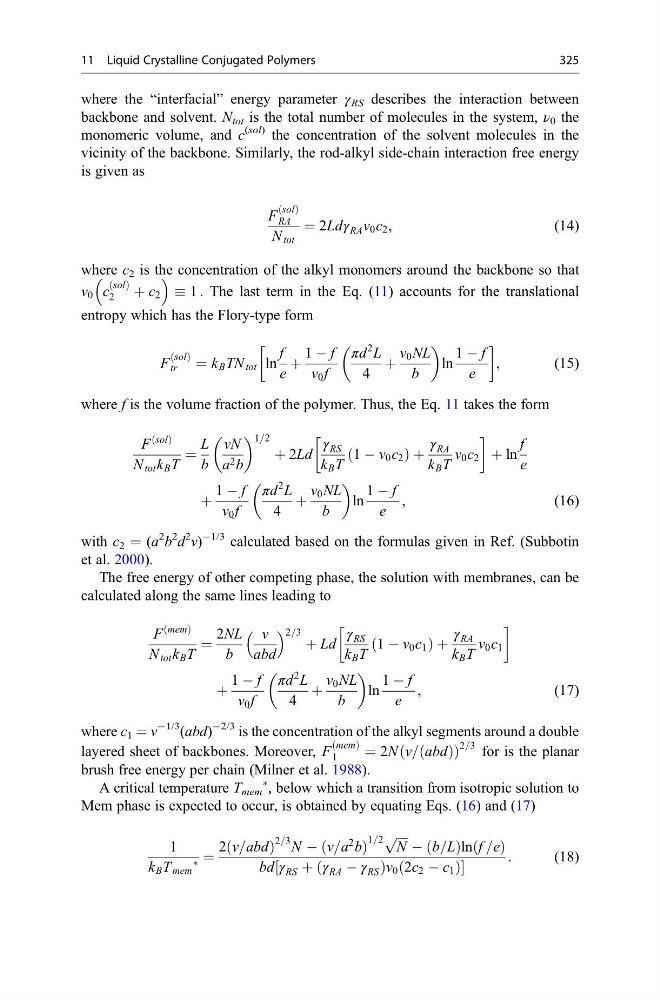
where the “interfacial” energy parameter γ RS describes the interaction between
backbone and solvent. N tot is the total number of molecules in the system, ν 0 the
monomeric volume, and c
(sol) the concentration of the solvent molecules in the
vicinity of the backbone. Similarly, the rod-alkyl side-chain interaction free energy
is given as
F
sol
ð Þ
RA
N tot
¼ 2Ldγ RA v 0 c 2 ,
(14)
where c 2 is the concentration of the alkyl monomers around the backbone so that
v 0 c
sol
ð Þ
2
þ c 2
1 . The last term in the Eq. (11) accounts for the translational
entropy which has the Flory-type form
F
sol
ð Þ
tr
¼ k B TN tot ln
f
e
þ
1 À f
v 0 f
πd
2 L
4
þ
v 0 NL
b
ln
1 À f
e
!
,
(15)
where f is the volume fraction of the polymer. Thus, the Eq. 11 takes the form
F
sol
ð Þ
N tot k B T
¼
L
b
vN
a 2 b
1=2
þ 2Ld
γ RS
k B T
1 À v 0 c 2
ð
Þþ
γ RA
k B T
v 0 c 2
!
þ ln
f
e
þ
1 À f
v 0 f
πd
2 L
4
þ
v 0 NL
b
ln
1 À f
e
,
(16)
with c 2 = (a
2 b
2 d
2 v)
À1/3 calculated based on the formulas given in Ref. (Subbotin
et al. 2000).
The free energy of other competing phase, the solution with membranes, can be
calculated along the same lines leading to
F
mem
ð
Þ
N tot k B T
¼
2NL
b
v
abd
2=3 þ Ld
γ RS
k B T
1 À v 0 c 1
ð
Þþ
γ RA
k B T
v 0 c 1
!
þ
1 À f
v 0 f
πd
2 L
4
þ
v 0 NL
b
ln
1 À f
e
,
(17)
where c 1 = v
À1/3
(abd)
À2/3 is the concentration of the alkyl segments around a double
layered sheet of backbones. Moreover, F
mem
ð
Þ
1
¼ 2N v= abd
ð
Þ
ð
Þ
2=3 for is the planar
brush free energy per chain (Milner et al. 1988).
A critical temperature T mem
à , below which a transition from isotropic solution to
Mem phase is expected to occur, is obtained by equating Eqs. (16) and (17)
1
k B T mem
à ¼
2 v=abd
ð
Þ
2=3 N À v=a
2 b
ð
Þ
1=2 ffiffiffiffi
N
p À b=L
ð
Þln f =e
ð Þ
bd γ RS þ γ RA À γ RS
ð
Þ v 0 2c 2 À c 1
ð
Þ
½
:
(18)
11 Liquid Crystalline Conjugated Polymers
325
backbone and solvent. N tot is the total number of molecules in the system, ν 0 the
monomeric volume, and c
(sol) the concentration of the solvent molecules in the
vicinity of the backbone. Similarly, the rod-alkyl side-chain interaction free energy
is given as
F
sol
ð Þ
RA
N tot
¼ 2Ldγ RA v 0 c 2 ,
(14)
where c 2 is the concentration of the alkyl monomers around the backbone so that
v 0 c
sol
ð Þ
2
þ c 2
1 . The last term in the Eq. (11) accounts for the translational
entropy which has the Flory-type form
F
sol
ð Þ
tr
¼ k B TN tot ln
f
e
þ
1 À f
v 0 f
πd
2 L
4
þ
v 0 NL
b
ln
1 À f
e
!
,
(15)
where f is the volume fraction of the polymer. Thus, the Eq. 11 takes the form
F
sol
ð Þ
N tot k B T
¼
L
b
vN
a 2 b
1=2
þ 2Ld
γ RS
k B T
1 À v 0 c 2
ð
Þþ
γ RA
k B T
v 0 c 2
!
þ ln
f
e
þ
1 À f
v 0 f
πd
2 L
4
þ
v 0 NL
b
ln
1 À f
e
,
(16)
with c 2 = (a
2 b
2 d
2 v)
À1/3 calculated based on the formulas given in Ref. (Subbotin
et al. 2000).
The free energy of other competing phase, the solution with membranes, can be
calculated along the same lines leading to
F
mem
ð
Þ
N tot k B T
¼
2NL
b
v
abd
2=3 þ Ld
γ RS
k B T
1 À v 0 c 1
ð
Þþ
γ RA
k B T
v 0 c 1
!
þ
1 À f
v 0 f
πd
2 L
4
þ
v 0 NL
b
ln
1 À f
e
,
(17)
where c 1 = v
À1/3
(abd)
À2/3 is the concentration of the alkyl segments around a double
layered sheet of backbones. Moreover, F
mem
ð
Þ
1
¼ 2N v= abd
ð
Þ
ð
Þ
2=3 for is the planar
brush free energy per chain (Milner et al. 1988).
A critical temperature T mem
à , below which a transition from isotropic solution to
Mem phase is expected to occur, is obtained by equating Eqs. (16) and (17)
1
k B T mem
à ¼
2 v=abd
ð
Þ
2=3 N À v=a
2 b
ð
Þ
1=2 ffiffiffiffi
N
p À b=L
ð
Þln f =e
ð Þ
bd γ RS þ γ RA À γ RS
ð
Þ v 0 2c 2 À c 1
ð
Þ
½
:
(18)
11 Liquid Crystalline Conjugated Polymers
325