

takes place in between the solution and the demixed state. The scaling of solutionMem transition temperature, T mem
à , as a function of N can be estimated by comparing the free energies of both phases.
The free energy of the Iso phase contains four contributions
F
sol
ð Þ
¼ F
sol
ð Þ
brush þ F
sol
ð Þ
RS þ F
sol
ð Þ
RA þ F
sol
ð Þ
tr ,
(11)
where the brush term F
sol
ð Þ
brush includes the excluded volume interaction between the
alkyl side chains in a good solvent and their stretch (which has been calculated in
Ref. (Subbotin et al. 2000)). Per side chain this contribution reads as
F
sol
ð Þ
1
¼ k B T
νN
a 2 b
1=2
,
(12)
where v is the excluded volume of a side-chain monomer in a good solvent and N and
a (marked as l K in Fig. 2) the number of side chain beads and its statistical segment
length. Here b is the grafting distance along the backbone (marked as l u in Fig. 2).
The terms F
sol
ð Þ
RS and F
sol
ð Þ
RA represent the interaction of the backbone rod (“R”) with
solvent (“S”) molecules and alkyl chains (“A”). The last term describes the translational free-energy of the hairy-rod polymers. The rod-solvent interaction free energy
is given as (Stepanyan et al. 2003)
F
sol
ð Þ
RS
N tot
¼ 2Ldγ RA v 0 c
sol
ð Þ ,
(13)
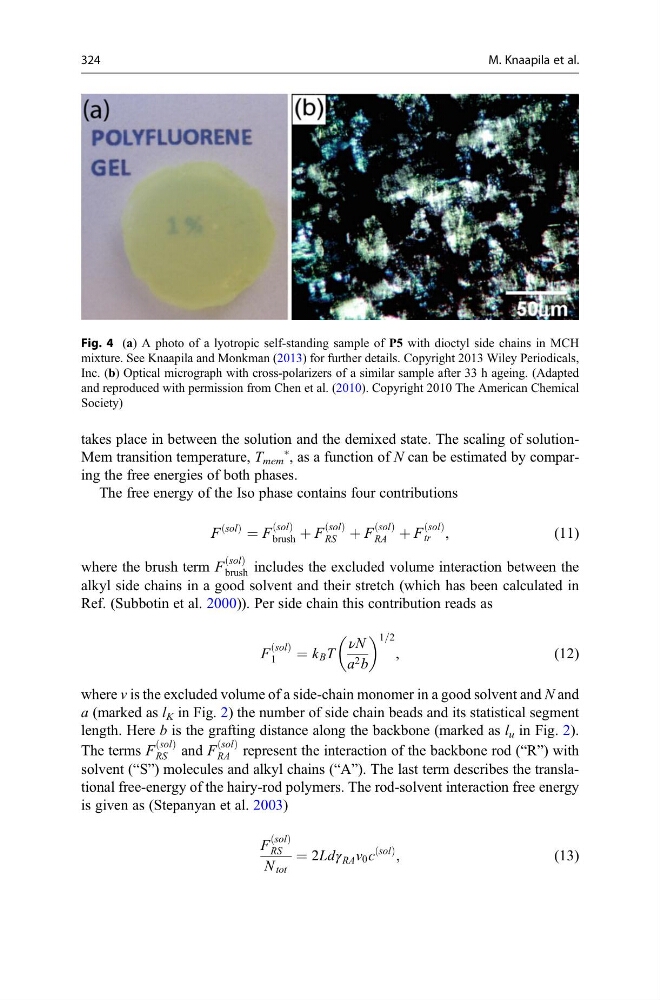
Fig. 4 (a) A photo of a lyotropic self-standing sample of P5 with dioctyl side chains in MCH
mixture. See Knaapila and Monkman (2013) for further details. Copyright 2013 Wiley Periodicals,
Inc. (b) Optical micrograph with cross-polarizers of a similar sample after 33 h ageing. (Adapted
and reproduced with permission from Chen et al. (2010). Copyright 2010 The American Chemical
Society)
324
M. Knaapila et al.
à , as a function of N can be estimated by comparing the free energies of both phases.
The free energy of the Iso phase contains four contributions
F
sol
ð Þ
¼ F
sol
ð Þ
brush þ F
sol
ð Þ
RS þ F
sol
ð Þ
RA þ F
sol
ð Þ
tr ,
(11)
where the brush term F
sol
ð Þ
brush includes the excluded volume interaction between the
alkyl side chains in a good solvent and their stretch (which has been calculated in
Ref. (Subbotin et al. 2000)). Per side chain this contribution reads as
F
sol
ð Þ
1
¼ k B T
νN
a 2 b
1=2
,
(12)
where v is the excluded volume of a side-chain monomer in a good solvent and N and
a (marked as l K in Fig. 2) the number of side chain beads and its statistical segment
length. Here b is the grafting distance along the backbone (marked as l u in Fig. 2).
The terms F
sol
ð Þ
RS and F
sol
ð Þ
RA represent the interaction of the backbone rod (“R”) with
solvent (“S”) molecules and alkyl chains (“A”). The last term describes the translational free-energy of the hairy-rod polymers. The rod-solvent interaction free energy
is given as (Stepanyan et al. 2003)
F
sol
ð Þ
RS
N tot
¼ 2Ldγ RA v 0 c
sol
ð Þ ,
(13)
Fig. 4 (a) A photo of a lyotropic self-standing sample of P5 with dioctyl side chains in MCH
mixture. See Knaapila and Monkman (2013) for further details. Copyright 2013 Wiley Periodicals,
Inc. (b) Optical micrograph with cross-polarizers of a similar sample after 33 h ageing. (Adapted
and reproduced with permission from Chen et al. (2010). Copyright 2010 The American Chemical
Society)
324
M. Knaapila et al.