

Lyotropic Behavior
Limit Between LC Conjugated Hairy-Rod Polymers and LC Conjugated
Rigid-Rod Polymers
Lyotropic LC conjugated polymers are ordered liquids obtained by the addition of
solvent. Fig. 4 shows a photo and polarized optical micrograph of 1% polyfluorene
P5 with octyl side chains in methylcyclohexane (MCH) mixture. This is an example of a
lyotropic LC conjugated polymer system. The mixture appears as a self-standing gel or a
very viscous liquid whose birefringence points to the self-alignment of rod-like material.
In this case, it is illustrative to consider the limit between hairy rods (with side
chains) and rigid rods (without side chains). This consideration reduces to the phase
behavior as a function of side chain length, N (Knaapila et al. 2008). It begins from
assumptions that the polymers can be dissolved at sufficiently high temperatures
forming an isotropic Iso phase and that this solution ultimately macrophase separates
(demixes) on cooling. It also assumes that an intermediate structure, Mem phase,
(b)
(a)
0
5 0
1 0 0
1 5 0
10
80
100
120
140
160
180
Nem
Hex
M n (kg/mol)
T (
o
C)
M n *
LMW
Nem
Hex
HMW
Nem
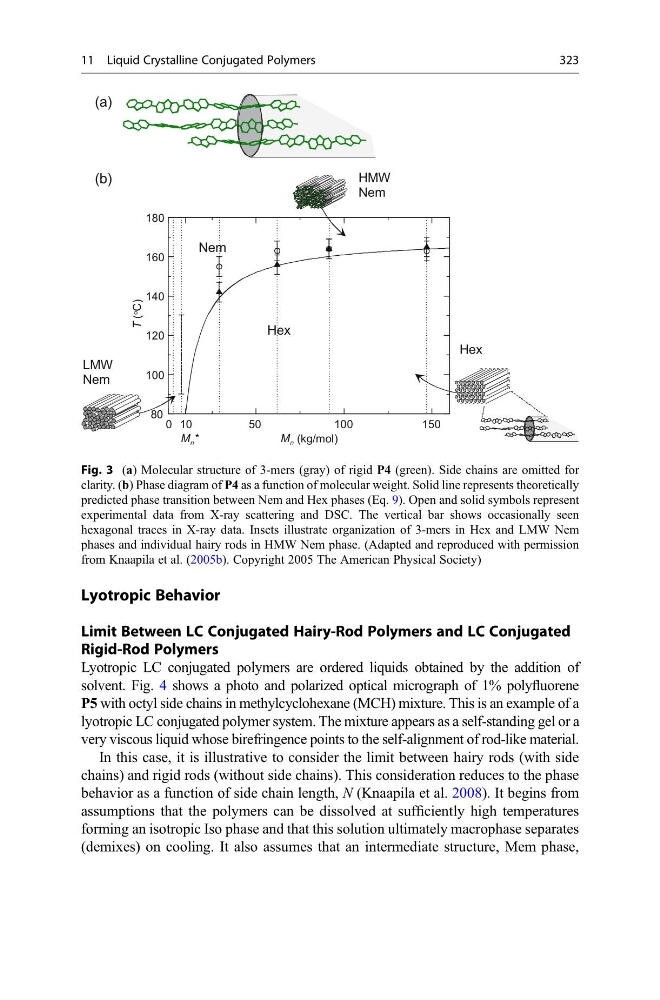
Fig. 3 (a) Molecular structure of 3-mers (gray) of rigid P4 (green). Side chains are omitted for
clarity. (b) Phase diagram of P4 as a function of molecular weight. Solid line represents theoretically
predicted phase transition between Nem and Hex phases (Eq. 9). Open and solid symbols represent
experimental data from X-ray scattering and DSC. The vertical bar shows occasionally seen
hexagonal traces in X-ray data. Insets illustrate organization of 3-mers in Hex and LMW Nem
phases and individual hairy rods in HMW Nem phase. (Adapted and reproduced with permission
from Knaapila et al. (2005b). Copyright 2005 The American Physical Society)
11 Liquid Crystalline Conjugated Polymers
323
Limit Between LC Conjugated Hairy-Rod Polymers and LC Conjugated
Rigid-Rod Polymers
Lyotropic LC conjugated polymers are ordered liquids obtained by the addition of
solvent. Fig. 4 shows a photo and polarized optical micrograph of 1% polyfluorene
P5 with octyl side chains in methylcyclohexane (MCH) mixture. This is an example of a
lyotropic LC conjugated polymer system. The mixture appears as a self-standing gel or a
very viscous liquid whose birefringence points to the self-alignment of rod-like material.
In this case, it is illustrative to consider the limit between hairy rods (with side
chains) and rigid rods (without side chains). This consideration reduces to the phase
behavior as a function of side chain length, N (Knaapila et al. 2008). It begins from
assumptions that the polymers can be dissolved at sufficiently high temperatures
forming an isotropic Iso phase and that this solution ultimately macrophase separates
(demixes) on cooling. It also assumes that an intermediate structure, Mem phase,
(b)
(a)
0
5 0
1 0 0
1 5 0
10
80
100
120
140
160
180
Nem
Hex
M n (kg/mol)
T (
o
C)
M n *
LMW
Nem
Hex
HMW
Nem
Fig. 3 (a) Molecular structure of 3-mers (gray) of rigid P4 (green). Side chains are omitted for
clarity. (b) Phase diagram of P4 as a function of molecular weight. Solid line represents theoretically
predicted phase transition between Nem and Hex phases (Eq. 9). Open and solid symbols represent
experimental data from X-ray scattering and DSC. The vertical bar shows occasionally seen
hexagonal traces in X-ray data. Insets illustrate organization of 3-mers in Hex and LMW Nem
phases and individual hairy rods in HMW Nem phase. (Adapted and reproduced with permission
from Knaapila et al. (2005b). Copyright 2005 The American Physical Society)
11 Liquid Crystalline Conjugated Polymers
323