

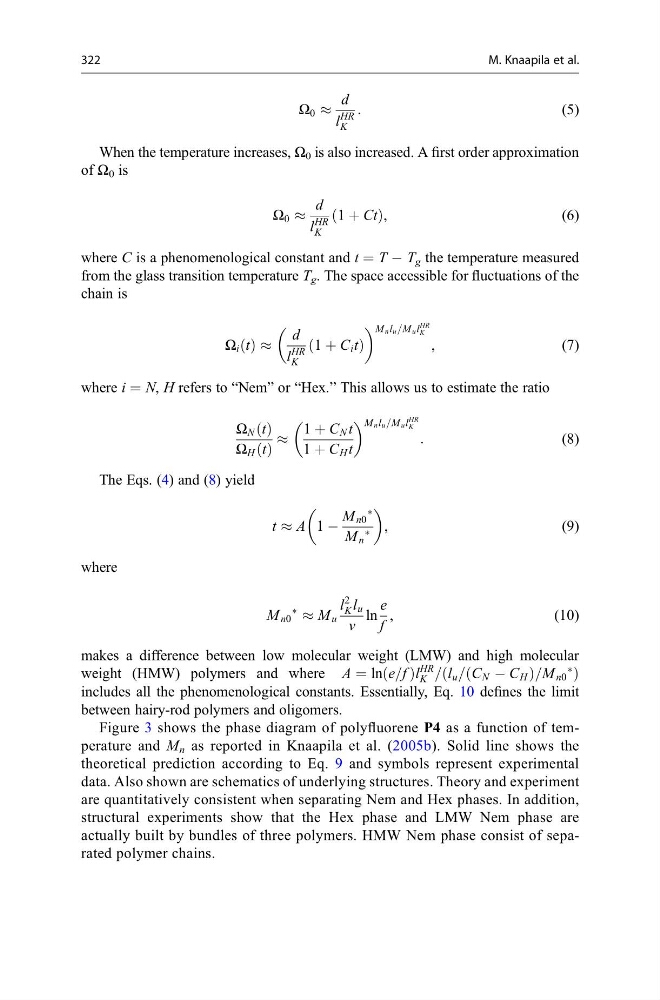
Ω 0 %
d
l
HR
K
:
(5)
When the temperature increases, Ω 0 is also increased. A first order approximation
of Ω 0 is
Ω 0 %
d
l
HR
K
1 þ Ct
ð
Þ,
(6)
where C is a phenomenological constant and t = T À T g the temperature measured
from the glass transition temperature T g . The space accessible for fluctuations of the
chain is
Ω i t
ð Þ %
d
l
HR
K
1 þ C i t
ð
Þ
M n l u =M u l
HR
K
,
(7)
where i = N, H refers to “Nem” or “Hex.” This allows us to estimate the ratio
Ω N t
ð Þ
Ω H t
ð Þ
%
1 þ C N t
1 þ C H t
M n l u =M u l
HR
K
:
(8)
The Eqs. (4) and (8) yield
t % A 1 À
M n0
Ã
M n
Ã
,
(9)
where
M n0
Ã
% M u
l
2
K l u
v
ln
e
f
,
(10)
makes a difference between low molecular weight (LMW) and high molecular
weight (HMW) polymers and where A ¼ ln e=f
ð Þl
HR
K = l u = C N À C H
ð
Þ =M n0
Ã
ð
Þ
includes all the phenomenological constants. Essentially, Eq. 10 defines the limit
between hairy-rod polymers and oligomers.
Figure 3 shows the phase diagram of polyfluorene P4 as a function of temperature and M n as reported in Knaapila et al. (2005b). Solid line shows the
theoretical prediction according to Eq. 9 and symbols represent experimental
data. Also shown are schematics of underlying structures. Theory and experiment
are quantitatively consistent when separating Nem and Hex phases. In addition,
structural experiments show that the Hex phase and LMW Nem phase are
actually built by bundles of three polymers. HMW Nem phase consist of separated polymer chains.
322
M. Knaapila et al.
d
l
HR
K
:
(5)
When the temperature increases, Ω 0 is also increased. A first order approximation
of Ω 0 is
Ω 0 %
d
l
HR
K
1 þ Ct
ð
Þ,
(6)
where C is a phenomenological constant and t = T À T g the temperature measured
from the glass transition temperature T g . The space accessible for fluctuations of the
chain is
Ω i t
ð Þ %
d
l
HR
K
1 þ C i t
ð
Þ
M n l u =M u l
HR
K
,
(7)
where i = N, H refers to “Nem” or “Hex.” This allows us to estimate the ratio
Ω N t
ð Þ
Ω H t
ð Þ
%
1 þ C N t
1 þ C H t
M n l u =M u l
HR
K
:
(8)
The Eqs. (4) and (8) yield
t % A 1 À
M n0
Ã
M n
Ã
,
(9)
where
M n0
Ã
% M u
l
2
K l u
v
ln
e
f
,
(10)
makes a difference between low molecular weight (LMW) and high molecular
weight (HMW) polymers and where A ¼ ln e=f
ð Þl
HR
K = l u = C N À C H
ð
Þ =M n0
Ã
ð
Þ
includes all the phenomenological constants. Essentially, Eq. 10 defines the limit
between hairy-rod polymers and oligomers.
Figure 3 shows the phase diagram of polyfluorene P4 as a function of temperature and M n as reported in Knaapila et al. (2005b). Solid line shows the
theoretical prediction according to Eq. 9 and symbols represent experimental
data. Also shown are schematics of underlying structures. Theory and experiment
are quantitatively consistent when separating Nem and Hex phases. In addition,
structural experiments show that the Hex phase and LMW Nem phase are
actually built by bundles of three polymers. HMW Nem phase consist of separated polymer chains.
322
M. Knaapila et al.