

Here we assume that ν, γ RA , and γ RS do not depend on the temperature.
Although generally incorrect, these assumptions do not change the scaling behavior
of T mem
à .
The results are valid for relatively long side chains, at least so long
that the distance between their grafting points is smaller than their Flory radius
R F = a(v/a
3 )
1/5 N
3/5 , i.e., N > N
Ã
= (b/a)
5/3 (v/a
3 )
1/3 . For shorter side chains, one can
expect a picture where isotropic liquid demixes with decreasing temperature
(Ballauff 1986).
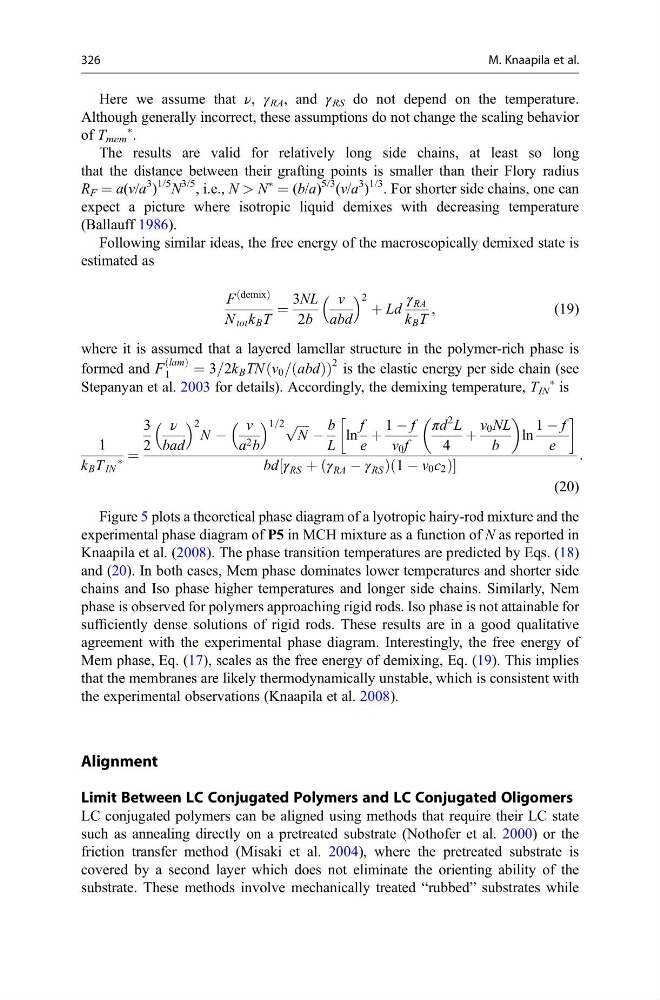
Following similar ideas, the free energy of the macroscopically demixed state is
estimated as
F
demix
ð
Þ
N tot k B T
¼
3NL
2b
v
abd
2 þ Ld
γ RA
k B T
,
(19)
where it is assumed that a layered lamellar structure in the polymer-rich phase is
formed and F
lam
ð Þ
1
¼ 3=2k B TN v 0 = abd
ð
Þ
ð
Þ
2 is the elastic energy per side chain (see
Stepanyan et al. 2003 for details). Accordingly, the demixing temperature, T IN
à is
1
k B T IN
à ¼
3
2
ν
bad
2
N À
v
a 2 b
1=2 ffiffiffiffi
N
p À
b
L
ln
f
e
þ
1 À f
v 0 f
πd
2 L
4
þ
v 0 NL
b
ln
1 À f
e
!
bd γ RS þ γ RA À γ RS
ð
Þ1 À v 0 c 2
ð
Þ
½
:
(20)
Figure 5 plots a theoretical phase diagram of a lyotropic hairy-rod mixture and the
experimental phase diagram of P5 in MCH mixture as a function of N as reported in
Knaapila et al. (2008). The phase transition temperatures are predicted by Eqs. (18)
and (20). In both cases, Mem phase dominates lower temperatures and shorter side
chains and Iso phase higher temperatures and longer side chains. Similarly, Nem
phase is observed for polymers approaching rigid rods. Iso phase is not attainable for
sufficiently dense solutions of rigid rods. These results are in a good qualitative
agreement with the experimental phase diagram. Interestingly, the free energy of
Mem phase, Eq. (17), scales as the free energy of demixing, Eq. (19). This implies
that the membranes are likely thermodynamically unstable, which is consistent with
the experimental observations (Knaapila et al. 2008).
Alignment
Limit Between LC Conjugated Polymers and LC Conjugated Oligomers
LC conjugated polymers can be aligned using methods that require their LC state
such as annealing directly on a pretreated substrate (Nothofer et al. 2000) or the
friction transfer method (Misaki et al. 2004), where the pretreated substrate is
covered by a second layer which does not eliminate the orienting ability of the
substrate. These methods involve mechanically treated “rubbed” substrates while
326
M. Knaapila et al.
Although generally incorrect, these assumptions do not change the scaling behavior
of T mem
à .
The results are valid for relatively long side chains, at least so long
that the distance between their grafting points is smaller than their Flory radius
R F = a(v/a
3 )
1/5 N
3/5 , i.e., N > N
Ã
= (b/a)
5/3 (v/a
3 )
1/3 . For shorter side chains, one can
expect a picture where isotropic liquid demixes with decreasing temperature
(Ballauff 1986).
Following similar ideas, the free energy of the macroscopically demixed state is
estimated as
F
demix
ð
Þ
N tot k B T
¼
3NL
2b
v
abd
2 þ Ld
γ RA
k B T
,
(19)
where it is assumed that a layered lamellar structure in the polymer-rich phase is
formed and F
lam
ð Þ
1
¼ 3=2k B TN v 0 = abd
ð
Þ
ð
Þ
2 is the elastic energy per side chain (see
Stepanyan et al. 2003 for details). Accordingly, the demixing temperature, T IN
à is
1
k B T IN
à ¼
3
2
ν
bad
2
N À
v
a 2 b
1=2 ffiffiffiffi
N
p À
b
L
ln
f
e
þ
1 À f
v 0 f
πd
2 L
4
þ
v 0 NL
b
ln
1 À f
e
!
bd γ RS þ γ RA À γ RS
ð
Þ1 À v 0 c 2
ð
Þ
½
:
(20)
Figure 5 plots a theoretical phase diagram of a lyotropic hairy-rod mixture and the
experimental phase diagram of P5 in MCH mixture as a function of N as reported in
Knaapila et al. (2008). The phase transition temperatures are predicted by Eqs. (18)
and (20). In both cases, Mem phase dominates lower temperatures and shorter side
chains and Iso phase higher temperatures and longer side chains. Similarly, Nem
phase is observed for polymers approaching rigid rods. Iso phase is not attainable for
sufficiently dense solutions of rigid rods. These results are in a good qualitative
agreement with the experimental phase diagram. Interestingly, the free energy of
Mem phase, Eq. (17), scales as the free energy of demixing, Eq. (19). This implies
that the membranes are likely thermodynamically unstable, which is consistent with
the experimental observations (Knaapila et al. 2008).
Alignment
Limit Between LC Conjugated Polymers and LC Conjugated Oligomers
LC conjugated polymers can be aligned using methods that require their LC state
such as annealing directly on a pretreated substrate (Nothofer et al. 2000) or the
friction transfer method (Misaki et al. 2004), where the pretreated substrate is
covered by a second layer which does not eliminate the orienting ability of the
substrate. These methods involve mechanically treated “rubbed” substrates while
326
M. Knaapila et al.