

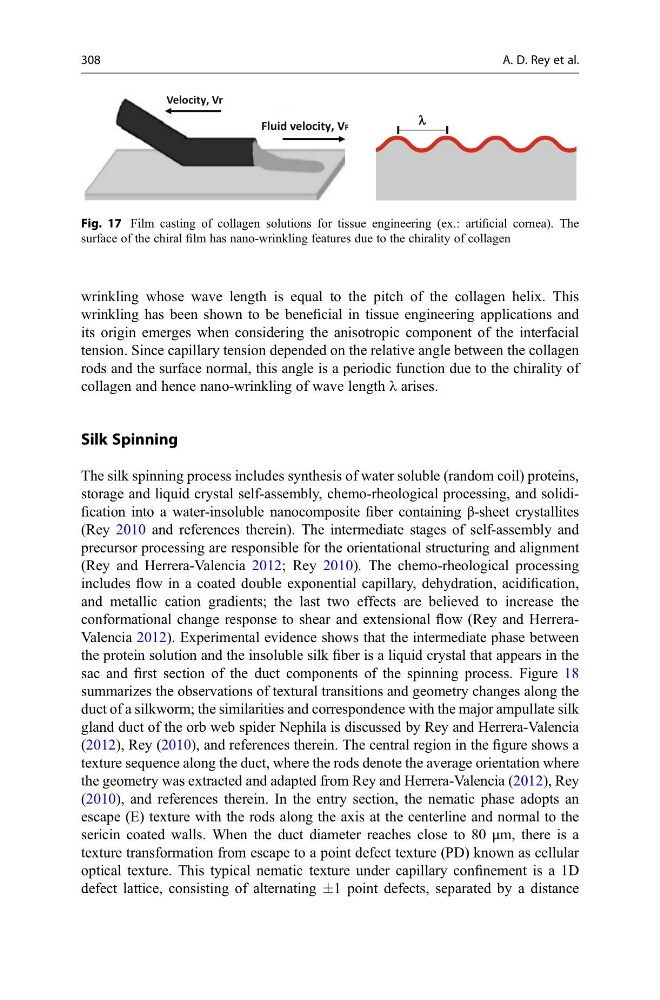
wrinkling whose wave length is equal to the pitch of the collagen helix. This
wrinkling has been shown to be beneficial in tissue engineering applications and
its origin emerges when considering the anisotropic component of the interfacial
tension. Since capillary tension depended on the relative angle between the collagen
rods and the surface normal, this angle is a periodic function due to the chirality of
collagen and hence nano-wrinkling of wave length λ arises.
Silk Spinning
The silk spinning process includes synthesis of water soluble (random coil) proteins,
storage and liquid crystal self-assembly, chemo-rheological processing, and solidification into a water-insoluble nanocomposite fiber containing β-sheet crystallites
(Rey 2010 and references therein). The intermediate stages of self-assembly and
precursor processing are responsible for the orientational structuring and alignment
(Rey and Herrera-Valencia 2012; Rey 2010). The chemo-rheological processing
includes flow in a coated double exponential capillary, dehydration, acidification,
and metallic cation gradients; the last two effects are believed to increase the
conformational change response to shear and extensional flow (Rey and HerreraValencia 2012). Experimental evidence shows that the intermediate phase between
the protein solution and the insoluble silk fiber is a liquid crystal that appears in the
sac and first section of the duct components of the spinning process. Figure 18
summarizes the observations of textural transitions and geometry changes along the
duct of a silkworm; the similarities and correspondence with the major ampullate silk
gland duct of the orb web spider Nephila is discussed by Rey and Herrera-Valencia
(2012), Rey (2010), and references therein. The central region in the figure shows a
texture sequence along the duct, where the rods denote the average orientation where
the geometry was extracted and adapted from Rey and Herrera-Valencia (2012), Rey
(2010), and references therein. In the entry section, the nematic phase adopts an
escape (E) texture with the rods along the axis at the centerline and normal to the
sericin coated walls. When the duct diameter reaches close to 80 μm, there is a
texture transformation from escape to a point defect texture (PD) known as cellular
optical texture. This typical nematic texture under capillary confinement is a 1D
defect lattice, consisting of alternating Æ1 point defects, separated by a distance
Velocity, Vr
Fluid velocity, VF
l
Fig. 17 Film casting of collagen solutions for tissue engineering (ex.: artificial cornea). The
surface of the chiral film has nano-wrinkling features due to the chirality of collagen
308
A. D. Rey et al.
wrinkling has been shown to be beneficial in tissue engineering applications and
its origin emerges when considering the anisotropic component of the interfacial
tension. Since capillary tension depended on the relative angle between the collagen
rods and the surface normal, this angle is a periodic function due to the chirality of
collagen and hence nano-wrinkling of wave length λ arises.
Silk Spinning
The silk spinning process includes synthesis of water soluble (random coil) proteins,
storage and liquid crystal self-assembly, chemo-rheological processing, and solidification into a water-insoluble nanocomposite fiber containing β-sheet crystallites
(Rey 2010 and references therein). The intermediate stages of self-assembly and
precursor processing are responsible for the orientational structuring and alignment
(Rey and Herrera-Valencia 2012; Rey 2010). The chemo-rheological processing
includes flow in a coated double exponential capillary, dehydration, acidification,
and metallic cation gradients; the last two effects are believed to increase the
conformational change response to shear and extensional flow (Rey and HerreraValencia 2012). Experimental evidence shows that the intermediate phase between
the protein solution and the insoluble silk fiber is a liquid crystal that appears in the
sac and first section of the duct components of the spinning process. Figure 18
summarizes the observations of textural transitions and geometry changes along the
duct of a silkworm; the similarities and correspondence with the major ampullate silk
gland duct of the orb web spider Nephila is discussed by Rey and Herrera-Valencia
(2012), Rey (2010), and references therein. The central region in the figure shows a
texture sequence along the duct, where the rods denote the average orientation where
the geometry was extracted and adapted from Rey and Herrera-Valencia (2012), Rey
(2010), and references therein. In the entry section, the nematic phase adopts an
escape (E) texture with the rods along the axis at the centerline and normal to the
sericin coated walls. When the duct diameter reaches close to 80 μm, there is a
texture transformation from escape to a point defect texture (PD) known as cellular
optical texture. This typical nematic texture under capillary confinement is a 1D
defect lattice, consisting of alternating Æ1 point defects, separated by a distance
Velocity, Vr
Fluid velocity, VF
l
Fig. 17 Film casting of collagen solutions for tissue engineering (ex.: artificial cornea). The
surface of the chiral film has nano-wrinkling features due to the chirality of collagen
308
A. D. Rey et al.