

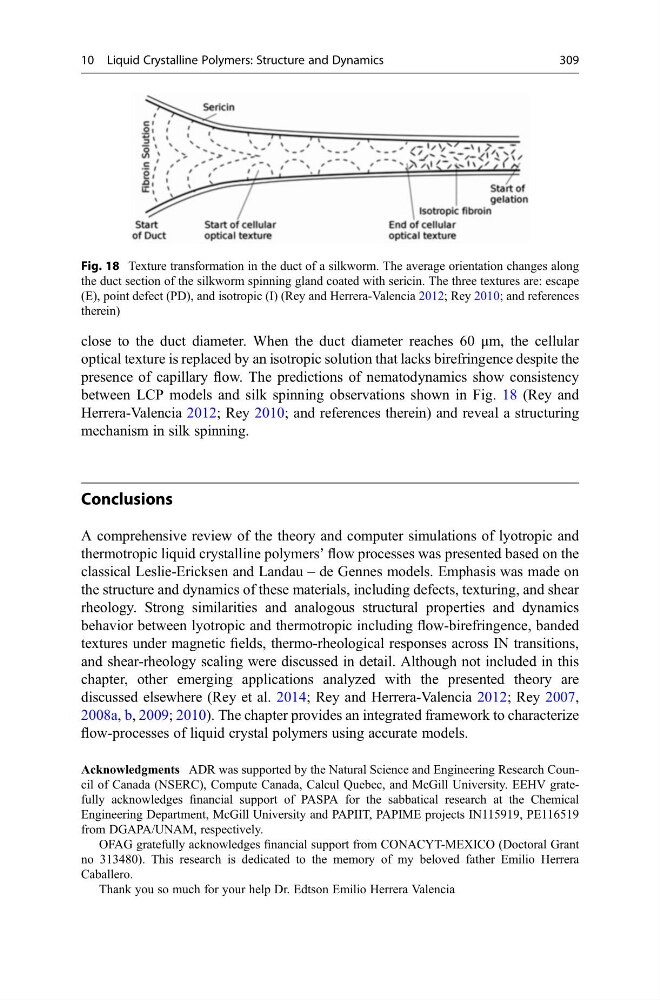
close to the duct diameter. When the duct diameter reaches 60 μm, the cellular
optical texture is replaced by an isotropic solution that lacks birefringence despite the
presence of capillary flow. The predictions of nematodynamics show consistency
between LCP models and silk spinning observations shown in Fig. 18 (Rey and
Herrera-Valencia 2012; Rey 2010; and references therein) and reveal a structuring
mechanism in silk spinning.
Conclusions
A comprehensive review of the theory and computer simulations of lyotropic and
thermotropic liquid crystalline polymers’ flow processes was presented based on the
classical Leslie-Ericksen and Landau – de Gennes models. Emphasis was made on
the structure and dynamics of these materials, including defects, texturing, and shear
rheology. Strong similarities and analogous structural properties and dynamics
behavior between lyotropic and thermotropic including flow-birefringence, banded
textures under magnetic fields, thermo-rheological responses across IN transitions,
and shear-rheology scaling were discussed in detail. Although not included in this
chapter, other emerging applications analyzed with the presented theory are
discussed elsewhere (Rey et al. 2014; Rey and Herrera-Valencia 2012; Rey 2007,
2008a, b, 2009; 2010). The chapter provides an integrated framework to characterize
flow-processes of liquid crystal polymers using accurate models.
Acknowledgments ADR was supported by the Natural Science and Engineering Research Council of Canada (NSERC), Compute Canada, Calcul Quebec, and McGill University. EEHV gratefully acknowledges financial support of PASPA for the sabbatical research at the Chemical
Engineering Department, McGill University and PAPIIT, PAPIME projects IN115919, PE116519
from DGAPA/UNAM, respectively.
OFAG gratefully acknowledges financial support from CONACYT-MEXICO (Doctoral Grant
no 313480). This research is dedicated to the memory of my beloved father Emilio Herrera
Caballero.
Thank you so much for your help Dr. Edtson Emilio Herrera Valencia
Fig. 18 Texture transformation in the duct of a silkworm. The average orientation changes along
the duct section of the silkworm spinning gland coated with sericin. The three textures are: escape
(E), point defect (PD), and isotropic (I) (Rey and Herrera-Valencia 2012; Rey 2010; and references
therein)
10 Liquid Crystalline Polymers: Structure and Dynamics
309
optical texture is replaced by an isotropic solution that lacks birefringence despite the
presence of capillary flow. The predictions of nematodynamics show consistency
between LCP models and silk spinning observations shown in Fig. 18 (Rey and
Herrera-Valencia 2012; Rey 2010; and references therein) and reveal a structuring
mechanism in silk spinning.
Conclusions
A comprehensive review of the theory and computer simulations of lyotropic and
thermotropic liquid crystalline polymers’ flow processes was presented based on the
classical Leslie-Ericksen and Landau – de Gennes models. Emphasis was made on
the structure and dynamics of these materials, including defects, texturing, and shear
rheology. Strong similarities and analogous structural properties and dynamics
behavior between lyotropic and thermotropic including flow-birefringence, banded
textures under magnetic fields, thermo-rheological responses across IN transitions,
and shear-rheology scaling were discussed in detail. Although not included in this
chapter, other emerging applications analyzed with the presented theory are
discussed elsewhere (Rey et al. 2014; Rey and Herrera-Valencia 2012; Rey 2007,
2008a, b, 2009; 2010). The chapter provides an integrated framework to characterize
flow-processes of liquid crystal polymers using accurate models.
Acknowledgments ADR was supported by the Natural Science and Engineering Research Council of Canada (NSERC), Compute Canada, Calcul Quebec, and McGill University. EEHV gratefully acknowledges financial support of PASPA for the sabbatical research at the Chemical
Engineering Department, McGill University and PAPIIT, PAPIME projects IN115919, PE116519
from DGAPA/UNAM, respectively.
OFAG gratefully acknowledges financial support from CONACYT-MEXICO (Doctoral Grant
no 313480). This research is dedicated to the memory of my beloved father Emilio Herrera
Caballero.
Thank you so much for your help Dr. Edtson Emilio Herrera Valencia
Fig. 18 Texture transformation in the duct of a silkworm. The average orientation changes along
the duct section of the silkworm spinning gland coated with sericin. The three textures are: escape
(E), point defect (PD), and isotropic (I) (Rey and Herrera-Valencia 2012; Rey 2010; and references
therein)
10 Liquid Crystalline Polymers: Structure and Dynamics
309