

Biological Liquid Crystalline Polymer Processes
The objective of this section is to show that once rheological characterization of
biological liquid crystals is carried out, such knowledge can be used to explore
processes reported in vitro as is the case of film casting of collagen type I solutions
and in vivo as is the case of silk spinning.
Film Casting of Cholesteric Collagen Solutions
Dilute collagen solutions have been processed into thin films as shown in Fig. 17 to
form defect-free cholesteric films with other transport processes as the evaporation
of solvent (Rey 2010). A key feature of the chiral film is the nano-scale surface
1
0.5
(a) t*=2
(b) t*=4
(c) t*=6
(d) t*=8
(e) t*=12
(f) t*=16
(g) t*=20
0
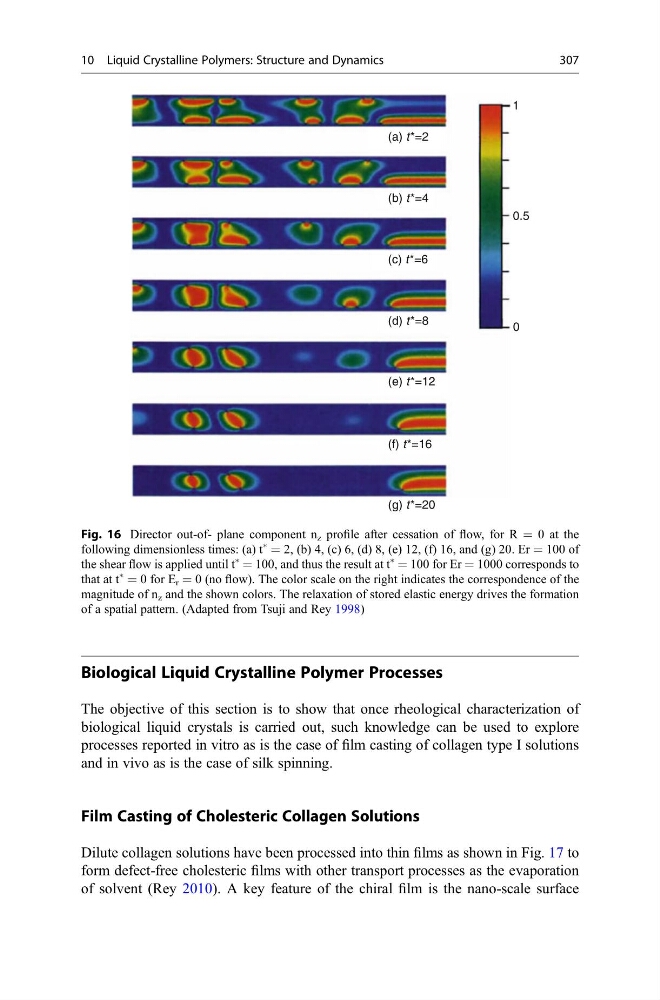
Fig. 16 Director out-of- plane component n z profile after cessation of flow, for R = 0 at the
following dimensionless times: (a) t
à = 2, (b) 4, (c) 6, (d) 8, (e) 12, (f) 16, and (g) 20. Er = 100 of
the shear flow is applied until t
à = 100, and thus the result at t
à = 100 for Er = 1000 corresponds to
that at t
à = 0 for E r = 0 (no flow). The color scale on the right indicates the correspondence of the
magnitude of n z and the shown colors. The relaxation of stored elastic energy drives the formation
of a spatial pattern. (Adapted from Tsuji and Rey 1998)
10 Liquid Crystalline Polymers: Structure and Dynamics
307
The objective of this section is to show that once rheological characterization of
biological liquid crystals is carried out, such knowledge can be used to explore
processes reported in vitro as is the case of film casting of collagen type I solutions
and in vivo as is the case of silk spinning.
Film Casting of Cholesteric Collagen Solutions
Dilute collagen solutions have been processed into thin films as shown in Fig. 17 to
form defect-free cholesteric films with other transport processes as the evaporation
of solvent (Rey 2010). A key feature of the chiral film is the nano-scale surface
1
0.5
(a) t*=2
(b) t*=4
(c) t*=6
(d) t*=8
(e) t*=12
(f) t*=16
(g) t*=20
0
Fig. 16 Director out-of- plane component n z profile after cessation of flow, for R = 0 at the
following dimensionless times: (a) t
à = 2, (b) 4, (c) 6, (d) 8, (e) 12, (f) 16, and (g) 20. Er = 100 of
the shear flow is applied until t
à = 100, and thus the result at t
à = 100 for Er = 1000 corresponds to
that at t
à = 0 for E r = 0 (no flow). The color scale on the right indicates the correspondence of the
magnitude of n z and the shown colors. The relaxation of stored elastic energy drives the formation
of a spatial pattern. (Adapted from Tsuji and Rey 1998)
10 Liquid Crystalline Polymers: Structure and Dynamics
307