

dimensionless backflow B (de Andrade Lima and Rey 2003a-c, 2004a-e). The
Ericksen number (i.e., dimensionless pressure drop) for small amplitude oscillatory
capillary Poiseuille flow oscillates as follows:
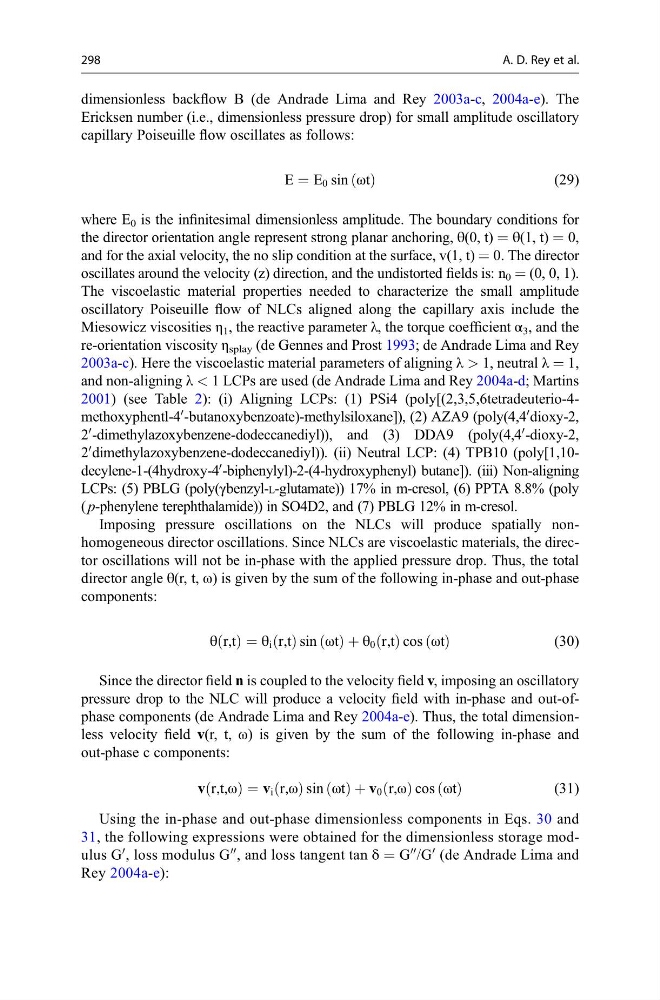
E ¼ E 0 sin ωt
ð Þ
(29)
where E 0 is the infinitesimal dimensionless amplitude. The boundary conditions for
the director orientation angle represent strong planar anchoring, θ(0, t) = θ(1, t) = 0,
and for the axial velocity, the no slip condition at the surface, v(1, t) = 0. The director
oscillates around the velocity (z) direction, and the undistorted fields is: n 0 = (0, 0, 1).
The viscoelastic material properties needed to characterize the small amplitude
oscillatory Poiseuille flow of NLCs aligned along the capillary axis include the
Miesowicz viscosities η 1 , the reactive parameter λ, the torque coefficient α 3 , and the
re-orientation viscosity η splay (de Gennes and Prost 1993; de Andrade Lima and Rey
2003a-c). Here the viscoelastic material parameters of aligning λ > 1, neutral λ = 1,
and non-aligning λ < 1 LCPs are used (de Andrade Lima and Rey 2004a-d; Martins
2001) (see Table 2): (i) Aligning LCPs: (1) PSi4 (poly[(2,3,5,6tetradeuterio-4methoxyphentl-4
0 -butanoxybenzoate)-methylsiloxane]), (2) AZA9 (poly(4,4
0 dioxy-2,
2
0 -dimethylazoxybenzene-dodeccanediyl)), and (3) DDA9 (poly(4,4
0 -dioxy-2,
2
0 dimethylazoxybenzene-dodeccanediyl)). (ii) Neutral LCP: (4) TPB10 (poly[1,10decylene-1-(4hydroxy-4
0 -biphenylyl)-2-(4-hydroxyphenyl) butane]). (iii) Non-aligning
LCPs: (5) PBLG (poly(γbenzyl-L-glutamate)) 17% in m-cresol, (6) PPTA 8.8% (poly
( p-phenylene terephthalamide)) in SO4D2, and (7) PBLG 12% in m-cresol.
Imposing pressure oscillations on the NLCs will produce spatially nonhomogeneous director oscillations. Since NLCs are viscoelastic materials, the director oscillations will not be in-phase with the applied pressure drop. Thus, the total
director angle θ(r, t, ω) is given by the sum of the following in-phase and out-phase
components:
θ r,t
ð Þ ¼ θ i r,t
ð Þsin ωt
ð Þ þ θ 0 r,t
ð Þcos ωt
ð Þ
(30)
Since the director field n is coupled to the velocity field v, imposing an oscillatory
pressure drop to the NLC will produce a velocity field with in-phase and out-ofphase components (de Andrade Lima and Rey 2004a-e). Thus, the total dimensionless velocity field v(r, t, ω) is given by the sum of the following in-phase and
out-phase c components:
v r,t,ω
ð
Þ ¼ v i r,ω
ð Þsin ωt
ð Þ þ v 0 r,ω
ð Þcos ωt
ð Þ
(31)
Using the in-phase and out-phase dimensionless components in Eqs. 30 and
31, the following expressions were obtained for the dimensionless storage modulus G
0 , loss modulus G
00 , and loss tangent tan δ = G
00 /G
0 (de Andrade Lima and
Rey 2004a-e):
298
A. D. Rey et al.
Ericksen number (i.e., dimensionless pressure drop) for small amplitude oscillatory
capillary Poiseuille flow oscillates as follows:
E ¼ E 0 sin ωt
ð Þ
(29)
where E 0 is the infinitesimal dimensionless amplitude. The boundary conditions for
the director orientation angle represent strong planar anchoring, θ(0, t) = θ(1, t) = 0,
and for the axial velocity, the no slip condition at the surface, v(1, t) = 0. The director
oscillates around the velocity (z) direction, and the undistorted fields is: n 0 = (0, 0, 1).
The viscoelastic material properties needed to characterize the small amplitude
oscillatory Poiseuille flow of NLCs aligned along the capillary axis include the
Miesowicz viscosities η 1 , the reactive parameter λ, the torque coefficient α 3 , and the
re-orientation viscosity η splay (de Gennes and Prost 1993; de Andrade Lima and Rey
2003a-c). Here the viscoelastic material parameters of aligning λ > 1, neutral λ = 1,
and non-aligning λ < 1 LCPs are used (de Andrade Lima and Rey 2004a-d; Martins
2001) (see Table 2): (i) Aligning LCPs: (1) PSi4 (poly[(2,3,5,6tetradeuterio-4methoxyphentl-4
0 -butanoxybenzoate)-methylsiloxane]), (2) AZA9 (poly(4,4
0 dioxy-2,
2
0 -dimethylazoxybenzene-dodeccanediyl)), and (3) DDA9 (poly(4,4
0 -dioxy-2,
2
0 dimethylazoxybenzene-dodeccanediyl)). (ii) Neutral LCP: (4) TPB10 (poly[1,10decylene-1-(4hydroxy-4
0 -biphenylyl)-2-(4-hydroxyphenyl) butane]). (iii) Non-aligning
LCPs: (5) PBLG (poly(γbenzyl-L-glutamate)) 17% in m-cresol, (6) PPTA 8.8% (poly
( p-phenylene terephthalamide)) in SO4D2, and (7) PBLG 12% in m-cresol.
Imposing pressure oscillations on the NLCs will produce spatially nonhomogeneous director oscillations. Since NLCs are viscoelastic materials, the director oscillations will not be in-phase with the applied pressure drop. Thus, the total
director angle θ(r, t, ω) is given by the sum of the following in-phase and out-phase
components:
θ r,t
ð Þ ¼ θ i r,t
ð Þsin ωt
ð Þ þ θ 0 r,t
ð Þcos ωt
ð Þ
(30)
Since the director field n is coupled to the velocity field v, imposing an oscillatory
pressure drop to the NLC will produce a velocity field with in-phase and out-ofphase components (de Andrade Lima and Rey 2004a-e). Thus, the total dimensionless velocity field v(r, t, ω) is given by the sum of the following in-phase and
out-phase c components:
v r,t,ω
ð
Þ ¼ v i r,ω
ð Þsin ωt
ð Þ þ v 0 r,ω
ð Þcos ωt
ð Þ
(31)
Using the in-phase and out-phase dimensionless components in Eqs. 30 and
31, the following expressions were obtained for the dimensionless storage modulus G
0 , loss modulus G
00 , and loss tangent tan δ = G
00 /G
0 (de Andrade Lima and
Rey 2004a-e):
298
A. D. Rey et al.