

Linear Viscoelasticity of Lyotropic and Thermotropic LCPs
The linear viscoelasticity of lyotropic and thermotropic liquid crystalline polymers
was characterized using the Leslie-Ericksen equation of defect-free nematodynamics
for small amplitude oscillatory capillary Poiseuille flow, and using analytical,
numerical, and scaling methods. The experimental datasets used in this study
correspond to the six Leslie viscosity coefficients for the seven samples (de Andrade
Lima and Rey 2003a-c, 2004a-e). The predicted equivalent rheological responses
between the shear flow-aligning and non-aligning polymers demonstrate the universality of nematodynamics. A dataset of viscoelastic parameters for seven thermotropic and lyotropic LCPs was recently presented (Martins 2011); it shows the
rheological differentiation between lyotropic and thermotropic LCPs. Small Amplitude oscillatory flows (SAOFs) are main rheological tool used to characterize
viscoelasticity in terms of the storage G
0 (ω, T) and loss G
00
(ω, T) moduli as a
function of the frequency ω and temperature T (Bird et al. 1977). Uniaxial NLC
are characterized by an average molecular orientation represented by the director
vector in colinear with average molecular orientation direction. For small-amplitude
oscillatory Poiseuille capillary flow of a NLC, the flow is described by an axisymmetric oscillatory planar director field n = (sinθ(r, t), 0, cosθ(r, t)) and a purely axial
oscillation velocity field v = (0, 0, v(r, t)) with finite velocity gradient at the
centerline. Linearizing the orientation equation, resulting from the angular momentum balance, around the axial direction (i.e., sinθ(r, t) ffi θ(r, t), cosθ(r, t) ffi 1), the
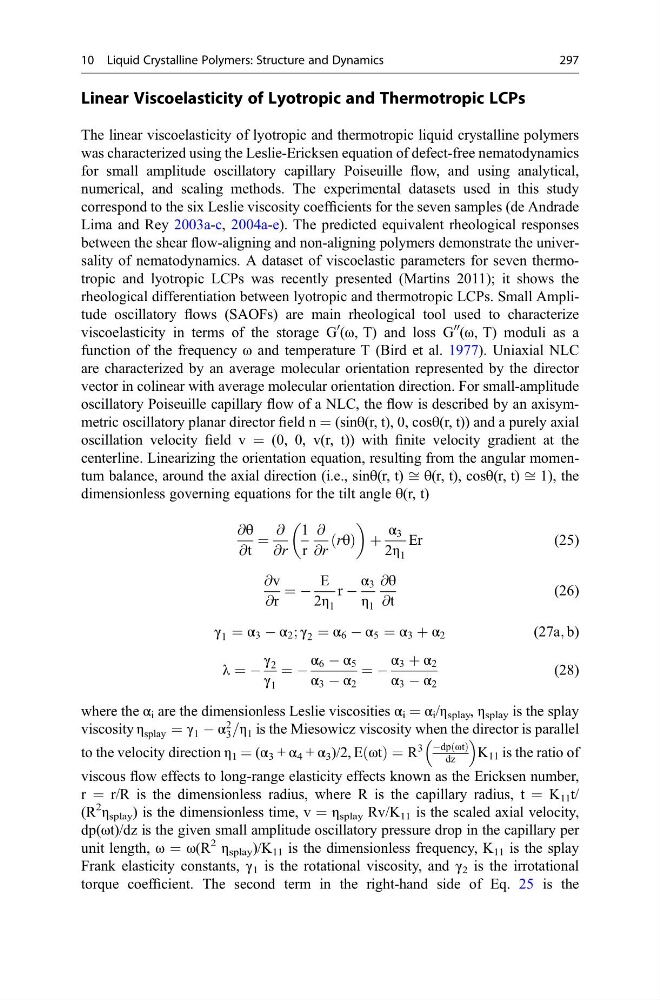
dimensionless governing equations for the tilt angle θ(r, t)
@θ
@t
¼
@
@r
1
r
@
@r
rθ
ð Þ
þ
α 3
2η 1
Er
(25)
@v
@r
¼ À
E
2η 1
r À
α 3
η 1
@θ
@t
(26)
γ 1 ¼ α 3 À α 2 ; γ 2 ¼ α 6 À α 5 ¼ α 3 þ α 2
(27a; b)
λ ¼ À
γ 2
γ 1
¼ À
α 6 À α 5
α 3 À α 2
¼ À
α 3 þ α 2
α 3 À α 2
(28)
where the α i are the dimensionless Leslie viscosities α i = α i /η splay , η splay is the splay
viscosity η splay ¼ γ 1 À α
2
3 =η 1 is the Miesowicz viscosity when the director is parallel
to the velocity direction η 1 = (α 3 + α 4 + α 3 )/2, E ωt
ð Þ ¼ R
3 Àdp ωt
ð Þ
dz
K 11 is the ratio of
viscous flow effects to long-range elasticity effects known as the Ericksen number,
r = r/R is the dimensionless radius, where R is the capillary radius, t = K 11 t/
(R
2
η splay ) is the dimensionless time, v = η splay Rv/K 11 is the scaled axial velocity,
dp(ωt)/dz is the given small amplitude oscillatory pressure drop in the capillary per
unit length, ω = ω(R
2
η splay )/K 11 is the dimensionless frequency, K 11 is the splay
Frank elasticity constants, γ 1 is the rotational viscosity, and γ 2 is the irrotational
torque coefficient. The second term in the right-hand side of Eq. 25 is the
10 Liquid Crystalline Polymers: Structure and Dynamics
297
The linear viscoelasticity of lyotropic and thermotropic liquid crystalline polymers
was characterized using the Leslie-Ericksen equation of defect-free nematodynamics
for small amplitude oscillatory capillary Poiseuille flow, and using analytical,
numerical, and scaling methods. The experimental datasets used in this study
correspond to the six Leslie viscosity coefficients for the seven samples (de Andrade
Lima and Rey 2003a-c, 2004a-e). The predicted equivalent rheological responses
between the shear flow-aligning and non-aligning polymers demonstrate the universality of nematodynamics. A dataset of viscoelastic parameters for seven thermotropic and lyotropic LCPs was recently presented (Martins 2011); it shows the
rheological differentiation between lyotropic and thermotropic LCPs. Small Amplitude oscillatory flows (SAOFs) are main rheological tool used to characterize
viscoelasticity in terms of the storage G
0 (ω, T) and loss G
00
(ω, T) moduli as a
function of the frequency ω and temperature T (Bird et al. 1977). Uniaxial NLC
are characterized by an average molecular orientation represented by the director
vector in colinear with average molecular orientation direction. For small-amplitude
oscillatory Poiseuille capillary flow of a NLC, the flow is described by an axisymmetric oscillatory planar director field n = (sinθ(r, t), 0, cosθ(r, t)) and a purely axial
oscillation velocity field v = (0, 0, v(r, t)) with finite velocity gradient at the
centerline. Linearizing the orientation equation, resulting from the angular momentum balance, around the axial direction (i.e., sinθ(r, t) ffi θ(r, t), cosθ(r, t) ffi 1), the
dimensionless governing equations for the tilt angle θ(r, t)
@θ
@t
¼
@
@r
1
r
@
@r
rθ
ð Þ
þ
α 3
2η 1
Er
(25)
@v
@r
¼ À
E
2η 1
r À
α 3
η 1
@θ
@t
(26)
γ 1 ¼ α 3 À α 2 ; γ 2 ¼ α 6 À α 5 ¼ α 3 þ α 2
(27a; b)
λ ¼ À
γ 2
γ 1
¼ À
α 6 À α 5
α 3 À α 2
¼ À
α 3 þ α 2
α 3 À α 2
(28)
where the α i are the dimensionless Leslie viscosities α i = α i /η splay , η splay is the splay
viscosity η splay ¼ γ 1 À α
2
3 =η 1 is the Miesowicz viscosity when the director is parallel
to the velocity direction η 1 = (α 3 + α 4 + α 3 )/2, E ωt
ð Þ ¼ R
3 Àdp ωt
ð Þ
dz
K 11 is the ratio of
viscous flow effects to long-range elasticity effects known as the Ericksen number,
r = r/R is the dimensionless radius, where R is the capillary radius, t = K 11 t/
(R
2
η splay ) is the dimensionless time, v = η splay Rv/K 11 is the scaled axial velocity,
dp(ωt)/dz is the given small amplitude oscillatory pressure drop in the capillary per
unit length, ω = ω(R
2
η splay )/K 11 is the dimensionless frequency, K 11 is the splay
Frank elasticity constants, γ 1 is the rotational viscosity, and γ 2 is the irrotational
torque coefficient. The second term in the right-hand side of Eq. 25 is the
10 Liquid Crystalline Polymers: Structure and Dynamics
297