

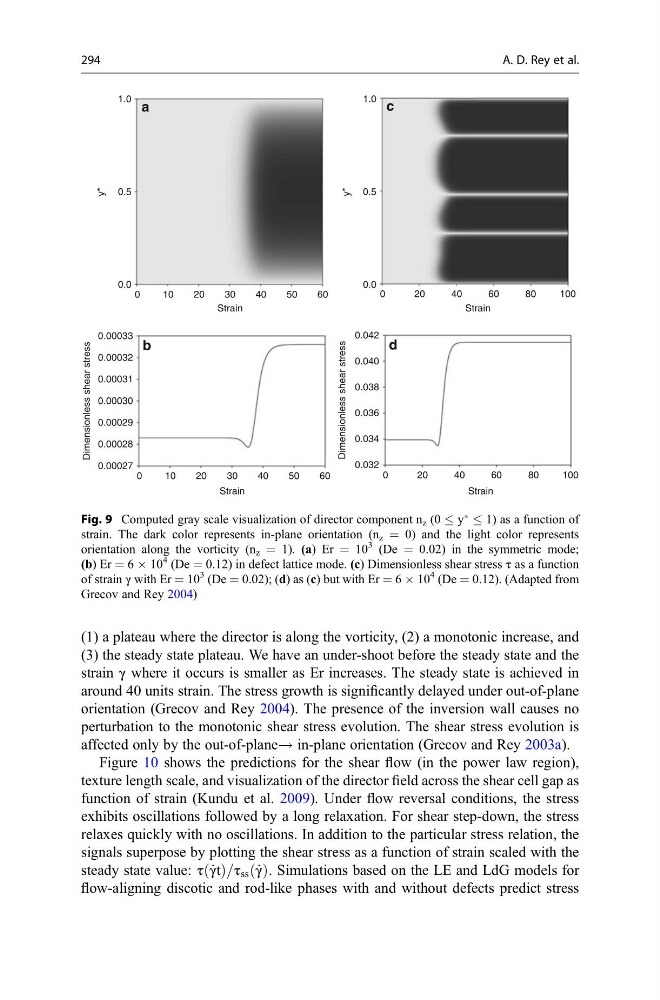
(1) a plateau where the director is along the vorticity, (2) a monotonic increase, and
(3) the steady state plateau. We have an under-shoot before the steady state and the
strain γ where it occurs is smaller as Er increases. The steady state is achieved in
around 40 units strain. The stress growth is significantly delayed under out-of-plane
orientation (Grecov and Rey 2004). The presence of the inversion wall causes no
perturbation to the monotonic shear stress evolution. The shear stress evolution is
affected only by the out-of-plane! in-plane orientation (Grecov and Rey 2003a).
Figure 10 shows the predictions for the shear flow (in the power law region),
texture length scale, and visualization of the director field across the shear cell gap as
function of strain (Kundu et al. 2009). Under flow reversal conditions, the stress
exhibits oscillations followed by a long relaxation. For shear step-down, the stress
relaxes quickly with no oscillations. In addition to the particular stress relation, the
signals superpose by plotting the shear stress as a function of strain scaled with the
steady state value: τ _
γt
ð Þ=τ ss _
γ
ð Þ. Simulations based on the LE and LdG models for
flow-aligning discotic and rod-like phases with and without defects predict stress
0
0
20
40
60
80
100
0
20
40
60
80
100
0.0
0.042
0.040
0.038
0.036
0.034
0.032
Dimensionless shear stress
Dimensionless shear stress
0.00033
0.00032
0.00031
0.00030
0.00029
0.00028
0.00027
0.5
y*
1.0 a
b
d
c
0.0
0.5
y*
1.0
10
20
30
Strain
Strain
Strain
40
50
60
0
1 0
2 0
3 0
Strain
40
50
60
Fig. 9 Computed gray scale visualization of director component n z (0 y
Ã
1) as a function of
strain. The dark color represents in-plane orientation (n z = 0) and the light color represents
orientation along the vorticity (n z = 1). (a) Er = 10
3 (De = 0.02) in the symmetric mode;
(b) Er = 6 Â 10
4 (De = 0.12) in defect lattice mode. (c) Dimensionless shear stress τ as a function
of strain γ with Er = 10
3 (De = 0.02); (d) as (c) but with Er = 6 Â 10
4 (De = 0.12). (Adapted from
Grecov and Rey 2004)
294
A. D. Rey et al.
(3) the steady state plateau. We have an under-shoot before the steady state and the
strain γ where it occurs is smaller as Er increases. The steady state is achieved in
around 40 units strain. The stress growth is significantly delayed under out-of-plane
orientation (Grecov and Rey 2004). The presence of the inversion wall causes no
perturbation to the monotonic shear stress evolution. The shear stress evolution is
affected only by the out-of-plane! in-plane orientation (Grecov and Rey 2003a).
Figure 10 shows the predictions for the shear flow (in the power law region),
texture length scale, and visualization of the director field across the shear cell gap as
function of strain (Kundu et al. 2009). Under flow reversal conditions, the stress
exhibits oscillations followed by a long relaxation. For shear step-down, the stress
relaxes quickly with no oscillations. In addition to the particular stress relation, the
signals superpose by plotting the shear stress as a function of strain scaled with the
steady state value: τ _
γt
ð Þ=τ ss _
γ
ð Þ. Simulations based on the LE and LdG models for
flow-aligning discotic and rod-like phases with and without defects predict stress
0
0
20
40
60
80
100
0
20
40
60
80
100
0.0
0.042
0.040
0.038
0.036
0.034
0.032
Dimensionless shear stress
Dimensionless shear stress
0.00033
0.00032
0.00031
0.00030
0.00029
0.00028
0.00027
0.5
y*
1.0 a
b
d
c
0.0
0.5
y*
1.0
10
20
30
Strain
Strain
Strain
40
50
60
0
1 0
2 0
3 0
Strain
40
50
60
Fig. 9 Computed gray scale visualization of director component n z (0 y
Ã
1) as a function of
strain. The dark color represents in-plane orientation (n z = 0) and the light color represents
orientation along the vorticity (n z = 1). (a) Er = 10
3 (De = 0.02) in the symmetric mode;
(b) Er = 6 Â 10
4 (De = 0.12) in defect lattice mode. (c) Dimensionless shear stress τ as a function
of strain γ with Er = 10
3 (De = 0.02); (d) as (c) but with Er = 6 Â 10
4 (De = 0.12). (Adapted from
Grecov and Rey 2004)
294
A. D. Rey et al.