

overshoots as well scaling behavior under certain orientation kinematics. Stress
overshoots and undershoots under transient shear rates due to a non-monotonic
stress surface as a function of the angle of the in-plane tilt angle and out-of-plane
twist angle.
Figure 11 shows a gray scale plot dimensionless surface shear stress as a function
of twist and tilt angles. In this case, white corresponds to the local maximum shear
stress (τ = τ max = 2.6) and black corresponds to the local minima (τ = τ max = 0.85).
A good characterization of shear stress response during shear start-up is to consider
the evolution from the three Miesowicz director orientations towards the steady state
(Han and Rey 1994a, b). By direct observation of Fig. 11a, we obtain the following
characteristic transient rheological responses:
Path 1: Evolution from velocity direction (θ = 0, ϕ = 0); the shear stress will present
one overshoot.
Path 2: Evolution from velocity gradient direction (θ = 90, ϕ = 0); the shear stress
will increase monotonically.
Path 3: Evolution from vorticity direction (θ = 0, ϕ = 90); the shear stress will
present an undershoot.
Figure 11b shows that the shear stress landscape is dense with local maxima and
local minima, and that monotonic responses are more the exception than the rule.
Anisotropic effects introduced by director-stress coupling do provide with an important mechanism of stress non-monotonicity in transient shear start-up flows. The
viscosity maxima, minima, and their difference in the figure is:
η max ¼
α 4
2
þ
α 1
2
þ
α 5 À α 6
α 3 À α 2
α 3
2
À
α 2 þ α 3
4
þ
α 6
2
(22)
η min ¼
α 4
2
þ
α 5 À α 6
α 3 À α 2
α 3
2
þ
α 6
2
(23)
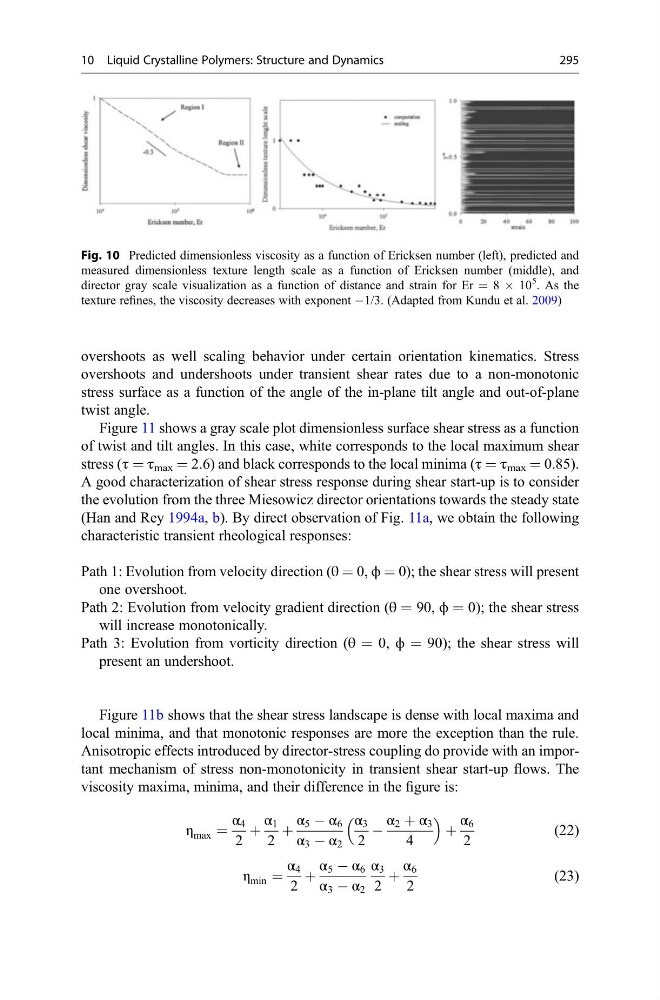
Fig. 10 Predicted dimensionless viscosity as a function of Ericksen number (left), predicted and
measured dimensionless texture length scale as a function of Ericksen number (middle), and
director gray scale visualization as a function of distance and strain for Er = 8 Â 10
5
. As the
texture refines, the viscosity decreases with exponent À1/3. (Adapted from Kundu et al. 2009)
10 Liquid Crystalline Polymers: Structure and Dynamics
295
overshoots and undershoots under transient shear rates due to a non-monotonic
stress surface as a function of the angle of the in-plane tilt angle and out-of-plane
twist angle.
Figure 11 shows a gray scale plot dimensionless surface shear stress as a function
of twist and tilt angles. In this case, white corresponds to the local maximum shear
stress (τ = τ max = 2.6) and black corresponds to the local minima (τ = τ max = 0.85).
A good characterization of shear stress response during shear start-up is to consider
the evolution from the three Miesowicz director orientations towards the steady state
(Han and Rey 1994a, b). By direct observation of Fig. 11a, we obtain the following
characteristic transient rheological responses:
Path 1: Evolution from velocity direction (θ = 0, ϕ = 0); the shear stress will present
one overshoot.
Path 2: Evolution from velocity gradient direction (θ = 90, ϕ = 0); the shear stress
will increase monotonically.
Path 3: Evolution from vorticity direction (θ = 0, ϕ = 90); the shear stress will
present an undershoot.
Figure 11b shows that the shear stress landscape is dense with local maxima and
local minima, and that monotonic responses are more the exception than the rule.
Anisotropic effects introduced by director-stress coupling do provide with an important mechanism of stress non-monotonicity in transient shear start-up flows. The
viscosity maxima, minima, and their difference in the figure is:
η max ¼
α 4
2
þ
α 1
2
þ
α 5 À α 6
α 3 À α 2
α 3
2
À
α 2 þ α 3
4
þ
α 6
2
(22)
η min ¼
α 4
2
þ
α 5 À α 6
α 3 À α 2
α 3
2
þ
α 6
2
(23)
Fig. 10 Predicted dimensionless viscosity as a function of Ericksen number (left), predicted and
measured dimensionless texture length scale as a function of Ericksen number (middle), and
director gray scale visualization as a function of distance and strain for Er = 8 Â 10
5
. As the
texture refines, the viscosity decreases with exponent À1/3. (Adapted from Kundu et al. 2009)
10 Liquid Crystalline Polymers: Structure and Dynamics
295