

Leslie Ericksen Nematodynamics (LE)
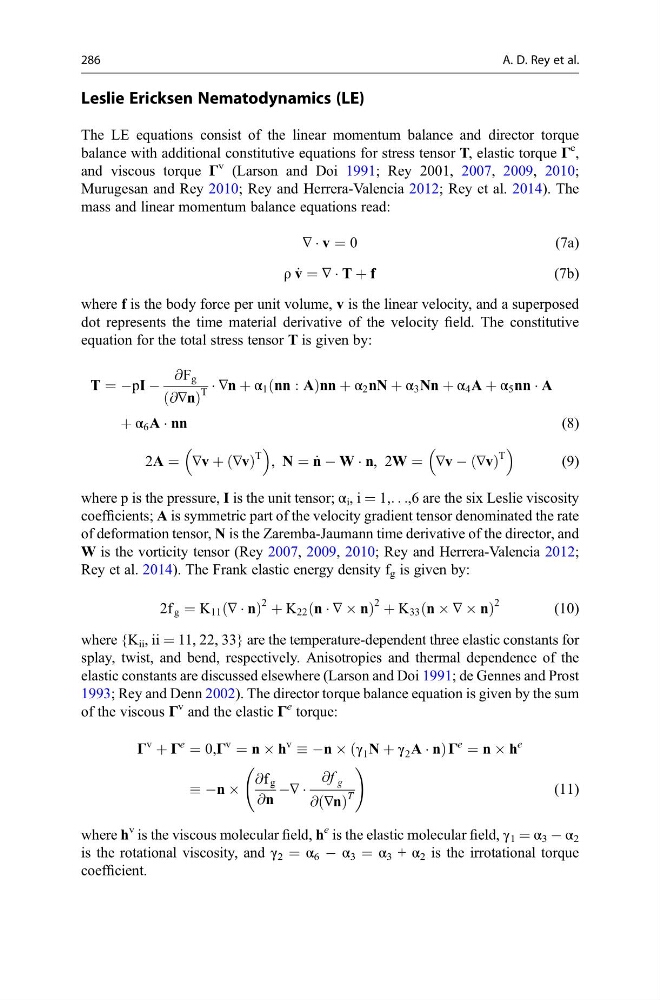
The LE equations consist of the linear momentum balance and director torque
balance with additional constitutive equations for stress tensor T, elastic torque Γ
e ,
and viscous torque Γ
v (Larson and Doi 1991; Rey 2001, 2007, 2009, 2010;
Murugesan and Rey 2010; Rey and Herrera-Valencia 2012; Rey et al. 2014). The
mass and linear momentum balance equations read:
∇ Á v ¼ 0
(7a)
ρ _
v ¼ ∇ Á T þ f
(7b)
where f is the body force per unit volume, v is the linear velocity, and a superposed
dot represents the time material derivative of the velocity field. The constitutive
equation for the total stress tensor T is given by:
T ¼ ÀpI À
@F g
@∇n
ð
Þ
T Á ∇n þ α 1 nn : A
ð
Þnn þ α 2 nN þ α 3 Nn þ α 4 A þ α 5 nn Á A
þ α 6 A Á nn
(8)
2A ¼ ∇v þ ∇v
ð Þ
T
, N ¼ _
n À W Á n, 2W ¼ ∇v À ∇v
ð Þ
T
(9)
where p is the pressure, I is the unit tensor; α i , i = 1,. . .,6 are the six Leslie viscosity
coefficients; A is symmetric part of the velocity gradient tensor denominated the rate
of deformation tensor, N is the Zaremba-Jaumann time derivative of the director, and
W is the vorticity tensor (Rey 2007, 2009, 2010; Rey and Herrera-Valencia 2012;
Rey et al. 2014). The Frank elastic energy density f g is given by:
2f g ¼ K 11 ∇ Á n
ð
Þ
2 þ K 22 n Á ∇ Â n
ð
Þ
2 þ K 33 n  ∇  n
ð
Þ
2
(10)
where {K ii , ii = 11, 22, 33} are the temperature-dependent three elastic constants for
splay, twist, and bend, respectively. Anisotropies and thermal dependence of the
elastic constants are discussed elsewhere (Larson and Doi 1991; de Gennes and Prost
1993; Rey and Denn 2002). The director torque balance equation is given by the sum
of the viscous Γ
v and the elastic Γ
e torque:
Γ
v
þ Γ
e
¼ 0,Γ
v
¼ n  h
v
Àn  γ 1 N þ γ 2 A Á n
ð
Þ Γ
e
¼ n  h
e
Àn Â
@f g
@n
À∇ Á
@f g
@ ∇n
ð Þ
T
!
(11)
where h
v is the viscous molecular field, h
e is the elastic molecular field, γ 1 = α 3 À α 2
is the rotational viscosity, and γ 2 = α 6 À α 3 = α 3 + α 2 is the irrotational torque
coefficient.
286
A. D. Rey et al.
The LE equations consist of the linear momentum balance and director torque
balance with additional constitutive equations for stress tensor T, elastic torque Γ
e ,
and viscous torque Γ
v (Larson and Doi 1991; Rey 2001, 2007, 2009, 2010;
Murugesan and Rey 2010; Rey and Herrera-Valencia 2012; Rey et al. 2014). The
mass and linear momentum balance equations read:
∇ Á v ¼ 0
(7a)
ρ _
v ¼ ∇ Á T þ f
(7b)
where f is the body force per unit volume, v is the linear velocity, and a superposed
dot represents the time material derivative of the velocity field. The constitutive
equation for the total stress tensor T is given by:
T ¼ ÀpI À
@F g
@∇n
ð
Þ
T Á ∇n þ α 1 nn : A
ð
Þnn þ α 2 nN þ α 3 Nn þ α 4 A þ α 5 nn Á A
þ α 6 A Á nn
(8)
2A ¼ ∇v þ ∇v
ð Þ
T
, N ¼ _
n À W Á n, 2W ¼ ∇v À ∇v
ð Þ
T
(9)
where p is the pressure, I is the unit tensor; α i , i = 1,. . .,6 are the six Leslie viscosity
coefficients; A is symmetric part of the velocity gradient tensor denominated the rate
of deformation tensor, N is the Zaremba-Jaumann time derivative of the director, and
W is the vorticity tensor (Rey 2007, 2009, 2010; Rey and Herrera-Valencia 2012;
Rey et al. 2014). The Frank elastic energy density f g is given by:
2f g ¼ K 11 ∇ Á n
ð
Þ
2 þ K 22 n Á ∇ Â n
ð
Þ
2 þ K 33 n  ∇  n
ð
Þ
2
(10)
where {K ii , ii = 11, 22, 33} are the temperature-dependent three elastic constants for
splay, twist, and bend, respectively. Anisotropies and thermal dependence of the
elastic constants are discussed elsewhere (Larson and Doi 1991; de Gennes and Prost
1993; Rey and Denn 2002). The director torque balance equation is given by the sum
of the viscous Γ
v and the elastic Γ
e torque:
Γ
v
þ Γ
e
¼ 0,Γ
v
¼ n  h
v
Àn  γ 1 N þ γ 2 A Á n
ð
Þ Γ
e
¼ n  h
e
Àn Â
@f g
@n
À∇ Á
@f g
@ ∇n
ð Þ
T
!
(11)
where h
v is the viscous molecular field, h
e is the elastic molecular field, γ 1 = α 3 À α 2
is the rotational viscosity, and γ 2 = α 6 À α 3 = α 3 + α 2 is the irrotational torque
coefficient.
286
A. D. Rey et al.