

molecular elasticity (S, P); c is the concentration per unit volume, k is the Boltzmann
constant, and T
à is the isotropic-nematic transition temperature (Rey 2007, 2009,
2010; Rey and Herrera-Valencia 2012; Rey et al. 2014). The former is associated
with micron-scale changes in (n, m, l) and the latter with nanoscale changes in (S, P).
One can conveniently take the ratio of the squared length scales which furnish the
parameter R as shown in Eq. 3 which is typically in the order of 10
6
–10
9 (Rey 2009).
In the LE model, R is assumed to be infinity; therefore, the scalar order parameters
(S, P) are not taken into account (Rey 2007, 2009, 2010; Rey and Herrera-Valencia
2012). Two characteristic times associated with each of the two length scales can
also be identified: (1) the external τ e and (2) internal τ i timescales of the LdG model
and are ordered as follows (Grecov and Rey 2003a-c, 2004, 2006; Rey 2010; Rey
et al. 2014):
τ e ¼
ηH
2
3L
,
τ i ¼
1
D r
,
τ e ) τ i
(4)
where D r is the bare rotational diffusivity and η = ckT
à /D r . The external timescale
describes slow orientation variations and the internal length scale describes fast order
parameter variations. In the LE model, τ i = 0 and no molecular dynamics are taken
into account. A third timescale can also be identified in the presence of shear flow
with rate _
γ whose reciprocal value defines the timescale τ f and a flow length scale l f
can be derived as shown in Eq. 5:
τ f ¼
1
_
γ
,l f ¼
ffiffiffiffiffiffiffiffiffiffiffi ffi
D orient
_
γ
s
, D orient ¼
LH
2
3τ e
¼
L
η
(5)
where D orient is the characteristic orientation diffusivity (length
2 /time). Regarding
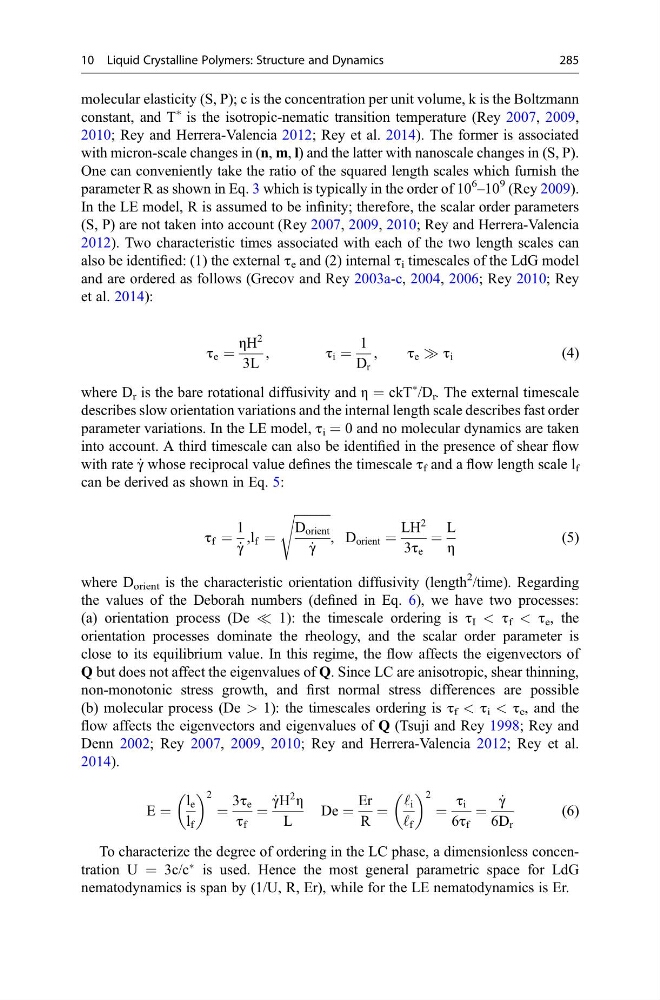
the values of the Deborah numbers (defined in Eq. 6), we have two processes:
(a) orientation process (De ( 1): the timescale ordering is τ I < τ f < τ e , the
orientation processes dominate the rheology, and the scalar order parameter is
close to its equilibrium value. In this regime, the flow affects the eigenvectors of
Q but does not affect the eigenvalues of Q. Since LC are anisotropic, shear thinning,
non-monotonic stress growth, and first normal stress differences are possible
(b) molecular process (De > 1): the timescales ordering is τ f < τ i < τ e , and the
flow affects the eigenvectors and eigenvalues of Q (Tsuji and Rey 1998; Rey and
Denn 2002; Rey 2007, 2009, 2010; Rey and Herrera-Valencia 2012; Rey et al.
2014).
E ¼
l e
l f
2
¼
3τ e
τ f
¼
_
γH
2
η
L
De ¼
Er
R
¼
‘ i
‘ f
2
¼
τ i
6τ f
¼
_
γ
6D r
(6)
To characterize the degree of ordering in the LC phase, a dimensionless concentration U = 3c/c
à is used. Hence the most general parametric space for LdG
nematodynamics is span by (1/U, R, Er), while for the LE nematodynamics is Er.
10 Liquid Crystalline Polymers: Structure and Dynamics
285
constant, and T
à is the isotropic-nematic transition temperature (Rey 2007, 2009,
2010; Rey and Herrera-Valencia 2012; Rey et al. 2014). The former is associated
with micron-scale changes in (n, m, l) and the latter with nanoscale changes in (S, P).
One can conveniently take the ratio of the squared length scales which furnish the
parameter R as shown in Eq. 3 which is typically in the order of 10
6
–10
9 (Rey 2009).
In the LE model, R is assumed to be infinity; therefore, the scalar order parameters
(S, P) are not taken into account (Rey 2007, 2009, 2010; Rey and Herrera-Valencia
2012). Two characteristic times associated with each of the two length scales can
also be identified: (1) the external τ e and (2) internal τ i timescales of the LdG model
and are ordered as follows (Grecov and Rey 2003a-c, 2004, 2006; Rey 2010; Rey
et al. 2014):
τ e ¼
ηH
2
3L
,
τ i ¼
1
D r
,
τ e ) τ i
(4)
where D r is the bare rotational diffusivity and η = ckT
à /D r . The external timescale
describes slow orientation variations and the internal length scale describes fast order
parameter variations. In the LE model, τ i = 0 and no molecular dynamics are taken
into account. A third timescale can also be identified in the presence of shear flow
with rate _
γ whose reciprocal value defines the timescale τ f and a flow length scale l f
can be derived as shown in Eq. 5:
τ f ¼
1
_
γ
,l f ¼
ffiffiffiffiffiffiffiffiffiffiffi ffi
D orient
_
γ
s
, D orient ¼
LH
2
3τ e
¼
L
η
(5)
where D orient is the characteristic orientation diffusivity (length
2 /time). Regarding
the values of the Deborah numbers (defined in Eq. 6), we have two processes:
(a) orientation process (De ( 1): the timescale ordering is τ I < τ f < τ e , the
orientation processes dominate the rheology, and the scalar order parameter is
close to its equilibrium value. In this regime, the flow affects the eigenvectors of
Q but does not affect the eigenvalues of Q. Since LC are anisotropic, shear thinning,
non-monotonic stress growth, and first normal stress differences are possible
(b) molecular process (De > 1): the timescales ordering is τ f < τ i < τ e , and the
flow affects the eigenvectors and eigenvalues of Q (Tsuji and Rey 1998; Rey and
Denn 2002; Rey 2007, 2009, 2010; Rey and Herrera-Valencia 2012; Rey et al.
2014).
E ¼
l e
l f
2
¼
3τ e
τ f
¼
_
γH
2
η
L
De ¼
Er
R
¼
‘ i
‘ f
2
¼
τ i
6τ f
¼
_
γ
6D r
(6)
To characterize the degree of ordering in the LC phase, a dimensionless concentration U = 3c/c
à is used. Hence the most general parametric space for LdG
nematodynamics is span by (1/U, R, Er), while for the LE nematodynamics is Er.
10 Liquid Crystalline Polymers: Structure and Dynamics
285