

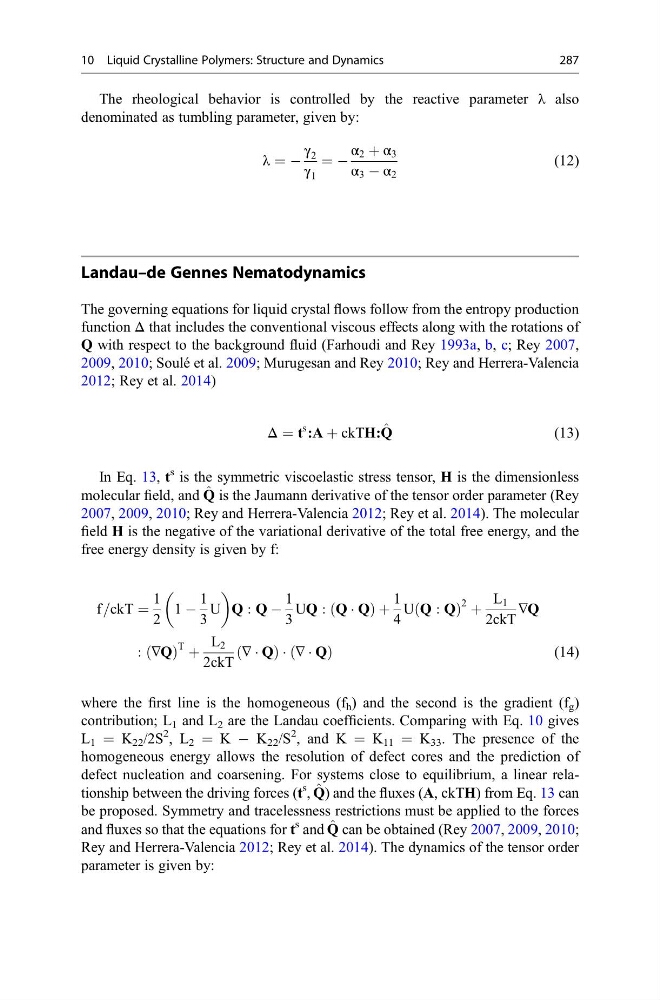
The rheological behavior is controlled by the reactive parameter λ also
denominated as tumbling parameter, given by:
λ ¼ À
γ 2
γ 1
¼ À
α 2 þ α 3
α 3 À α 2
(12)
Landau–de Gennes Nematodynamics
The governing equations for liquid crystal flows follow from the entropy production
function Δ that includes the conventional viscous effects along with the rotations of
Q with respect to the background fluid (Farhoudi and Rey 1993a, b, c; Rey 2007,
2009, 2010; Soulé et al. 2009; Murugesan and Rey 2010; Rey and Herrera-Valencia
2012; Rey et al. 2014)
Δ ¼ t
s :A þ ckTH: ^
Q
(13)
In Eq. 13, t
s is the symmetric viscoelastic stress tensor, H is the dimensionless
molecular field, and ^
Q is the Jaumann derivative of the tensor order parameter (Rey
2007, 2009, 2010; Rey and Herrera-Valencia 2012; Rey et al. 2014). The molecular
field H is the negative of the variational derivative of the total free energy, and the
free energy density is given by f:
f =ckT ¼
1
2
1 À
1
3
U
Q : Q À
1
3
UQ : Q Á Q
ð
Þþ
1
4
U Q : Q
ð
Þ
2 þ
L 1
2ckT
∇Q
: ∇Q
ð Þ
T þ
L 2
2ckT
∇ Á Q
ð
ÞÁ ∇ Á Q
ð
Þ
(14)
where the first line is the homogeneous (f h ) and the second is the gradient (f g )
contribution; L 1 and L 2 are the Landau coefficients. Comparing with Eq. 10 gives
L 1 = K 22 /2S
2 , L 2 = K À K 22 /S
2 , and K = K 11 = K 33 . The presence of the
homogeneous energy allows the resolution of defect cores and the prediction of
defect nucleation and coarsening. For systems close to equilibrium, a linear relationship between the driving forces (t
s , ^
Q) and the fluxes (A, ckTH) from Eq. 13 can
be proposed. Symmetry and tracelessness restrictions must be applied to the forces
and fluxes so that the equations for t
s and ^
Q can be obtained (Rey 2007, 2009, 2010;
Rey and Herrera-Valencia 2012; Rey et al. 2014). The dynamics of the tensor order
parameter is given by:
10 Liquid Crystalline Polymers: Structure and Dynamics
287
denominated as tumbling parameter, given by:
λ ¼ À
γ 2
γ 1
¼ À
α 2 þ α 3
α 3 À α 2
(12)
Landau–de Gennes Nematodynamics
The governing equations for liquid crystal flows follow from the entropy production
function Δ that includes the conventional viscous effects along with the rotations of
Q with respect to the background fluid (Farhoudi and Rey 1993a, b, c; Rey 2007,
2009, 2010; Soulé et al. 2009; Murugesan and Rey 2010; Rey and Herrera-Valencia
2012; Rey et al. 2014)
Δ ¼ t
s :A þ ckTH: ^
Q
(13)
In Eq. 13, t
s is the symmetric viscoelastic stress tensor, H is the dimensionless
molecular field, and ^
Q is the Jaumann derivative of the tensor order parameter (Rey
2007, 2009, 2010; Rey and Herrera-Valencia 2012; Rey et al. 2014). The molecular
field H is the negative of the variational derivative of the total free energy, and the
free energy density is given by f:
f =ckT ¼
1
2
1 À
1
3
U
Q : Q À
1
3
UQ : Q Á Q
ð
Þþ
1
4
U Q : Q
ð
Þ
2 þ
L 1
2ckT
∇Q
: ∇Q
ð Þ
T þ
L 2
2ckT
∇ Á Q
ð
ÞÁ ∇ Á Q
ð
Þ
(14)
where the first line is the homogeneous (f h ) and the second is the gradient (f g )
contribution; L 1 and L 2 are the Landau coefficients. Comparing with Eq. 10 gives
L 1 = K 22 /2S
2 , L 2 = K À K 22 /S
2 , and K = K 11 = K 33 . The presence of the
homogeneous energy allows the resolution of defect cores and the prediction of
defect nucleation and coarsening. For systems close to equilibrium, a linear relationship between the driving forces (t
s , ^
Q) and the fluxes (A, ckTH) from Eq. 13 can
be proposed. Symmetry and tracelessness restrictions must be applied to the forces
and fluxes so that the equations for t
s and ^
Q can be obtained (Rey 2007, 2009, 2010;
Rey and Herrera-Valencia 2012; Rey et al. 2014). The dynamics of the tensor order
parameter is given by:
10 Liquid Crystalline Polymers: Structure and Dynamics
287