

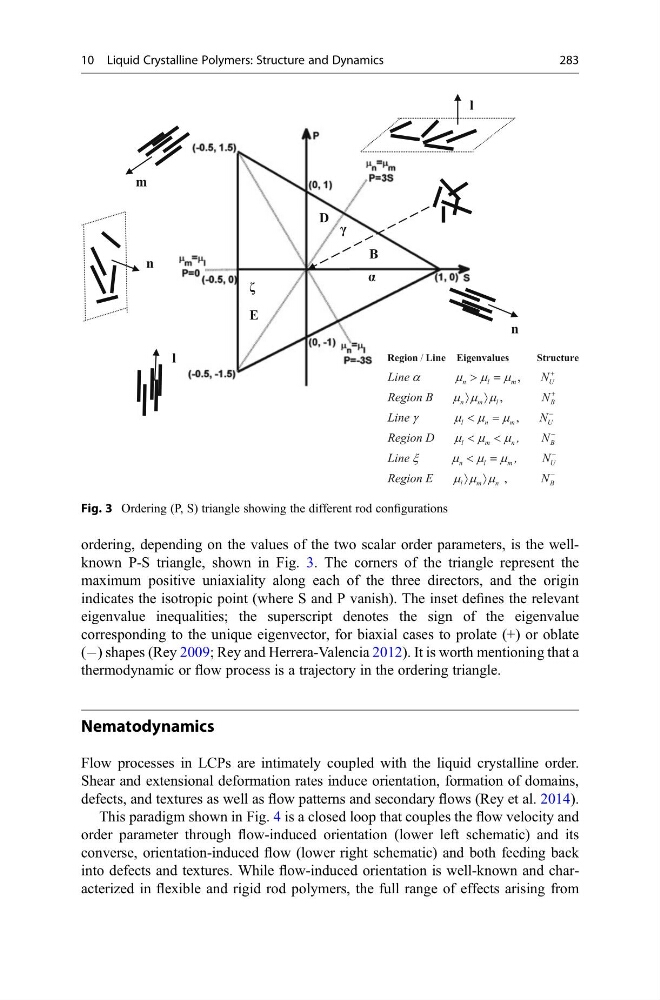
ordering, depending on the values of the two scalar order parameters, is the wellknown P-S triangle, shown in Fig. 3. The corners of the triangle represent the
maximum positive uniaxiality along each of the three directors, and the origin
indicates the isotropic point (where S and P vanish). The inset defines the relevant
eigenvalue inequalities; the superscript denotes the sign of the eigenvalue
corresponding to the unique eigenvector, for biaxial cases to prolate (+) or oblate
(À) shapes (Rey 2009; Rey and Herrera-Valencia 2012). It is worth mentioning that a
thermodynamic or flow process is a trajectory in the ordering triangle.
Nematodynamics
Flow processes in LCPs are intimately coupled with the liquid crystalline order.
Shear and extensional deformation rates induce orientation, formation of domains,
defects, and textures as well as flow patterns and secondary flows (Rey et al. 2014).
This paradigm shown in Fig. 4 is a closed loop that couples the flow velocity and
order parameter through flow-induced orientation (lower left schematic) and its
converse, orientation-induced flow (lower right schematic) and both feeding back
into defects and textures. While flow-induced orientation is well-known and characterized in flexible and rigid rod polymers, the full range of effects arising from
α
B
γ
D
ζ
E
n
l
m
n
l
Fig. 3 Ordering (P, S) triangle showing the different rod configurations
10 Liquid Crystalline Polymers: Structure and Dynamics
283
maximum positive uniaxiality along each of the three directors, and the origin
indicates the isotropic point (where S and P vanish). The inset defines the relevant
eigenvalue inequalities; the superscript denotes the sign of the eigenvalue
corresponding to the unique eigenvector, for biaxial cases to prolate (+) or oblate
(À) shapes (Rey 2009; Rey and Herrera-Valencia 2012). It is worth mentioning that a
thermodynamic or flow process is a trajectory in the ordering triangle.
Nematodynamics
Flow processes in LCPs are intimately coupled with the liquid crystalline order.
Shear and extensional deformation rates induce orientation, formation of domains,
defects, and textures as well as flow patterns and secondary flows (Rey et al. 2014).
This paradigm shown in Fig. 4 is a closed loop that couples the flow velocity and
order parameter through flow-induced orientation (lower left schematic) and its
converse, orientation-induced flow (lower right schematic) and both feeding back
into defects and textures. While flow-induced orientation is well-known and characterized in flexible and rigid rod polymers, the full range of effects arising from
α
B
γ
D
ζ
E
n
l
m
n
l
Fig. 3 Ordering (P, S) triangle showing the different rod configurations
10 Liquid Crystalline Polymers: Structure and Dynamics
283