

Rey and Herrera-Valencia 2012), application to biological liquid crystal systems
(Rey 2007, 2009, 2010; Rey et al. 2014), followed by some concluding remarks;
this is summarized in Fig. 2.
Flow Modeling of Liquid Crystalline Polymers
We present here the main equations for the tensor order parameter Q, fluid mechanics, bulk and interfacial science, Leslie-Ericksen (LE) constitutive equations and the
Landau – de Gennes (LdG) model for chiral self-assembly are presented based on
previous work by Rey (Rey 2007, 2009, 2010; Rey and Herrera-Valencia 2012; Rey
et al. 2014); the reader is referred to such citations for the full details and we present
only a general overview.
Quadrupolar Order Parameter
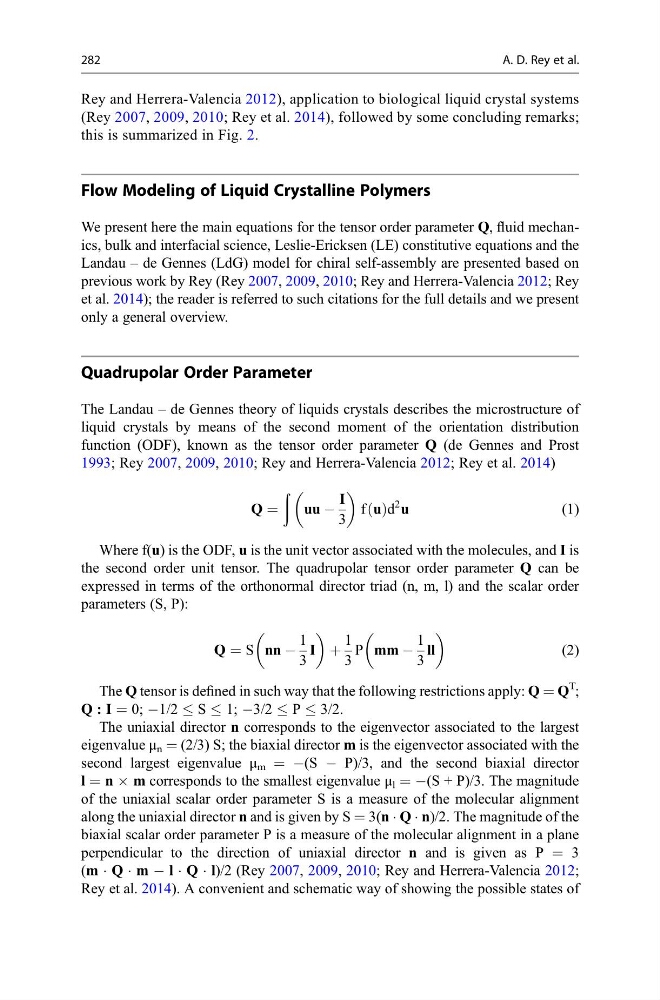
The Landau – de Gennes theory of liquids crystals describes the microstructure of
liquid crystals by means of the second moment of the orientation distribution
function (ODF), known as the tensor order parameter Q (de Gennes and Prost
1993; Rey 2007, 2009, 2010; Rey and Herrera-Valencia 2012; Rey et al. 2014)
Q ¼
ð
uu À
I
3
f u
ð Þd
2 u
(1)
Where f(u) is the ODF, u is the unit vector associated with the molecules, and I is
the second order unit tensor. The quadrupolar tensor order parameter Q can be
expressed in terms of the orthonormal director triad (n, m, l) and the scalar order
parameters (S, P):
Q ¼ S nn À
1
3
I
þ
1
3
Ρ mm À
1
3
ll
(2)
The Q tensor is defined in such way that the following restrictions apply: Q = Q
T
;
Q : I = 0; À1/2 S 1; À3/2 P 3/2.
The uniaxial director n corresponds to the eigenvector associated to the largest
eigenvalue μ n = (2/3) S; the biaxial director m is the eigenvector associated with the
second largest eigenvalue μ m = À(S À P)/3, and the second biaxial director
l = n  m corresponds to the smallest eigenvalue μ l = À(S + P)/3. The magnitude
of the uniaxial scalar order parameter S is a measure of the molecular alignment
along the uniaxial director n and is given by S = 3(n Á Q Á n)/2. The magnitude of the
biaxial scalar order parameter P is a measure of the molecular alignment in a plane
perpendicular to the direction of uniaxial director n and is given as P = 3
(m Á Q Á m À l Á Q Á l)/2 (Rey 2007, 2009, 2010; Rey and Herrera-Valencia 2012;
Rey et al. 2014). A convenient and schematic way of showing the possible states of
282
A. D. Rey et al.
(Rey 2007, 2009, 2010; Rey et al. 2014), followed by some concluding remarks;
this is summarized in Fig. 2.
Flow Modeling of Liquid Crystalline Polymers
We present here the main equations for the tensor order parameter Q, fluid mechanics, bulk and interfacial science, Leslie-Ericksen (LE) constitutive equations and the
Landau – de Gennes (LdG) model for chiral self-assembly are presented based on
previous work by Rey (Rey 2007, 2009, 2010; Rey and Herrera-Valencia 2012; Rey
et al. 2014); the reader is referred to such citations for the full details and we present
only a general overview.
Quadrupolar Order Parameter
The Landau – de Gennes theory of liquids crystals describes the microstructure of
liquid crystals by means of the second moment of the orientation distribution
function (ODF), known as the tensor order parameter Q (de Gennes and Prost
1993; Rey 2007, 2009, 2010; Rey and Herrera-Valencia 2012; Rey et al. 2014)
Q ¼
ð
uu À
I
3
f u
ð Þd
2 u
(1)
Where f(u) is the ODF, u is the unit vector associated with the molecules, and I is
the second order unit tensor. The quadrupolar tensor order parameter Q can be
expressed in terms of the orthonormal director triad (n, m, l) and the scalar order
parameters (S, P):
Q ¼ S nn À
1
3
I
þ
1
3
Ρ mm À
1
3
ll
(2)
The Q tensor is defined in such way that the following restrictions apply: Q = Q
T
;
Q : I = 0; À1/2 S 1; À3/2 P 3/2.
The uniaxial director n corresponds to the eigenvector associated to the largest
eigenvalue μ n = (2/3) S; the biaxial director m is the eigenvector associated with the
second largest eigenvalue μ m = À(S À P)/3, and the second biaxial director
l = n  m corresponds to the smallest eigenvalue μ l = À(S + P)/3. The magnitude
of the uniaxial scalar order parameter S is a measure of the molecular alignment
along the uniaxial director n and is given by S = 3(n Á Q Á n)/2. The magnitude of the
biaxial scalar order parameter P is a measure of the molecular alignment in a plane
perpendicular to the direction of uniaxial director n and is given as P = 3
(m Á Q Á m À l Á Q Á l)/2 (Rey 2007, 2009, 2010; Rey and Herrera-Valencia 2012;
Rey et al. 2014). A convenient and schematic way of showing the possible states of
282
A. D. Rey et al.