

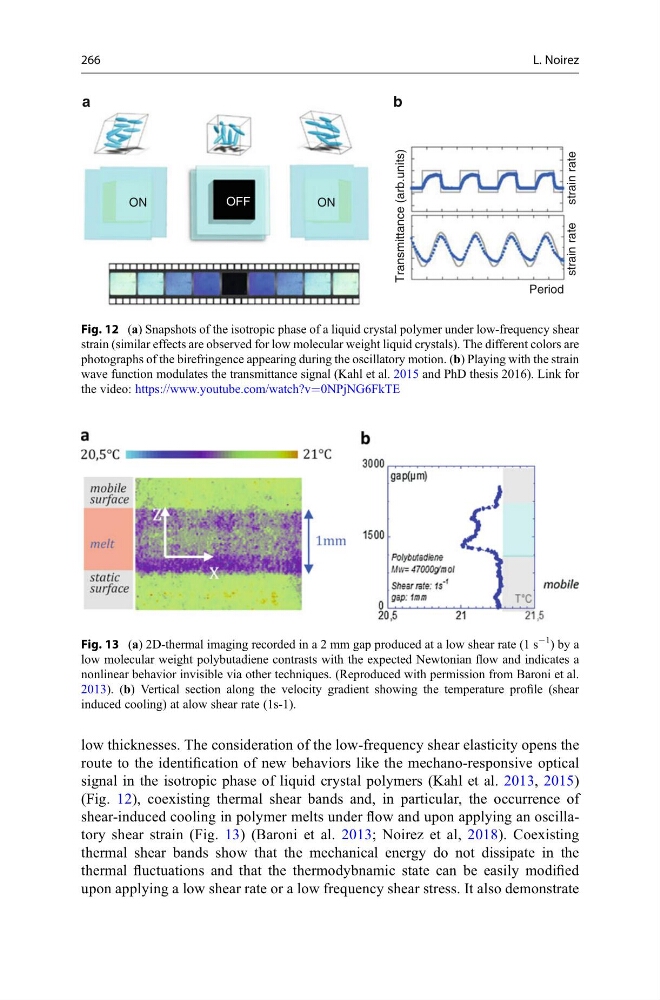
low thicknesses. The consideration of the low-frequency shear elasticity opens the
route to the identification of new behaviors like the mechano-responsive optical
signal in the isotropic phase of liquid crystal polymers (Kahl et al. 2013, 2015)
(Fig. 12), coexisting thermal shear bands and, in particular, the occurrence of
shear-induced cooling in polymer melts under flow and upon applying an oscillatory shear strain (Fig. 13) (Baroni et al. 2013; Noirez et al, 2018). Coexisting
thermal shear bands show that the mechanical energy do not dissipate in the
thermal fluctuations and that the thermodybnamic state can be easily modified
upon applying a low shear rate or a low frequency shear stress. It also demonstrate
ON
ON
Period
a
b
OFF
Transmittance (arb.units)
strain rate strain rate
Fig. 12 (a) Snapshots of the isotropic phase of a liquid crystal polymer under low-frequency shear
strain (similar effects are observed for low molecular weight liquid crystals). The different colors are
photographs of the birefringence appearing during the oscillatory motion. (b) Playing with the strain
wave function modulates the transmittance signal (Kahl et al. 2015 and PhD thesis 2016). Link for
the video: https://www.youtube.com/watch?v=0NPjNG6FkTE
Fig. 13 (a) 2D-thermal imaging recorded in a 2 mm gap produced at a low shear rate (1 s
À1
) by a
low molecular weight polybutadiene contrasts with the expected Newtonian flow and indicates a
nonlinear behavior invisible via other techniques. (Reproduced with permission from Baroni et al.
2013). (b) Vertical section along the velocity gradient showing the temperature profile (shear
induced cooling) at alow shear rate (1s-1).
266
L. Noirez
route to the identification of new behaviors like the mechano-responsive optical
signal in the isotropic phase of liquid crystal polymers (Kahl et al. 2013, 2015)
(Fig. 12), coexisting thermal shear bands and, in particular, the occurrence of
shear-induced cooling in polymer melts under flow and upon applying an oscillatory shear strain (Fig. 13) (Baroni et al. 2013; Noirez et al, 2018). Coexisting
thermal shear bands show that the mechanical energy do not dissipate in the
thermal fluctuations and that the thermodybnamic state can be easily modified
upon applying a low shear rate or a low frequency shear stress. It also demonstrate
ON
ON
Period
a
b
OFF
Transmittance (arb.units)
strain rate strain rate
Fig. 12 (a) Snapshots of the isotropic phase of a liquid crystal polymer under low-frequency shear
strain (similar effects are observed for low molecular weight liquid crystals). The different colors are
photographs of the birefringence appearing during the oscillatory motion. (b) Playing with the strain
wave function modulates the transmittance signal (Kahl et al. 2015 and PhD thesis 2016). Link for
the video: https://www.youtube.com/watch?v=0NPjNG6FkTE
Fig. 13 (a) 2D-thermal imaging recorded in a 2 mm gap produced at a low shear rate (1 s
À1
) by a
low molecular weight polybutadiene contrasts with the expected Newtonian flow and indicates a
nonlinear behavior invisible via other techniques. (Reproduced with permission from Baroni et al.
2013). (b) Vertical section along the velocity gradient showing the temperature profile (shear
induced cooling) at alow shear rate (1s-1).
266
L. Noirez