

that the thermal fluctuations are not simply linked to density fluctuations but also
strongly correlated to the shear elasticity and thus to the ability of changing the
liquid compressibility. The shear-induced cooling has been also observed up the
millimeter scale in liquid water (Fig. 13, Baroni 2013). This is very likely a generic
effect that concerns particularly microfluidic conditions. Biomedicine via the
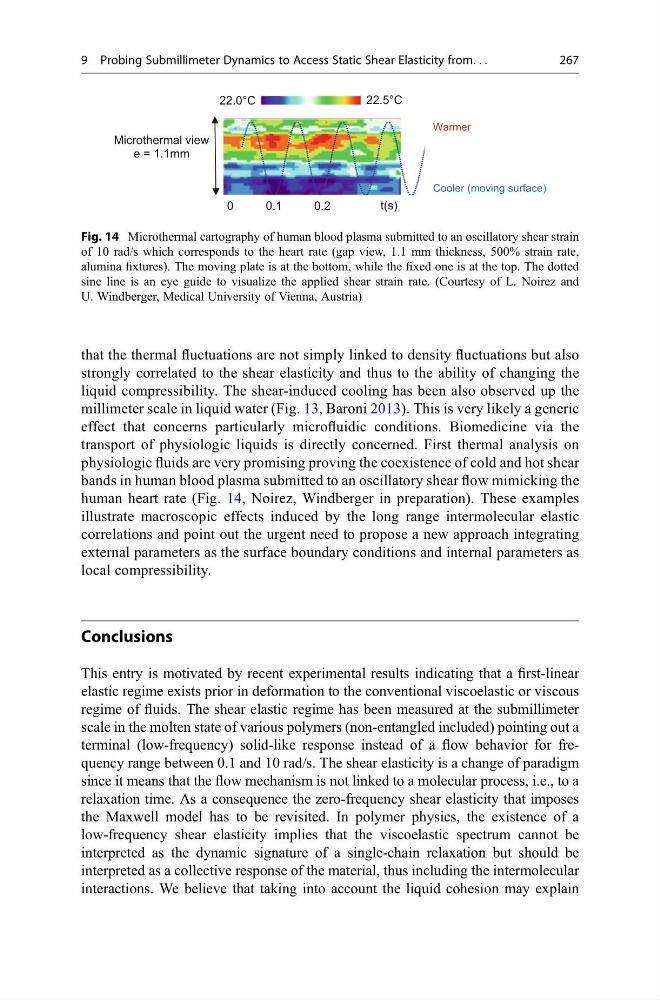
transport of physiologic liquids is directly concerned. First thermal analysis on
physiologic fluids are very promising proving the coexistence of cold and hot shear
bands in human blood plasma submitted to an oscillatory shear flow mimicking the
human heart rate (Fig. 14, Noirez, Windberger in preparation). These examples
illustrate macroscopic effects induced by the long range intermolecular elastic
correlations and point out the urgent need to propose a new approach integrating
external parameters as the surface boundary conditions and internal parameters as
local compressibility.
Conclusions
This entry is motivated by recent experimental results indicating that a first-linear
elastic regime exists prior in deformation to the conventional viscoelastic or viscous
regime of fluids. The shear elastic regime has been measured at the submillimeter
scale in the molten state of various polymers (non-entangled included) pointing out a
terminal (low-frequency) solid-like response instead of a flow behavior for frequency range between 0.1 and 10 rad/s. The shear elasticity is a change of paradigm
since it means that the flow mechanism is not linked to a molecular process, i.e., to a
relaxation time. As a consequence the zero-frequency shear elasticity that imposes
the Maxwell model has to be revisited. In polymer physics, the existence of a
low-frequency shear elasticity implies that the viscoelastic spectrum cannot be
interpreted as the dynamic signature of a single-chain relaxation but should be
interpreted as a collective response of the material, thus including the intermolecular
interactions. We believe that taking into account the liquid cohesion may explain
Warmer
Cooler (moving surface)
t(s)
22.0°C
22.5°C
Microthermal view
e = 1.1mm
0
0.1
0.2
Fig. 14 Microthermal cartography of human blood plasma submitted to an oscillatory shear strain
of 10 rad/s which corresponds to the heart rate (gap view, 1.1 mm thickness, 500% strain rate,
alumina fixtures). The moving plate is at the bottom, while the fixed one is at the top. The dotted
sine line is an eye guide to visualize the applied shear strain rate. (Courtesy of L. Noirez and
U. Windberger, Medical University of Vienna, Austria)
9 Probing Submillimeter Dynamics to Access Static Shear Elasticity from. . .
267
strongly correlated to the shear elasticity and thus to the ability of changing the
liquid compressibility. The shear-induced cooling has been also observed up the
millimeter scale in liquid water (Fig. 13, Baroni 2013). This is very likely a generic
effect that concerns particularly microfluidic conditions. Biomedicine via the
transport of physiologic liquids is directly concerned. First thermal analysis on
physiologic fluids are very promising proving the coexistence of cold and hot shear
bands in human blood plasma submitted to an oscillatory shear flow mimicking the
human heart rate (Fig. 14, Noirez, Windberger in preparation). These examples
illustrate macroscopic effects induced by the long range intermolecular elastic
correlations and point out the urgent need to propose a new approach integrating
external parameters as the surface boundary conditions and internal parameters as
local compressibility.
Conclusions
This entry is motivated by recent experimental results indicating that a first-linear
elastic regime exists prior in deformation to the conventional viscoelastic or viscous
regime of fluids. The shear elastic regime has been measured at the submillimeter
scale in the molten state of various polymers (non-entangled included) pointing out a
terminal (low-frequency) solid-like response instead of a flow behavior for frequency range between 0.1 and 10 rad/s. The shear elasticity is a change of paradigm
since it means that the flow mechanism is not linked to a molecular process, i.e., to a
relaxation time. As a consequence the zero-frequency shear elasticity that imposes
the Maxwell model has to be revisited. In polymer physics, the existence of a
low-frequency shear elasticity implies that the viscoelastic spectrum cannot be
interpreted as the dynamic signature of a single-chain relaxation but should be
interpreted as a collective response of the material, thus including the intermolecular
interactions. We believe that taking into account the liquid cohesion may explain
Warmer
Cooler (moving surface)
t(s)
22.0°C
22.5°C
Microthermal view
e = 1.1mm
0
0.1
0.2
Fig. 14 Microthermal cartography of human blood plasma submitted to an oscillatory shear strain
of 10 rad/s which corresponds to the heart rate (gap view, 1.1 mm thickness, 500% strain rate,
alumina fixtures). The moving plate is at the bottom, while the fixed one is at the top. The dotted
sine line is an eye guide to visualize the applied shear strain rate. (Courtesy of L. Noirez and
U. Windberger, Medical University of Vienna, Austria)
9 Probing Submillimeter Dynamics to Access Static Shear Elasticity from. . .
267