

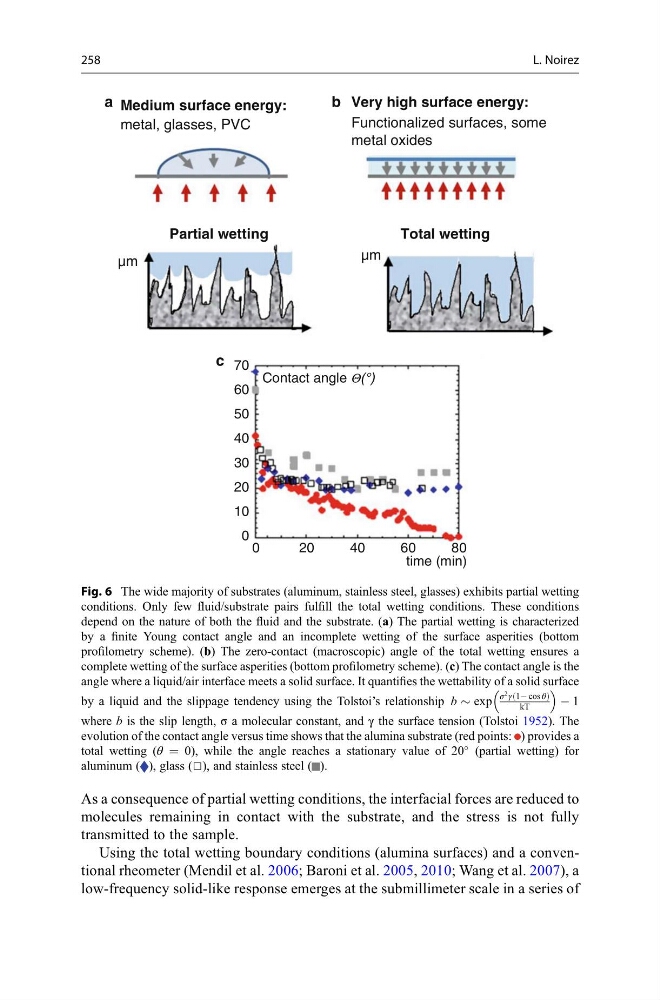
As a consequence of partial wetting conditions, the interfacial forces are reduced to
molecules remaining in contact with the substrate, and the stress is not fully
transmitted to the sample.
Using the total wetting boundary conditions (alumina surfaces) and a conventional rheometer (Mendil et al. 2006; Baroni et al. 2005, 2010; Wang et al. 2007), a
low-frequency solid-like response emerges at the submillimeter scale in a series of
Medium surface energy:
Very high surface energy:
Partial wetting
Total wetting
µm
µm
70
a
c
b
60
Contact angle Q(°)
50
40
30
20
10
0
0
2 0
4 0
6 0
80
time (min)
metal, glasses, PVC
Functionalized surfaces, some
metal oxides
Fig. 6 The wide majority of substrates (aluminum, stainless steel, glasses) exhibits partial wetting
conditions. Only few fluid/substrate pairs fulfill the total wetting conditions. These conditions
depend on the nature of both the fluid and the substrate. (a) The partial wetting is characterized
by a finite Young contact angle and an incomplete wetting of the surface asperities (bottom
profilometry scheme). (b) The zero-contact (macroscopic) angle of the total wetting ensures a
complete wetting of the surface asperities (bottom profilometry scheme). (c) The contact angle is the
angle where a liquid/air interface meets a solid surface. It quantifies the wettability of a solid surface
by a liquid and the slippage tendency using the Tolstoi’s relationship b $ exp
σ
2 γ 1À cos θ
ð
Þ
kT
À 1
where b is the slip length, σ a molecular constant, and γ the surface tension (Tolstoi 1952). The
evolution of the contact angle versus time shows that the alumina substrate (red points: ) provides a
total wetting (θ = 0), while the angle reaches a stationary value of 20
(partial wetting) for
aluminum ( ), glass (□), and stainless steel ( ).
258
L. Noirez
molecules remaining in contact with the substrate, and the stress is not fully
transmitted to the sample.
Using the total wetting boundary conditions (alumina surfaces) and a conventional rheometer (Mendil et al. 2006; Baroni et al. 2005, 2010; Wang et al. 2007), a
low-frequency solid-like response emerges at the submillimeter scale in a series of
Medium surface energy:
Very high surface energy:
Partial wetting
Total wetting
µm
µm
70
a
c
b
60
Contact angle Q(°)
50
40
30
20
10
0
0
2 0
4 0
6 0
80
time (min)
metal, glasses, PVC
Functionalized surfaces, some
metal oxides
Fig. 6 The wide majority of substrates (aluminum, stainless steel, glasses) exhibits partial wetting
conditions. Only few fluid/substrate pairs fulfill the total wetting conditions. These conditions
depend on the nature of both the fluid and the substrate. (a) The partial wetting is characterized
by a finite Young contact angle and an incomplete wetting of the surface asperities (bottom
profilometry scheme). (b) The zero-contact (macroscopic) angle of the total wetting ensures a
complete wetting of the surface asperities (bottom profilometry scheme). (c) The contact angle is the
angle where a liquid/air interface meets a solid surface. It quantifies the wettability of a solid surface
by a liquid and the slippage tendency using the Tolstoi’s relationship b $ exp
σ
2 γ 1À cos θ
ð
Þ
kT
À 1
where b is the slip length, σ a molecular constant, and γ the surface tension (Tolstoi 1952). The
evolution of the contact angle versus time shows that the alumina substrate (red points: ) provides a
total wetting (θ = 0), while the angle reaches a stationary value of 20
(partial wetting) for
aluminum ( ), glass (□), and stainless steel ( ).
258
L. Noirez