

A good criterion is the observation of a total wetting of the fluid onto the substrate
(de Gennes et al. 2005 – Fig. 6b). The total wetting maximizes the molecular
interactions to the surface. By filling voids, roughness, and asperities, it prevents
the slippage.
The discipline of rheology has grown ignoring the fluid/substrate boundary
conditions on the dynamic measurement, treating in an equal way, wetting or
non-wetting, hydrophilic or hydrophobic surfaces. Rheology supposes that the
fluid wets adequately the metallic surfaces of the fixtures (generally made of
aluminum or stainless steel). However, the determination of the contact angle
shows that metallic substrates do not guaranty an optimal wetting (Fig. 6b, c).
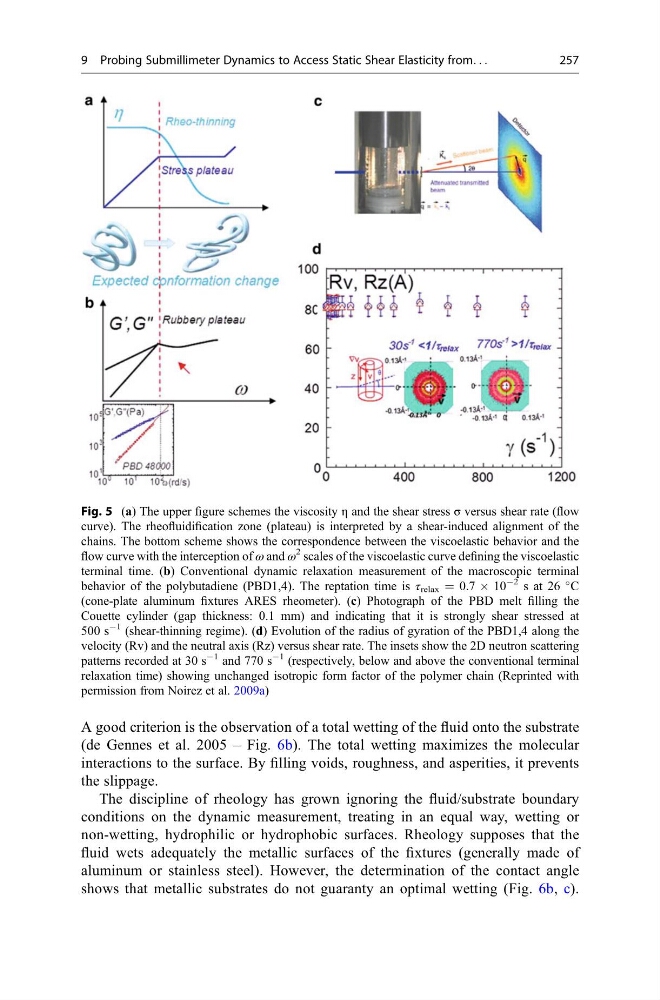
Fig. 5 (a) The upper figure schemes the viscosity η and the shear stress σ versus shear rate (flow
curve). The rheofluidification zone (plateau) is interpreted by a shear-induced alignment of the
chains. The bottom scheme shows the correspondence between the viscoelastic behavior and the
flow curve with the interception of ω and ω
2 scales of the viscoelastic curve defining the viscoelastic
terminal time. (b) Conventional dynamic relaxation measurement of the macroscopic terminal
behavior of the polybutadiene (PBD1,4). The reptation time is τ relax = 0.7 Â 10
À2 s at 26
C
(cone-plate aluminum fixtures ARES rheometer). (c) Photograph of the PBD melt filling the
Couette cylinder (gap thickness: 0.1 mm) and indicating that it is strongly shear stressed at
500 s
À1 (shear-thinning regime). (d) Evolution of the radius of gyration of the PBD1,4 along the
velocity (Rv) and the neutral axis (Rz) versus shear rate. The insets show the 2D neutron scattering
patterns recorded at 30 s
À1 and 770 s
À1 (respectively, below and above the conventional terminal
relaxation time) showing unchanged isotropic form factor of the polymer chain (Reprinted with
permission from Noirez et al. 2009a)
9 Probing Submillimeter Dynamics to Access Static Shear Elasticity from. . .
257
(de Gennes et al. 2005 – Fig. 6b). The total wetting maximizes the molecular
interactions to the surface. By filling voids, roughness, and asperities, it prevents
the slippage.
The discipline of rheology has grown ignoring the fluid/substrate boundary
conditions on the dynamic measurement, treating in an equal way, wetting or
non-wetting, hydrophilic or hydrophobic surfaces. Rheology supposes that the
fluid wets adequately the metallic surfaces of the fixtures (generally made of
aluminum or stainless steel). However, the determination of the contact angle
shows that metallic substrates do not guaranty an optimal wetting (Fig. 6b, c).
Fig. 5 (a) The upper figure schemes the viscosity η and the shear stress σ versus shear rate (flow
curve). The rheofluidification zone (plateau) is interpreted by a shear-induced alignment of the
chains. The bottom scheme shows the correspondence between the viscoelastic behavior and the
flow curve with the interception of ω and ω
2 scales of the viscoelastic curve defining the viscoelastic
terminal time. (b) Conventional dynamic relaxation measurement of the macroscopic terminal
behavior of the polybutadiene (PBD1,4). The reptation time is τ relax = 0.7 Â 10
À2 s at 26
C
(cone-plate aluminum fixtures ARES rheometer). (c) Photograph of the PBD melt filling the
Couette cylinder (gap thickness: 0.1 mm) and indicating that it is strongly shear stressed at
500 s
À1 (shear-thinning regime). (d) Evolution of the radius of gyration of the PBD1,4 along the
velocity (Rv) and the neutral axis (Rz) versus shear rate. The insets show the 2D neutron scattering
patterns recorded at 30 s
À1 and 770 s
À1 (respectively, below and above the conventional terminal
relaxation time) showing unchanged isotropic form factor of the polymer chain (Reprinted with
permission from Noirez et al. 2009a)
9 Probing Submillimeter Dynamics to Access Static Shear Elasticity from. . .
257