

10
0
10
2
10
4
10
6
10
-1
10
1
10
3
10
5
'
'
G
,
'
G
)
a
P
(
w (rad/s)
G''
G'
e=0.7 mm
10
0
10
2
10
4
10
6
10
-1
10
0
10
1
10
2
w(rad/s)
"
G
,
'
G
)
a
P
(
G''
G'
e=0.2 mm
10
0
10
2
10
4
10
6
10
-1
10
0
10
1
10
2
"
G
,
'
G
)
a
P
(
w(rad/s)
G'
G''
e=0.025 mm
a
b
10
0
10
2
10
4
10
6
10
-1
10
1
10
3
10
5
G(Pa)
t(s)
PBuA Mw=40 000 T=26°C
c
10
0
10
2
10
4
10
6
0.01
0.1
1
e(mm)
PBuA Mw = 47 500
Tg = - 64°C
G'(Pa) Low frequency shear elasticity
versus thickness
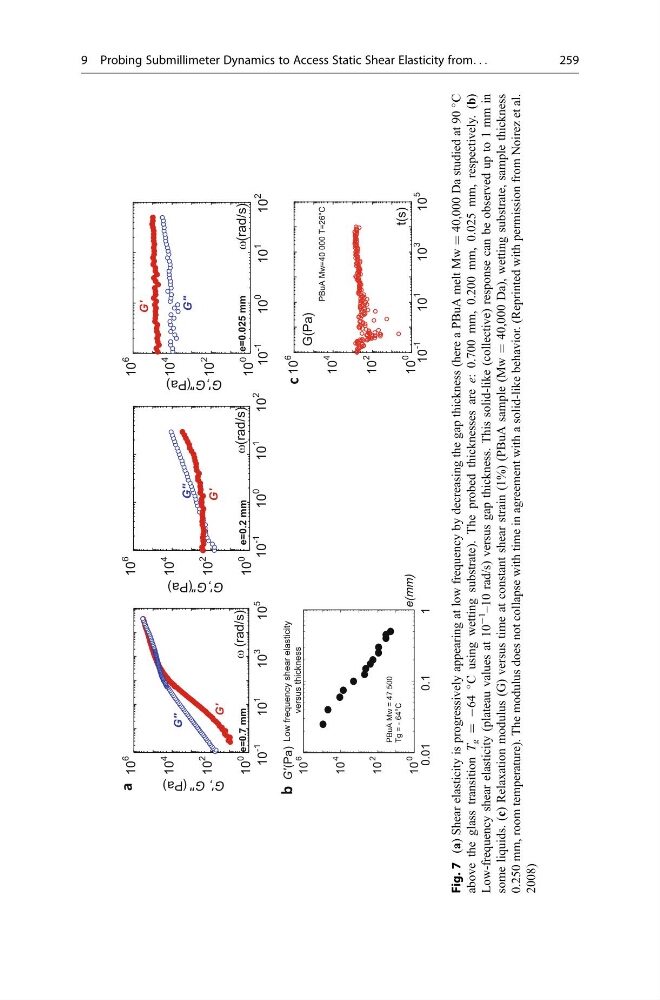
Fig. 7
(a) Shear elasticity is progressively appearing at low frequency by decreasing the gap thickness (here a PBuA melt Mw
= 40,000 Da studied at 90
C
above the glass transition T
g
= À64
C using wetting substrate). The probed thicknesses are e: 0.700 mm, 0.200 mm, 0.025 mm, respectively. (b)
Low-frequency shear elasticity (plateau values at 10
À1
–10 rad/s) versus gap thickness. This solid-like (collective) response can be observed up to 1 mm in
some liquids. (c) Relaxation modulus (G) versus time at constant shear strain (1%) (PBuA sample (Mw
= 40,000 Da), wetting substrate, sample thickness
0.250 mm, room temperature). The modulus does not collapse with time in agreement with a solid-like behavior. (Reprinted with permission from Noirez et al.
2008)
9 Probing Submillimeter Dynamics to Access Static Shear Elasticity from. . .
259
0
10
2
10
4
10
6
10
-1
10
1
10
3
10
5
'
'
G
,
'
G
)
a
P
(
w (rad/s)
G''
G'
e=0.7 mm
10
0
10
2
10
4
10
6
10
-1
10
0
10
1
10
2
w(rad/s)
"
G
,
'
G
)
a
P
(
G''
G'
e=0.2 mm
10
0
10
2
10
4
10
6
10
-1
10
0
10
1
10
2
"
G
,
'
G
)
a
P
(
w(rad/s)
G'
G''
e=0.025 mm
a
b
10
0
10
2
10
4
10
6
10
-1
10
1
10
3
10
5
G(Pa)
t(s)
PBuA Mw=40 000 T=26°C
c
10
0
10
2
10
4
10
6
0.01
0.1
1
e(mm)
PBuA Mw = 47 500
Tg = - 64°C
G'(Pa) Low frequency shear elasticity
versus thickness
Fig. 7
(a) Shear elasticity is progressively appearing at low frequency by decreasing the gap thickness (here a PBuA melt Mw
= 40,000 Da studied at 90
C
above the glass transition T
g
= À64
C using wetting substrate). The probed thicknesses are e: 0.700 mm, 0.200 mm, 0.025 mm, respectively. (b)
Low-frequency shear elasticity (plateau values at 10
À1
–10 rad/s) versus gap thickness. This solid-like (collective) response can be observed up to 1 mm in
some liquids. (c) Relaxation modulus (G) versus time at constant shear strain (1%) (PBuA sample (Mw
= 40,000 Da), wetting substrate, sample thickness
0.250 mm, room temperature). The modulus does not collapse with time in agreement with a solid-like behavior. (Reprinted with permission from Noirez et al.
2008)
9 Probing Submillimeter Dynamics to Access Static Shear Elasticity from. . .
259