

side-chain LCPs. These three general methods lead to the formation of covalently
bonded liquid crystal homo- and copolymers.
Liquid crystalline polymer networks (LCNs) are the recent class of LCPs made of
loosely crosslinked LCPs with mesogens in the polymer structures either in its main
or side chain. When mesogens are aligned in a uniaxial direction, the LCN can
reversibly transit between shrinkage in isotropic state and expansion in liquid crystal
state. Hence, these materials will behave differently in an aligned direction and
perpendicular direction leading to a rapid and extreme shape change. This property
of LCN makes them useful in several applications such as robotics, sensors, actuators,
optics, biomedical applications, etc. (Ohm et al. 2010; Kar 2016; Ditter et al. 2017).
Other important areas of application of LCN belongs to energy generators, soft
robotics, motors, actuators, etc. (Tang et al. 2015; Wie et al. 2016). LCN-based
actuators are prepared by the alignment of mesogens via application of mechanical
force or electric or magnetic field. Afterward, the liquid crystal alignment gets fixed
by the crosslinking of the polymer chains (Yoon et al. 2018). LCN actuators can
develop an intricate and reversible change in shape due to the phase transitions of the
mesogen units achieved via controlling the alignment of liquid crystals through the
disbursement of the crosslinkable area or via formation of patterned stimulations
HO
C
O
C
O
OH
Terephthalic acid
C
O
OH
C
O
HO
Naphthalene-2,6-dicarboxylic acid
C
C
O
OH
O
HO
Isophthalic acid
HO
OH
HO
OH
Hydroquinone
4-(4-hydroxyphenyl)phenol
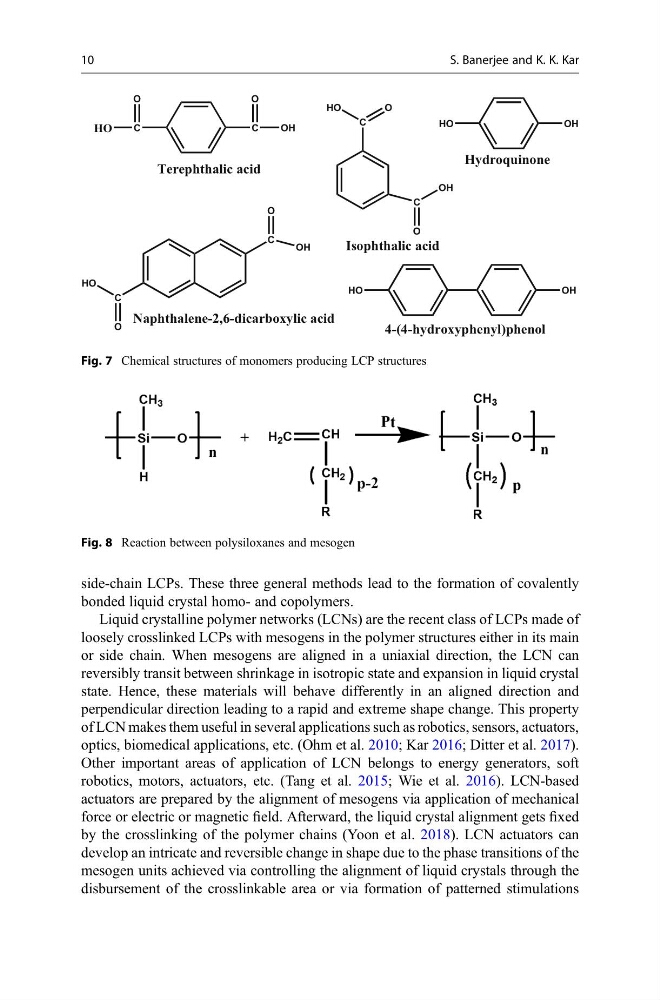
Fig. 7 Chemical structures of monomers producing LCP structures
Fig. 8 Reaction between polysiloxanes and mesogen
10
S. Banerjee and K. K. Kar
bonded liquid crystal homo- and copolymers.
Liquid crystalline polymer networks (LCNs) are the recent class of LCPs made of
loosely crosslinked LCPs with mesogens in the polymer structures either in its main
or side chain. When mesogens are aligned in a uniaxial direction, the LCN can
reversibly transit between shrinkage in isotropic state and expansion in liquid crystal
state. Hence, these materials will behave differently in an aligned direction and
perpendicular direction leading to a rapid and extreme shape change. This property
of LCN makes them useful in several applications such as robotics, sensors, actuators,
optics, biomedical applications, etc. (Ohm et al. 2010; Kar 2016; Ditter et al. 2017).
Other important areas of application of LCN belongs to energy generators, soft
robotics, motors, actuators, etc. (Tang et al. 2015; Wie et al. 2016). LCN-based
actuators are prepared by the alignment of mesogens via application of mechanical
force or electric or magnetic field. Afterward, the liquid crystal alignment gets fixed
by the crosslinking of the polymer chains (Yoon et al. 2018). LCN actuators can
develop an intricate and reversible change in shape due to the phase transitions of the
mesogen units achieved via controlling the alignment of liquid crystals through the
disbursement of the crosslinkable area or via formation of patterned stimulations
HO
C
O
C
O
OH
Terephthalic acid
C
O
OH
C
O
HO
Naphthalene-2,6-dicarboxylic acid
C
C
O
OH
O
HO
Isophthalic acid
HO
OH
HO
OH
Hydroquinone
4-(4-hydroxyphenyl)phenol
Fig. 7 Chemical structures of monomers producing LCP structures
Fig. 8 Reaction between polysiloxanes and mesogen
10
S. Banerjee and K. K. Kar