

Synthesis of Liquid Crystalline Polymers
There are some principles for the synthesis of side chain bearing comb-shaped LCPs
that can be broadly divided into three classes. Examples of the chemical structure of
few monomers used for the synthesis of LCPs are represented in Fig. 7.
First method remains the synthesis of monomers bearing mesogenic groups
followed by homo- or copolymerization with other mesogenic or non-mesogenic
units that finally leads to the synthesis of comb-shaped LCPs.
In the second method, LCPs can be synthesized chemically binding the mesogen
units to the already prepared polymer main chain leading to the creation of side-chain
LCPs. However, this method is less preferred compared to the first one, since this
method may generate compositional inhomogeneity in the final LCPs and, in addition to
that, other constraint remains a difficulty in obtaining the polymers with a complete
degree of substitution. Liquid crystal polysiloxanes are prepared mostly by this method,
where hydrosilylation reaction between polysiloxanes and mesogen-type monomers is
carried out as represented in Fig. 8.
where R is the mesogen. The ease of this kind of reaction leads to the formation of
LCPs with a certain degree of polymerization leading to the commercialization
of polysiloxanes. This type of synthesis methodology is also utilized for the synthesis
of liquid crystal-based elastomers and dendrimers based on the chemistry of carbosilane
derivatives.
In the third synthesis method, LCPs are synthesized by using condensation
polymerization. Polycondensation reactions can generate both main- and
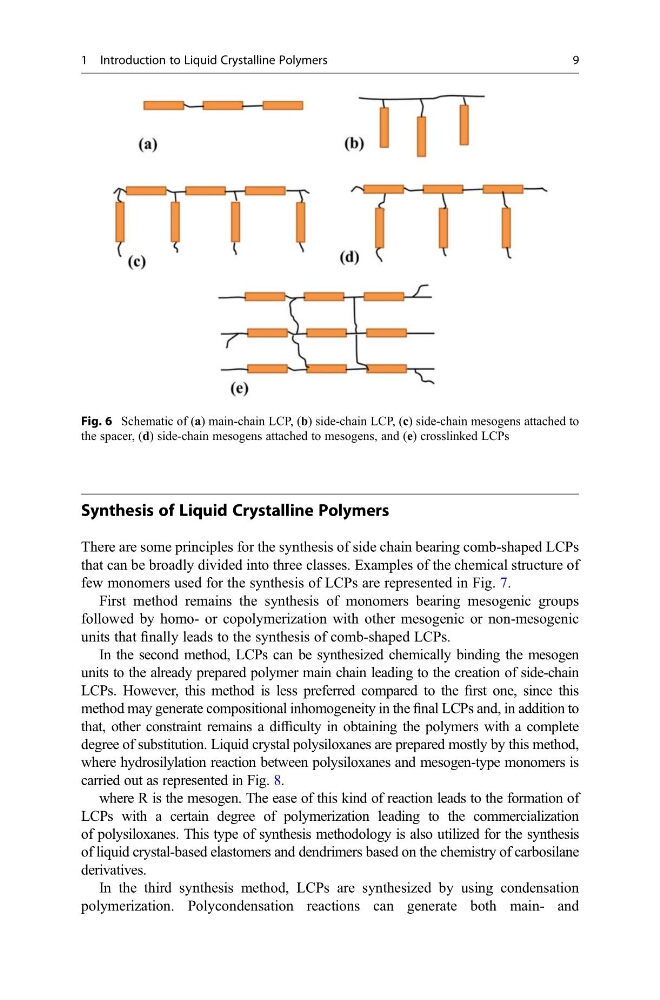
Fig. 6 Schematic of (a) main-chain LCP, (b) side-chain LCP, (c) side-chain mesogens attached to
the spacer, (d) side-chain mesogens attached to mesogens, and (e) crosslinked LCPs
1 Introduction to Liquid Crystalline Polymers
9
There are some principles for the synthesis of side chain bearing comb-shaped LCPs
that can be broadly divided into three classes. Examples of the chemical structure of
few monomers used for the synthesis of LCPs are represented in Fig. 7.
First method remains the synthesis of monomers bearing mesogenic groups
followed by homo- or copolymerization with other mesogenic or non-mesogenic
units that finally leads to the synthesis of comb-shaped LCPs.
In the second method, LCPs can be synthesized chemically binding the mesogen
units to the already prepared polymer main chain leading to the creation of side-chain
LCPs. However, this method is less preferred compared to the first one, since this
method may generate compositional inhomogeneity in the final LCPs and, in addition to
that, other constraint remains a difficulty in obtaining the polymers with a complete
degree of substitution. Liquid crystal polysiloxanes are prepared mostly by this method,
where hydrosilylation reaction between polysiloxanes and mesogen-type monomers is
carried out as represented in Fig. 8.
where R is the mesogen. The ease of this kind of reaction leads to the formation of
LCPs with a certain degree of polymerization leading to the commercialization
of polysiloxanes. This type of synthesis methodology is also utilized for the synthesis
of liquid crystal-based elastomers and dendrimers based on the chemistry of carbosilane
derivatives.
In the third synthesis method, LCPs are synthesized by using condensation
polymerization. Polycondensation reactions can generate both main- and
Fig. 6 Schematic of (a) main-chain LCP, (b) side-chain LCP, (c) side-chain mesogens attached to
the spacer, (d) side-chain mesogens attached to mesogens, and (e) crosslinked LCPs
1 Introduction to Liquid Crystalline Polymers
9