

(Saed et al. 2019). A common way to prepare well-organized LCN is via photoinitiated polymerization of liquid crystal monomers (Broer et al. 1989; Broer 1993).
The monomers used for the development of LCPs by photoinitiated polymerization
have a structure similar to conventional liquid crystals. They possess anisotropic
shape with a tough central core of rod or disk-like nature. In addition to generic
structural arrangement, the liquid crystal monomers possess groups that can be
polymerized. The polymerizable groups can be positioned either on the lateral side
or at far ends. The liquid crystal monomers may possess one, two, or more functional
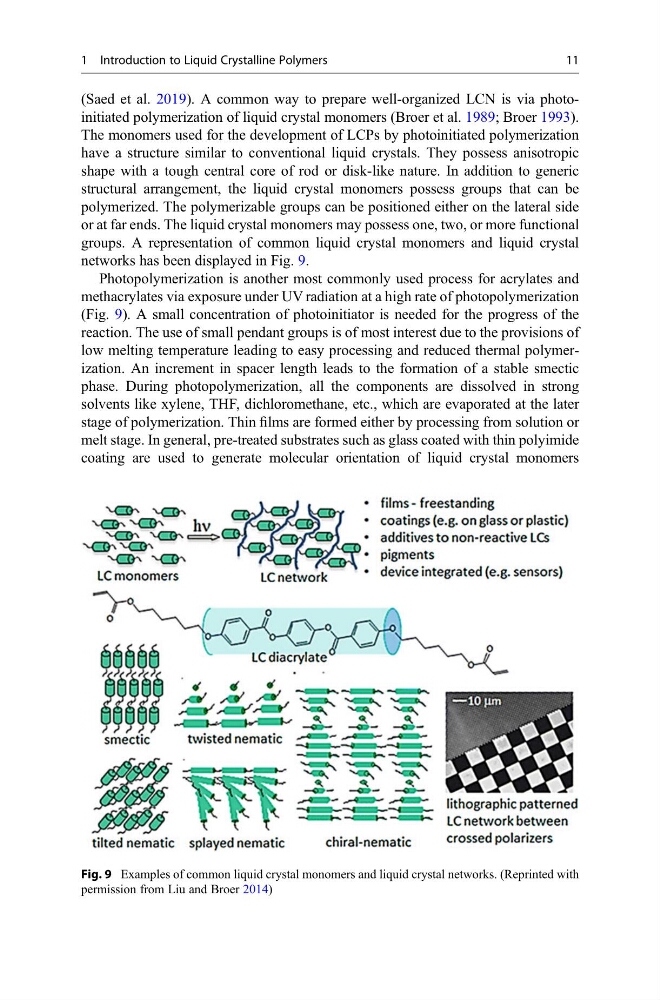
groups. A representation of common liquid crystal monomers and liquid crystal
networks has been displayed in Fig. 9.
Photopolymerization is another most commonly used process for acrylates and
methacrylates via exposure under UV radiation at a high rate of photopolymerization
(Fig. 9). A small concentration of photoinitiator is needed for the progress of the
reaction. The use of small pendant groups is of most interest due to the provisions of
low melting temperature leading to easy processing and reduced thermal polymerization. An increment in spacer length leads to the formation of a stable smectic
phase. During photopolymerization, all the components are dissolved in strong
solvents like xylene, THF, dichloromethane, etc., which are evaporated at the later
stage of polymerization. Thin films are formed either by processing from solution or
melt stage. In general, pre-treated substrates such as glass coated with thin polyimide
coating are used to generate molecular orientation of liquid crystal monomers
Fig. 9 Examples of common liquid crystal monomers and liquid crystal networks. (Reprinted with
permission from Liu and Broer 2014)
1 Introduction to Liquid Crystalline Polymers
11
The monomers used for the development of LCPs by photoinitiated polymerization
have a structure similar to conventional liquid crystals. They possess anisotropic
shape with a tough central core of rod or disk-like nature. In addition to generic
structural arrangement, the liquid crystal monomers possess groups that can be
polymerized. The polymerizable groups can be positioned either on the lateral side
or at far ends. The liquid crystal monomers may possess one, two, or more functional
groups. A representation of common liquid crystal monomers and liquid crystal
networks has been displayed in Fig. 9.
Photopolymerization is another most commonly used process for acrylates and
methacrylates via exposure under UV radiation at a high rate of photopolymerization
(Fig. 9). A small concentration of photoinitiator is needed for the progress of the
reaction. The use of small pendant groups is of most interest due to the provisions of
low melting temperature leading to easy processing and reduced thermal polymerization. An increment in spacer length leads to the formation of a stable smectic
phase. During photopolymerization, all the components are dissolved in strong
solvents like xylene, THF, dichloromethane, etc., which are evaporated at the later
stage of polymerization. Thin films are formed either by processing from solution or
melt stage. In general, pre-treated substrates such as glass coated with thin polyimide
coating are used to generate molecular orientation of liquid crystal monomers
Fig. 9 Examples of common liquid crystal monomers and liquid crystal networks. (Reprinted with
permission from Liu and Broer 2014)
1 Introduction to Liquid Crystalline Polymers
11