

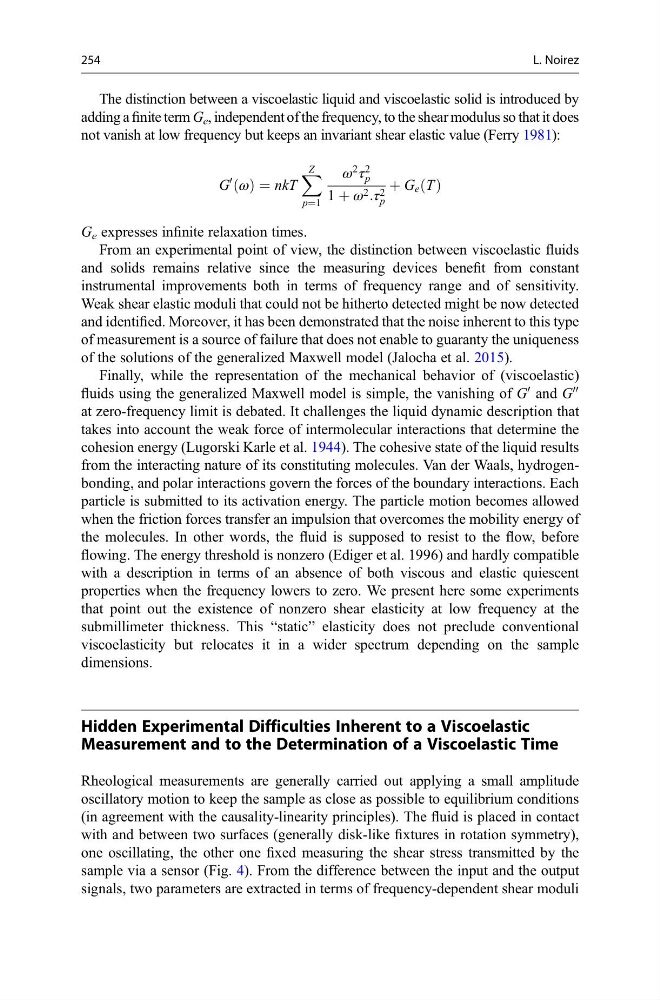
The distinction between a viscoelastic liquid and viscoelastic solid is introduced by
adding a finite term G e , independent of the frequency, to the shear modulus so that it does
not vanish at low frequency but keeps an invariant shear elastic value (Ferry 1981):
G
0
ω
ð Þ ¼ nkT
X Z
p¼1
ω
2
τ
2
p
1 þ ω 2 :τ 2
p
þ G e T
ð Þ
G e expresses infinite relaxation times.
From an experimental point of view, the distinction between viscoelastic fluids
and solids remains relative since the measuring devices benefit from constant
instrumental improvements both in terms of frequency range and of sensitivity.
Weak shear elastic moduli that could not be hitherto detected might be now detected
and identified. Moreover, it has been demonstrated that the noise inherent to this type
of measurement is a source of failure that does not enable to guaranty the uniqueness
of the solutions of the generalized Maxwell model (Jalocha et al. 2015).
Finally, while the representation of the mechanical behavior of (viscoelastic)
fluids using the generalized Maxwell model is simple, the vanishing of G
0 and G
00
at zero-frequency limit is debated. It challenges the liquid dynamic description that
takes into account the weak force of intermolecular interactions that determine the
cohesion energy (Lugorski Karle et al. 1944). The cohesive state of the liquid results
from the interacting nature of its constituting molecules. Van der Waals, hydrogenbonding, and polar interactions govern the forces of the boundary interactions. Each
particle is submitted to its activation energy. The particle motion becomes allowed
when the friction forces transfer an impulsion that overcomes the mobility energy of
the molecules. In other words, the fluid is supposed to resist to the flow, before
flowing. The energy threshold is nonzero (Ediger et al. 1996) and hardly compatible
with a description in terms of an absence of both viscous and elastic quiescent
properties when the frequency lowers to zero. We present here some experiments
that point out the existence of nonzero shear elasticity at low frequency at the
submillimeter thickness. This “static” elasticity does not preclude conventional
viscoelasticity but relocates it in a wider spectrum depending on the sample
dimensions.
Hidden Experimental Difficulties Inherent to a Viscoelastic
Measurement and to the Determination of a Viscoelastic Time
Rheological measurements are generally carried out applying a small amplitude
oscillatory motion to keep the sample as close as possible to equilibrium conditions
(in agreement with the causality-linearity principles). The fluid is placed in contact
with and between two surfaces (generally disk-like fixtures in rotation symmetry),
one oscillating, the other one fixed measuring the shear stress transmitted by the
sample via a sensor (Fig. 4). From the difference between the input and the output
signals, two parameters are extracted in terms of frequency-dependent shear moduli
254
L. Noirez
adding a finite term G e , independent of the frequency, to the shear modulus so that it does
not vanish at low frequency but keeps an invariant shear elastic value (Ferry 1981):
G
0
ω
ð Þ ¼ nkT
X Z
p¼1
ω
2
τ
2
p
1 þ ω 2 :τ 2
p
þ G e T
ð Þ
G e expresses infinite relaxation times.
From an experimental point of view, the distinction between viscoelastic fluids
and solids remains relative since the measuring devices benefit from constant
instrumental improvements both in terms of frequency range and of sensitivity.
Weak shear elastic moduli that could not be hitherto detected might be now detected
and identified. Moreover, it has been demonstrated that the noise inherent to this type
of measurement is a source of failure that does not enable to guaranty the uniqueness
of the solutions of the generalized Maxwell model (Jalocha et al. 2015).
Finally, while the representation of the mechanical behavior of (viscoelastic)
fluids using the generalized Maxwell model is simple, the vanishing of G
0 and G
00
at zero-frequency limit is debated. It challenges the liquid dynamic description that
takes into account the weak force of intermolecular interactions that determine the
cohesion energy (Lugorski Karle et al. 1944). The cohesive state of the liquid results
from the interacting nature of its constituting molecules. Van der Waals, hydrogenbonding, and polar interactions govern the forces of the boundary interactions. Each
particle is submitted to its activation energy. The particle motion becomes allowed
when the friction forces transfer an impulsion that overcomes the mobility energy of
the molecules. In other words, the fluid is supposed to resist to the flow, before
flowing. The energy threshold is nonzero (Ediger et al. 1996) and hardly compatible
with a description in terms of an absence of both viscous and elastic quiescent
properties when the frequency lowers to zero. We present here some experiments
that point out the existence of nonzero shear elasticity at low frequency at the
submillimeter thickness. This “static” elasticity does not preclude conventional
viscoelasticity but relocates it in a wider spectrum depending on the sample
dimensions.
Hidden Experimental Difficulties Inherent to a Viscoelastic
Measurement and to the Determination of a Viscoelastic Time
Rheological measurements are generally carried out applying a small amplitude
oscillatory motion to keep the sample as close as possible to equilibrium conditions
(in agreement with the causality-linearity principles). The fluid is placed in contact
with and between two surfaces (generally disk-like fixtures in rotation symmetry),
one oscillating, the other one fixed measuring the shear stress transmitted by the
sample via a sensor (Fig. 4). From the difference between the input and the output
signals, two parameters are extracted in terms of frequency-dependent shear moduli
254
L. Noirez