

developments based on collective dynamics. Examples of spectacular low-frequency
mechano-responsive effects due to the static elasticity are shortly presented including
both simple liquids and the fluidics of physiologic liquids.
Empirical Origins of the Viscoelastic Approach in Polymer
Dynamics and Limitations
Polymer science and technology have made considerable increasing proportions in the
twentieth century. Characterizing mechanical properties of polymers raised new
challenges since the question of viscous-like or solid-like property appears to be
relative to the patience of the observer. The foundations of a systematic study versus
time, i.e., versus frequency, were laid. The principle of a systematic time-dependent
measurement relating the strain to the stress was achieved by Weissenberg and
coworkers (Weissenberg 1948) designing the future rheometer. The commercialization
of instruments for rheology has accelerated the promotion of the technique that rapidly
became the method to expertise the dynamic properties of viscoelastic fluids. The
frequency dependence of experimental curves served as the basis for theoretical
approaches for polymer physics (Doi and Edwards 1978; Ferry 1961; de Gennes 1971)
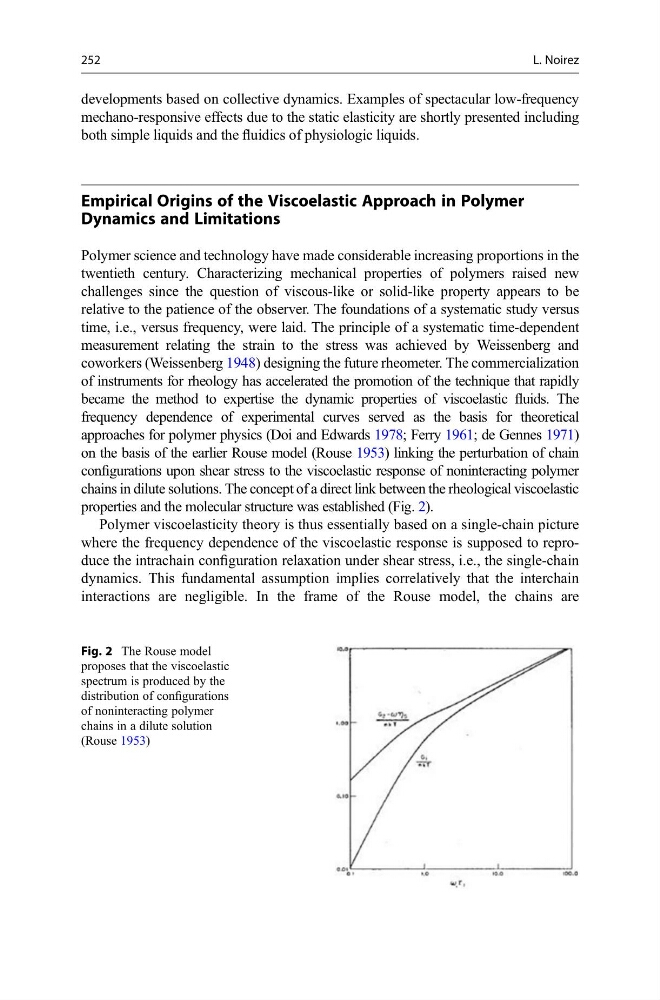
on the basis of the earlier Rouse model (Rouse 1953) linking the perturbation of chain
configurations upon shear stress to the viscoelastic response of noninteracting polymer
chains in dilute solutions. The concept of a direct link between the rheological viscoelastic
properties and the molecular structure was established (Fig. 2).
Polymer viscoelasticity theory is thus essentially based on a single-chain picture
where the frequency dependence of the viscoelastic response is supposed to reproduce the intrachain configuration relaxation under shear stress, i.e., the single-chain
dynamics. This fundamental assumption implies correlatively that the interchain
interactions are negligible. In the frame of the Rouse model, the chains are
Fig. 2 The Rouse model
proposes that the viscoelastic
spectrum is produced by the
distribution of configurations
of noninteracting polymer
chains in a dilute solution
(Rouse 1953)
252
L. Noirez
mechano-responsive effects due to the static elasticity are shortly presented including
both simple liquids and the fluidics of physiologic liquids.
Empirical Origins of the Viscoelastic Approach in Polymer
Dynamics and Limitations
Polymer science and technology have made considerable increasing proportions in the
twentieth century. Characterizing mechanical properties of polymers raised new
challenges since the question of viscous-like or solid-like property appears to be
relative to the patience of the observer. The foundations of a systematic study versus
time, i.e., versus frequency, were laid. The principle of a systematic time-dependent
measurement relating the strain to the stress was achieved by Weissenberg and
coworkers (Weissenberg 1948) designing the future rheometer. The commercialization
of instruments for rheology has accelerated the promotion of the technique that rapidly
became the method to expertise the dynamic properties of viscoelastic fluids. The
frequency dependence of experimental curves served as the basis for theoretical
approaches for polymer physics (Doi and Edwards 1978; Ferry 1961; de Gennes 1971)
on the basis of the earlier Rouse model (Rouse 1953) linking the perturbation of chain
configurations upon shear stress to the viscoelastic response of noninteracting polymer
chains in dilute solutions. The concept of a direct link between the rheological viscoelastic
properties and the molecular structure was established (Fig. 2).
Polymer viscoelasticity theory is thus essentially based on a single-chain picture
where the frequency dependence of the viscoelastic response is supposed to reproduce the intrachain configuration relaxation under shear stress, i.e., the single-chain
dynamics. This fundamental assumption implies correlatively that the interchain
interactions are negligible. In the frame of the Rouse model, the chains are
Fig. 2 The Rouse model
proposes that the viscoelastic
spectrum is produced by the
distribution of configurations
of noninteracting polymer
chains in a dilute solution
(Rouse 1953)
252
L. Noirez