

commercial equipment has quickly emerged as the discipline of characterization of
the fluidic state and of deformable materials at a macroscopic scale (Ferry 1981). Its
principle consists in the analysis of the response transmitted by the material subjected to a dynamic mechanical shear stress. The shear stress being transferred to the
sample by the simple contact to the substrate the technique is entirely dependent on
the energy of interaction between the material and the substrate. However, very few
studies have been aimed at analyzing the influence of the impact of the interaction
between the support (substrate) and the sample on the rheological behavior. Despite
the early works of Young-Dupré (Young 1805), it has long been regarded that the
interaction between a liquid and a surface has no effect on the measurement, as it
seems obvious that a liquid wets any surface and that the obtaining of reproducible
results validate these assumptions.
The emergence of new disciplines combining different techniques as microrheology
(Goyon et al. 2008), microtribology, dielectric relaxation (Pronin et al. 2011),
NMR (Tracht et al. 1998a, b), X-ray photon correlation spectroscopy (Chushkin
et al. 2008; Conrad et al. 2015), SANS measurement (Watanabe et al. 2007; Noirez
2009b; Korolkovas et al. 2019), and particle tracking velocimetry (Noirez et al. 2009b;
Mansard et al. 2014), but also critical reviews of flow of molten polymers
(Hatzikiriakos 2012), highlights dynamic heterogeneities and relaxation modes in
fluids much lower than the terminal defined by the viscoelastic model. The impossibility of describing the fluid as a continuum from macroscopic to the molecular level
invites to revisit the assumption of molecular relaxation times as a relevant parameter to
describe flow mechanisms. This entry reminds briefly the premises of the viscoelastic
approach in polymer dynamics and the assumptions and the difficulties inherent in an
empirical approach linked to a mechanical measurement and describes an alternative
strategy taking into account microtribology, adhesion, and wetting parameters to
improve the quality of the rheology measurement. These developments point out that
fluids contain “static” (low-frequency) shear elasticity away from phase transition
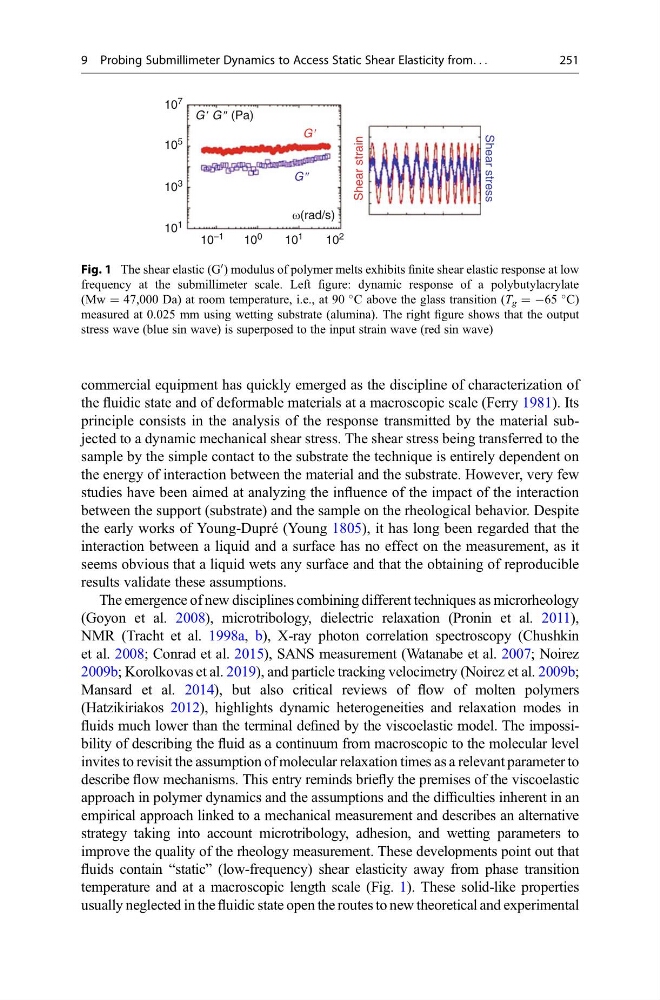
temperature and at a macroscopic length scale (Fig. 1). These solid-like properties
usually neglected in the fluidic state open the routes to new theoretical and experimental
10
7
10
5
10 3
10 1
10
–1
10
0
10
1
ω(rad/s)
G ¢ G ¢¢ (Pa)
G ¢
10 2
Shear strain
Shear stress
G ¢¢
Fig. 1 The shear elastic (G
0 ) modulus of polymer melts exhibits finite shear elastic response at low
frequency at the submillimeter scale. Left figure: dynamic response of a polybutylacrylate
(Mw = 47,000 Da) at room temperature, i.e., at 90
C above the glass transition (T g = À65
C)
measured at 0.025 mm using wetting substrate (alumina). The right figure shows that the output
stress wave (blue sin wave) is superposed to the input strain wave (red sin wave)
9 Probing Submillimeter Dynamics to Access Static Shear Elasticity from. . .
251
the fluidic state and of deformable materials at a macroscopic scale (Ferry 1981). Its
principle consists in the analysis of the response transmitted by the material subjected to a dynamic mechanical shear stress. The shear stress being transferred to the
sample by the simple contact to the substrate the technique is entirely dependent on
the energy of interaction between the material and the substrate. However, very few
studies have been aimed at analyzing the influence of the impact of the interaction
between the support (substrate) and the sample on the rheological behavior. Despite
the early works of Young-Dupré (Young 1805), it has long been regarded that the
interaction between a liquid and a surface has no effect on the measurement, as it
seems obvious that a liquid wets any surface and that the obtaining of reproducible
results validate these assumptions.
The emergence of new disciplines combining different techniques as microrheology
(Goyon et al. 2008), microtribology, dielectric relaxation (Pronin et al. 2011),
NMR (Tracht et al. 1998a, b), X-ray photon correlation spectroscopy (Chushkin
et al. 2008; Conrad et al. 2015), SANS measurement (Watanabe et al. 2007; Noirez
2009b; Korolkovas et al. 2019), and particle tracking velocimetry (Noirez et al. 2009b;
Mansard et al. 2014), but also critical reviews of flow of molten polymers
(Hatzikiriakos 2012), highlights dynamic heterogeneities and relaxation modes in
fluids much lower than the terminal defined by the viscoelastic model. The impossibility of describing the fluid as a continuum from macroscopic to the molecular level
invites to revisit the assumption of molecular relaxation times as a relevant parameter to
describe flow mechanisms. This entry reminds briefly the premises of the viscoelastic
approach in polymer dynamics and the assumptions and the difficulties inherent in an
empirical approach linked to a mechanical measurement and describes an alternative
strategy taking into account microtribology, adhesion, and wetting parameters to
improve the quality of the rheology measurement. These developments point out that
fluids contain “static” (low-frequency) shear elasticity away from phase transition
temperature and at a macroscopic length scale (Fig. 1). These solid-like properties
usually neglected in the fluidic state open the routes to new theoretical and experimental
10
7
10
5
10 3
10 1
10
–1
10
0
10
1
ω(rad/s)
G ¢ G ¢¢ (Pa)
G ¢
10 2
Shear strain
Shear stress
G ¢¢
Fig. 1 The shear elastic (G
0 ) modulus of polymer melts exhibits finite shear elastic response at low
frequency at the submillimeter scale. Left figure: dynamic response of a polybutylacrylate
(Mw = 47,000 Da) at room temperature, i.e., at 90
C above the glass transition (T g = À65
C)
measured at 0.025 mm using wetting substrate (alumina). The right figure shows that the output
stress wave (blue sin wave) is superposed to the input strain wave (red sin wave)
9 Probing Submillimeter Dynamics to Access Static Shear Elasticity from. . .
251