

feature is largely preserved, suggesting that the C 12 alkyl chain-induced crystallization does not destroy the columnar packing. Figure 20b shows the 2D XRD pattern
of the shear-oriented sample 16 (the shear temperature is a few to 20
C below the
isotropization temperature). Clearly, the (100), (110), and (300) reflections are
observed on the equator at low angles, indicating that the hexagonally packed
columns were oriented along the shear direction. In the high-angle region, the Tp
π-π stacking reflection (0.365 nm) is observed on the meridian, suggesting that the
Tp disks oriented perpendicular to the columns.
The supramolecular self-assembly of the POSS(Tp) 8 17 is studied by
temperature-dependent 1D XRD, as shown in Fig. 20c. The isotropic melt at
120
C again shows two amorphous halos at 1.383 (4.54 nm) and 13.50 nm
À1
(0.465 nm), respectively. The low-angle halo represents the average distance among
randomly packed supermolecules. When the temperature decreases to 50
C, sharp
reflection peaks are observed at low angles, and a weak Tp π-π stacking reflection is
observed at 17.4 nm
À1 (0.36 nm). To solve the liquid crystalline structure, 2D XRD
experiments are performed on the shear-oriented sample (Fig. 20d). All low-angle
reflections are observed on the equator, and thus they can be fitted using a 2D
rectangular structure: a = 5.10 nm and b = 4.35 nm. The Tp π-π stacking reflection
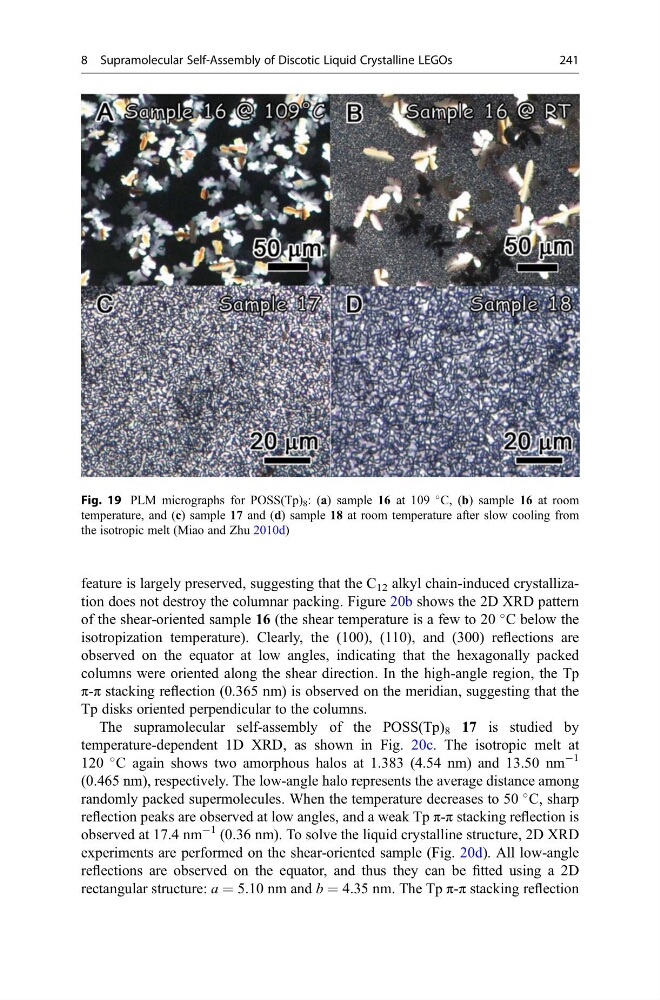
Fig. 19 PLM micrographs for POSS(Tp) 8 : (a) sample 16 at 109
C, (b) sample 16 at room
temperature, and (c) sample 17 and (d) sample 18 at room temperature after slow cooling from
the isotropic melt (Miao and Zhu 2010d)
8 Supramolecular Self-Assembly of Discotic Liquid Crystalline LEGOs
241
of the shear-oriented sample 16 (the shear temperature is a few to 20
C below the
isotropization temperature). Clearly, the (100), (110), and (300) reflections are
observed on the equator at low angles, indicating that the hexagonally packed
columns were oriented along the shear direction. In the high-angle region, the Tp
π-π stacking reflection (0.365 nm) is observed on the meridian, suggesting that the
Tp disks oriented perpendicular to the columns.
The supramolecular self-assembly of the POSS(Tp) 8 17 is studied by
temperature-dependent 1D XRD, as shown in Fig. 20c. The isotropic melt at
120
C again shows two amorphous halos at 1.383 (4.54 nm) and 13.50 nm
À1
(0.465 nm), respectively. The low-angle halo represents the average distance among
randomly packed supermolecules. When the temperature decreases to 50
C, sharp
reflection peaks are observed at low angles, and a weak Tp π-π stacking reflection is
observed at 17.4 nm
À1 (0.36 nm). To solve the liquid crystalline structure, 2D XRD
experiments are performed on the shear-oriented sample (Fig. 20d). All low-angle
reflections are observed on the equator, and thus they can be fitted using a 2D
rectangular structure: a = 5.10 nm and b = 4.35 nm. The Tp π-π stacking reflection
Fig. 19 PLM micrographs for POSS(Tp) 8 : (a) sample 16 at 109
C, (b) sample 16 at room
temperature, and (c) sample 17 and (d) sample 18 at room temperature after slow cooling from
the isotropic melt (Miao and Zhu 2010d)
8 Supramolecular Self-Assembly of Discotic Liquid Crystalline LEGOs
241