

The PLM image for sample 16 in Fig. 19a shows a leaflike texture at 109
C,
which is a typical texture for hexagonal columnar phases. After cooling to room
temperature, a mixture of the leaflike texture and small crystalline grains was
observed in Fig. 19b. For samples 17 and 18, focal conic-like textures were observed
(Fig. 19c and d). For both samples 17 and 18, the high-temperature liquid crystalline
textures differed very little from those after cooling to the solid state at low
temperatures.
Supramolecular self-assembly of starburst supermolecules 16–18 is studied by
XRD. Figure 20a shows 1D XRD profiles for sample 16 during cooling from the
isotropic melt. At 150
C, two amorphous halos are observed in both the low- and
high-angle regions. At low angles, the peak of the halo is located at q = 1.56 nm
À1 ,
corresponding to a d-spacing of 4.03 nm. This is close to the size of the entire
supermolecule (~5 nm). Therefore, it can be attributed to the average distance among
randomly packed neighboring supermolecules. The high-angle amorphous halo at
13.47 nm
À1 (0.466 nm) is attributed to the average distance among amorphous alkyl
chains. At 100
C, sharp reflection peaks are observed in the low-angle region with a
q-relationship being 1:√3:√4:√7:√9. Thus, a hexagonal columnar structure can be
determined for sample 16. Judging from the first-order peak at 1.476 nm
À1 , the
distance between neighboring columns is 4.92 nm. Because this distance again is
similar to the whole molecule size of ~5 nm, we consider that the entire supermolecules stack together to form a liquid crystalline column. In the high-angle
region, a broad reflection peak is observed at 17.2 nm
À1 , which corresponded to a
d-spacing of 0.365 nm. This is a typical π-π stacking distance for ordered Tp
columnar liquid crystals. With gradually decreasing the temperature to À50
C,
the whole supermolecule crystallizes as induced by the C 12 alkyl chain crystallization. This crystallization results in broader reflections and disappearance of some
high q reflections in the low-angle region. However, the general hexagonal columnar
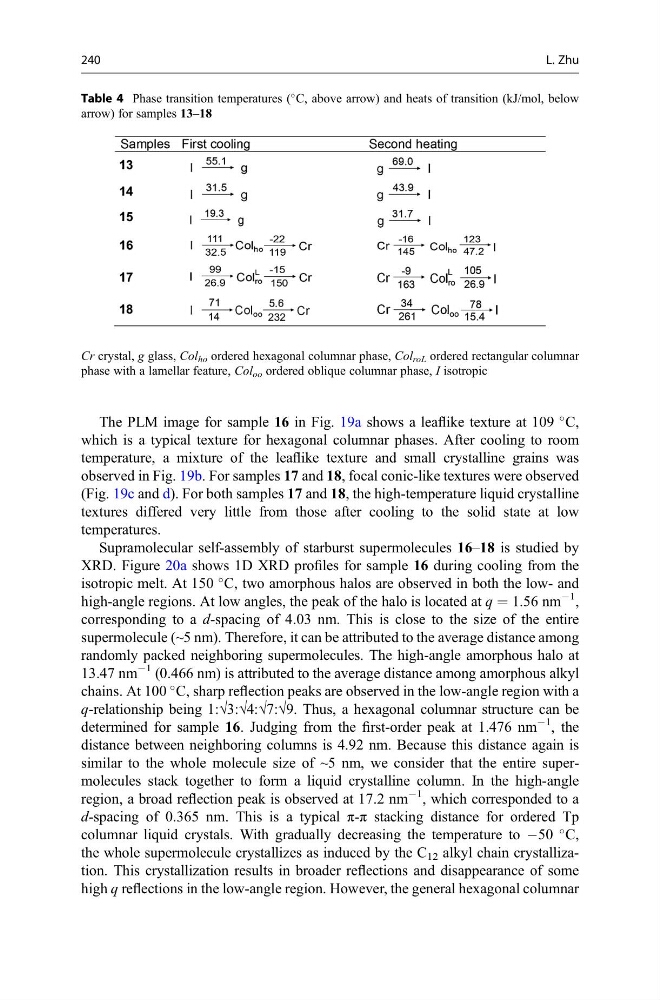
Table 4 Phase transition temperatures (
C, above arrow) and heats of transition (kJ/mol, below
arrow) for samples 13–18
Cr crystal, g glass, Col ho ordered hexagonal columnar phase, Col roL ordered rectangular columnar
phase with a lamellar feature, Col oo ordered oblique columnar phase, I isotropic
240
L. Zhu
C,
which is a typical texture for hexagonal columnar phases. After cooling to room
temperature, a mixture of the leaflike texture and small crystalline grains was
observed in Fig. 19b. For samples 17 and 18, focal conic-like textures were observed
(Fig. 19c and d). For both samples 17 and 18, the high-temperature liquid crystalline
textures differed very little from those after cooling to the solid state at low
temperatures.
Supramolecular self-assembly of starburst supermolecules 16–18 is studied by
XRD. Figure 20a shows 1D XRD profiles for sample 16 during cooling from the
isotropic melt. At 150
C, two amorphous halos are observed in both the low- and
high-angle regions. At low angles, the peak of the halo is located at q = 1.56 nm
À1 ,
corresponding to a d-spacing of 4.03 nm. This is close to the size of the entire
supermolecule (~5 nm). Therefore, it can be attributed to the average distance among
randomly packed neighboring supermolecules. The high-angle amorphous halo at
13.47 nm
À1 (0.466 nm) is attributed to the average distance among amorphous alkyl
chains. At 100
C, sharp reflection peaks are observed in the low-angle region with a
q-relationship being 1:√3:√4:√7:√9. Thus, a hexagonal columnar structure can be
determined for sample 16. Judging from the first-order peak at 1.476 nm
À1 , the
distance between neighboring columns is 4.92 nm. Because this distance again is
similar to the whole molecule size of ~5 nm, we consider that the entire supermolecules stack together to form a liquid crystalline column. In the high-angle
region, a broad reflection peak is observed at 17.2 nm
À1 , which corresponded to a
d-spacing of 0.365 nm. This is a typical π-π stacking distance for ordered Tp
columnar liquid crystals. With gradually decreasing the temperature to À50
C,
the whole supermolecule crystallizes as induced by the C 12 alkyl chain crystallization. This crystallization results in broader reflections and disappearance of some
high q reflections in the low-angle region. However, the general hexagonal columnar
Table 4 Phase transition temperatures (
C, above arrow) and heats of transition (kJ/mol, below
arrow) for samples 13–18
Cr crystal, g glass, Col ho ordered hexagonal columnar phase, Col roL ordered rectangular columnar
phase with a lamellar feature, Col oo ordered oblique columnar phase, I isotropic
240
L. Zhu