

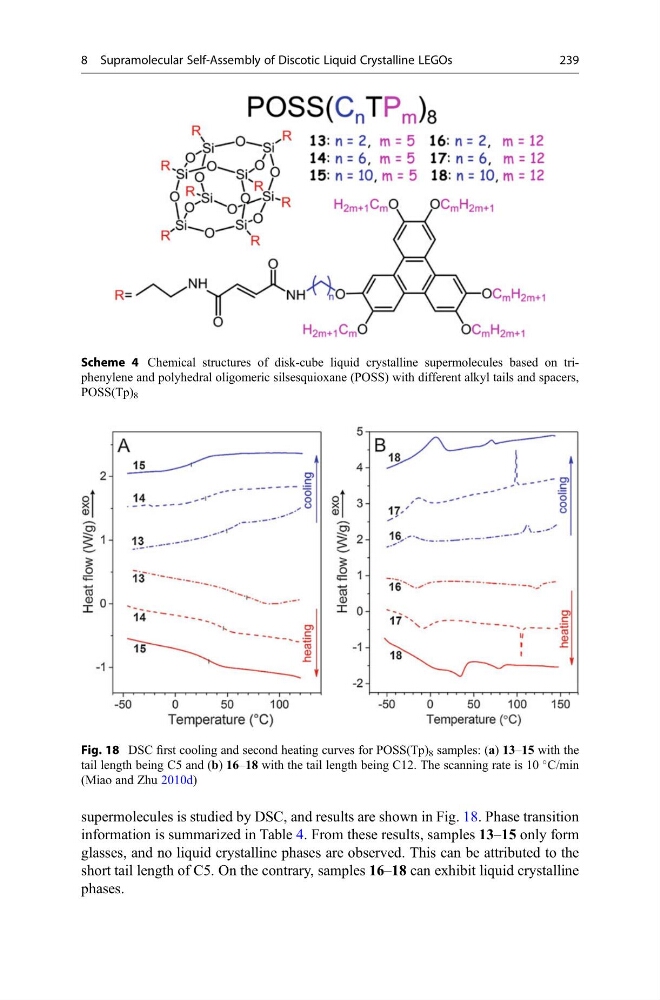
supermolecules is studied by DSC, and results are shown in Fig. 18. Phase transition
information is summarized in Table 4. From these results, samples 13–15 only form
glasses, and no liquid crystalline phases are observed. This can be attributed to the
short tail length of C5. On the contrary, samples 16–18 can exhibit liquid crystalline
phases.
Scheme 4 Chemical structures of disk-cube liquid crystalline supermolecules based on triphenylene and polyhedral oligomeric silsesquioxane (POSS) with different alkyl tails and spacers,
POSS(Tp) 8
Fig. 18 DSC first cooling and second heating curves for POSS(Tp) 8 samples: (a) 13–15 with the
tail length being C5 and (b) 16–18 with the tail length being C12. The scanning rate is 10
C/min
(Miao and Zhu 2010d)
8 Supramolecular Self-Assembly of Discotic Liquid Crystalline LEGOs
239
information is summarized in Table 4. From these results, samples 13–15 only form
glasses, and no liquid crystalline phases are observed. This can be attributed to the
short tail length of C5. On the contrary, samples 16–18 can exhibit liquid crystalline
phases.
Scheme 4 Chemical structures of disk-cube liquid crystalline supermolecules based on triphenylene and polyhedral oligomeric silsesquioxane (POSS) with different alkyl tails and spacers,
POSS(Tp) 8
Fig. 18 DSC first cooling and second heating curves for POSS(Tp) 8 samples: (a) 13–15 with the
tail length being C5 and (b) 16–18 with the tail length being C12. The scanning rate is 10
C/min
(Miao and Zhu 2010d)
8 Supramolecular Self-Assembly of Discotic Liquid Crystalline LEGOs
239