

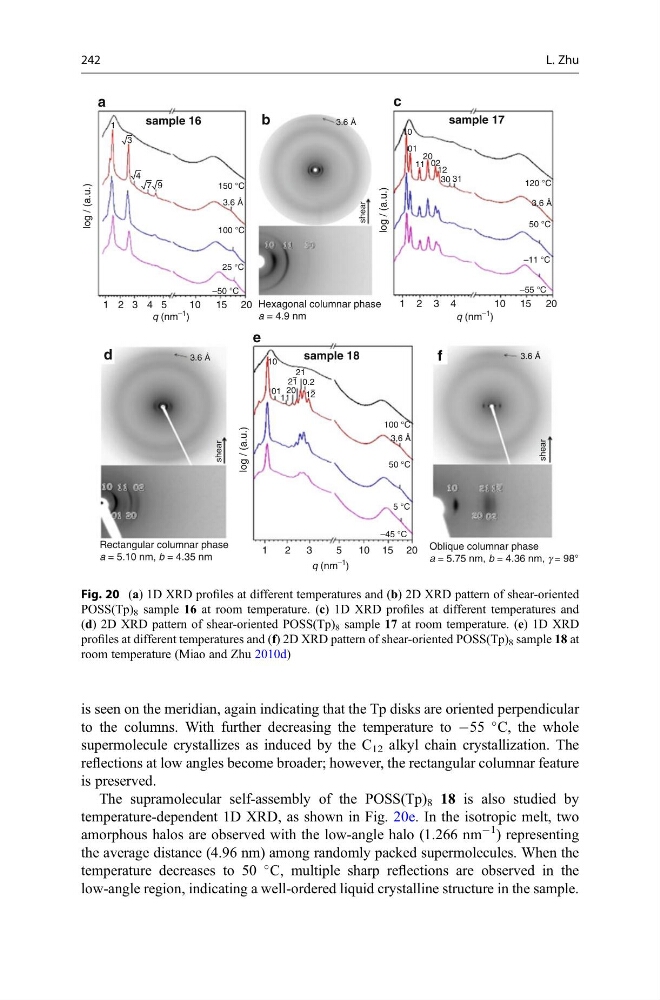
is seen on the meridian, again indicating that the Tp disks are oriented perpendicular
to the columns. With further decreasing the temperature to À55
C, the whole
supermolecule crystallizes as induced by the C 12 alkyl chain crystallization. The
reflections at low angles become broader; however, the rectangular columnar feature
is preserved.
The supramolecular self-assembly of the POSS(Tp) 8 18 is also studied by
temperature-dependent 1D XRD, as shown in Fig. 20e. In the isotropic melt, two
amorphous halos are observed with the low-angle halo (1.266 nm
À1 ) representing
the average distance (4.96 nm) among randomly packed supermolecules. When the
temperature decreases to 50
C, multiple sharp reflections are observed in the
low-angle region, indicating a well-ordered liquid crystalline structure in the sample.
sample 16
sample 17
sample 18
log / (a.u.)
log / (a.u.)
log / (a.u.)
1
3
4
7 9
150 °C
100 °C
25 °C
–50 °C
20 Hexagonal columnar phase
a = 4.9 nm
Rectangular columnar phase
a = 5.10 nm, b = 4.35 nm
Oblique columnar phase
a = 5.75 nm, b = 4.36 nm, g = 98°
3.6 Å
3.6 Å
3.6 Å
shear
shear
shear
15
10
q (nm
–1 )
5
4
3
2
1
20
15
10
q (nm
–1
)
q (nm
–1 )
4
10
21
10
01
11
20
02
12
30 31
0.2
12
21
20
11
01
3
2
1
2
3
5
10 15 20
1
3.6 Å
120 °C
50 °C
–11 °C
–55 °C
3,6 Å
100 °C
50 °C
5 °C
–45 °C
3,6 Å
a
b
c
e
d
f
Fig. 20 (a) 1D XRD profiles at different temperatures and (b) 2D XRD pattern of shear-oriented
POSS(Tp) 8 sample 16 at room temperature. (c) 1D XRD profiles at different temperatures and
(d) 2D XRD pattern of shear-oriented POSS(Tp) 8 sample 17 at room temperature. (e) 1D XRD
profiles at different temperatures and (f) 2D XRD pattern of shear-oriented POSS(Tp) 8 sample 18 at
room temperature (Miao and Zhu 2010d)
242
L. Zhu
to the columns. With further decreasing the temperature to À55
C, the whole
supermolecule crystallizes as induced by the C 12 alkyl chain crystallization. The
reflections at low angles become broader; however, the rectangular columnar feature
is preserved.
The supramolecular self-assembly of the POSS(Tp) 8 18 is also studied by
temperature-dependent 1D XRD, as shown in Fig. 20e. In the isotropic melt, two
amorphous halos are observed with the low-angle halo (1.266 nm
À1 ) representing
the average distance (4.96 nm) among randomly packed supermolecules. When the
temperature decreases to 50
C, multiple sharp reflections are observed in the
low-angle region, indicating a well-ordered liquid crystalline structure in the sample.
sample 16
sample 17
sample 18
log / (a.u.)
log / (a.u.)
log / (a.u.)
1
3
4
7 9
150 °C
100 °C
25 °C
–50 °C
20 Hexagonal columnar phase
a = 4.9 nm
Rectangular columnar phase
a = 5.10 nm, b = 4.35 nm
Oblique columnar phase
a = 5.75 nm, b = 4.36 nm, g = 98°
3.6 Å
3.6 Å
3.6 Å
shear
shear
shear
15
10
q (nm
–1 )
5
4
3
2
1
20
15
10
q (nm
–1
)
q (nm
–1 )
4
10
21
10
01
11
20
02
12
30 31
0.2
12
21
20
11
01
3
2
1
2
3
5
10 15 20
1
3.6 Å
120 °C
50 °C
–11 °C
–55 °C
3,6 Å
100 °C
50 °C
5 °C
–45 °C
3,6 Å
a
b
c
e
d
f
Fig. 20 (a) 1D XRD profiles at different temperatures and (b) 2D XRD pattern of shear-oriented
POSS(Tp) 8 sample 16 at room temperature. (c) 1D XRD profiles at different temperatures and
(d) 2D XRD pattern of shear-oriented POSS(Tp) 8 sample 17 at room temperature. (e) 1D XRD
profiles at different temperatures and (f) 2D XRD pattern of shear-oriented POSS(Tp) 8 sample 18 at
room temperature (Miao and Zhu 2010d)
242
L. Zhu