

Considering that the molecular weight of sample 5 was 2,247 g/mol and the
measured density was 1.120 g/cm
3 , each unit cell should have eight Py(Tp) 2
supermolecules to match the theoretical density of 1.156 g/cm
3 . To determine the
exact molecular packing inside this orthorhombic unit cell, one needed to perform
single crystal XRD studies. Unfortunately, large enough single crystals could not be
obtained, possibly due to too many alkyl chains in the sample. Therefore, we
propose a reasonable packing model within the unit cell based on the molecular
sizes: Py, 1.99 nm; C5Tp, 1.7 nm; and C12Tp, 2.5 nm. When we consider eight
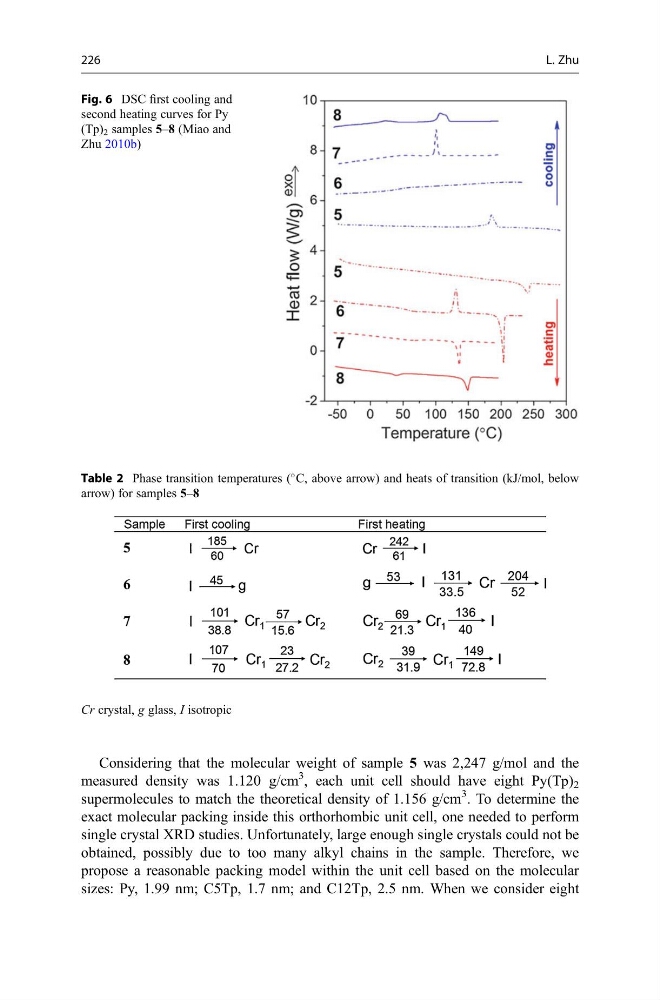
Fig. 6 DSC first cooling and
second heating curves for Py
(Tp) 2 samples 5–8 (Miao and
Zhu 2010b)
Table 2 Phase transition temperatures (
C, above arrow) and heats of transition (kJ/mol, below
arrow) for samples 5–8
Cr crystal, g glass, I isotropic
226
L. Zhu
measured density was 1.120 g/cm
3 , each unit cell should have eight Py(Tp) 2
supermolecules to match the theoretical density of 1.156 g/cm
3 . To determine the
exact molecular packing inside this orthorhombic unit cell, one needed to perform
single crystal XRD studies. Unfortunately, large enough single crystals could not be
obtained, possibly due to too many alkyl chains in the sample. Therefore, we
propose a reasonable packing model within the unit cell based on the molecular
sizes: Py, 1.99 nm; C5Tp, 1.7 nm; and C12Tp, 2.5 nm. When we consider eight
Fig. 6 DSC first cooling and
second heating curves for Py
(Tp) 2 samples 5–8 (Miao and
Zhu 2010b)
Table 2 Phase transition temperatures (
C, above arrow) and heats of transition (kJ/mol, below
arrow) for samples 5–8
Cr crystal, g glass, I isotropic
226
L. Zhu