

supermolecules in a unit cell, the a-axis should accommodate two Py(Tp) 2 supermolecules. However, the a-axis (7.16 nm) was smaller than twice the total planar
length of the supermolecule (2 Â 5.4 = 10.8 nm). Therefore, the Py(Tp) 2 supermolecules should tilt at an angle with respect to the a-axis (see Fig. 9a). Because the
spacer length (C6) was longer than the C5 alkyl chain length in the Tp arms, Py and
Tp disks were decoupled. Two consequences resulted: (1) the tilt angles for Py and
Tp might be different, and (2) neighboring Py and Tp disks along the c-axis might
have different tilt angles, and four molecules formed a regular motif (see Fig. 9a). In
this model, the hydrogen bonds were along the c-axis, which was parallel to the shear
direction.
This molecular packing scheme also applies for samples 6 and 8 because their
unit cell dimensions are similar to that for sample 5. Experimental densities for
samples 6 and 8 were 1.025 and 0.937 g/cm
3 , again suggesting eight supermolecules
per unit cell. Therefore, theoretical densities for samples 6 and 8 are 1.041 and
0.963 g/cm
3 , respectively.
For sample 7, the observed a- and c-axes were only 5.02 and 0.511 nm, respectively, much smaller than those (a = 9.3 nm and c = 2.35 nm) for sample 8.
Considering that the spacer length C6 in sample 7 is shorter than the alkyl chain
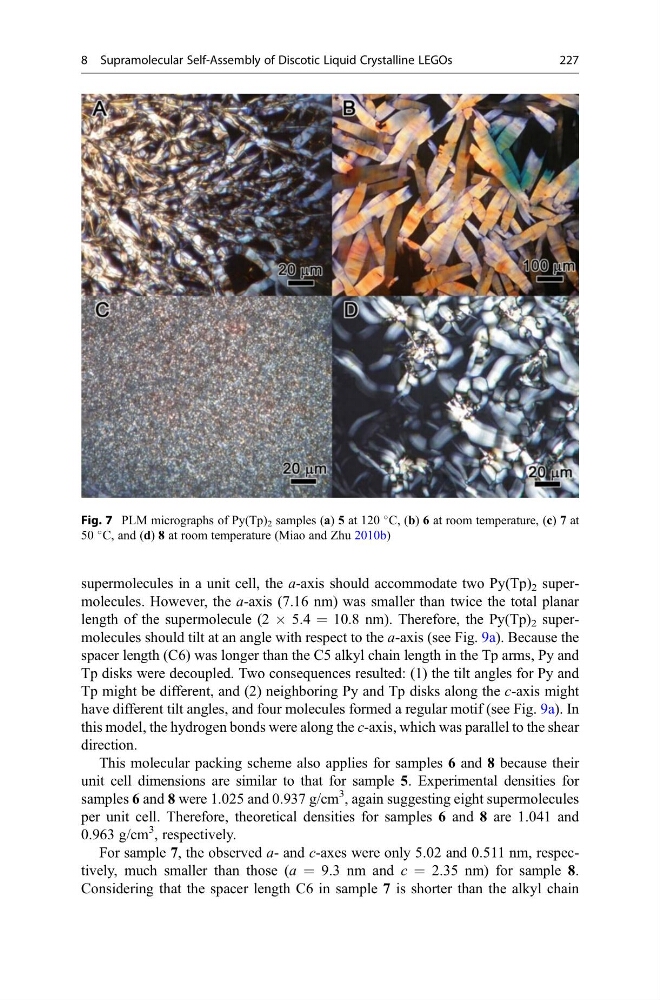
Fig. 7 PLM micrographs of Py(Tp) 2 samples (a) 5 at 120
C, (b) 6 at room temperature, (c) 7 at
50
C, and (d) 8 at room temperature (Miao and Zhu 2010b)
8 Supramolecular Self-Assembly of Discotic Liquid Crystalline LEGOs
227
length of the supermolecule (2 Â 5.4 = 10.8 nm). Therefore, the Py(Tp) 2 supermolecules should tilt at an angle with respect to the a-axis (see Fig. 9a). Because the
spacer length (C6) was longer than the C5 alkyl chain length in the Tp arms, Py and
Tp disks were decoupled. Two consequences resulted: (1) the tilt angles for Py and
Tp might be different, and (2) neighboring Py and Tp disks along the c-axis might
have different tilt angles, and four molecules formed a regular motif (see Fig. 9a). In
this model, the hydrogen bonds were along the c-axis, which was parallel to the shear
direction.
This molecular packing scheme also applies for samples 6 and 8 because their
unit cell dimensions are similar to that for sample 5. Experimental densities for
samples 6 and 8 were 1.025 and 0.937 g/cm
3 , again suggesting eight supermolecules
per unit cell. Therefore, theoretical densities for samples 6 and 8 are 1.041 and
0.963 g/cm
3 , respectively.
For sample 7, the observed a- and c-axes were only 5.02 and 0.511 nm, respectively, much smaller than those (a = 9.3 nm and c = 2.35 nm) for sample 8.
Considering that the spacer length C6 in sample 7 is shorter than the alkyl chain
Fig. 7 PLM micrographs of Py(Tp) 2 samples (a) 5 at 120
C, (b) 6 at room temperature, (c) 7 at
50
C, and (d) 8 at room temperature (Miao and Zhu 2010b)
8 Supramolecular Self-Assembly of Discotic Liquid Crystalline LEGOs
227