

than the alkyl tails in Tp, Tp and Pc columns will randomly pack into mixed
columnar structures. When the alkyl spacer is shorter than the alkyl tails in Tp, the
entire molecule will behave like a giant disk and self-assemble into an ordered
columnar phase.
As we introduced in the Introduction, hydrogen bonding is important in supramolecular self-assembly. The above Pc(Tp) 4 samples do not contain hydrogen
bonding; therefore, Tp and Pc columns are randomly packed in the columnar
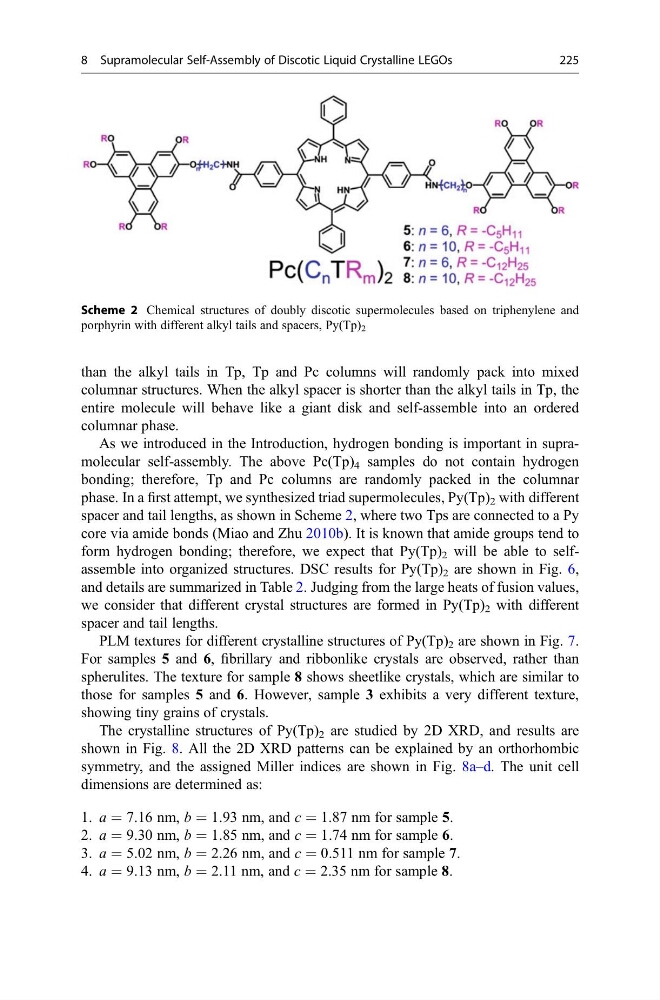
phase. In a first attempt, we synthesized triad supermolecules, Py(Tp) 2 with different
spacer and tail lengths, as shown in Scheme 2, where two Tps are connected to a Py
core via amide bonds (Miao and Zhu 2010b). It is known that amide groups tend to
form hydrogen bonding; therefore, we expect that Py(Tp) 2 will be able to selfassemble into organized structures. DSC results for Py(Tp) 2 are shown in Fig. 6,
and details are summarized in Table 2. Judging from the large heats of fusion values,
we consider that different crystal structures are formed in Py(Tp) 2 with different
spacer and tail lengths.
PLM textures for different crystalline structures of Py(Tp) 2 are shown in Fig. 7.
For samples 5 and 6, fibrillary and ribbonlike crystals are observed, rather than
spherulites. The texture for sample 8 shows sheetlike crystals, which are similar to
those for samples 5 and 6. However, sample 3 exhibits a very different texture,
showing tiny grains of crystals.
The crystalline structures of Py(Tp) 2 are studied by 2D XRD, and results are
shown in Fig. 8. All the 2D XRD patterns can be explained by an orthorhombic
symmetry, and the assigned Miller indices are shown in Fig. 8a–d. The unit cell
dimensions are determined as:
1. a = 7.16 nm, b = 1.93 nm, and c = 1.87 nm for sample 5.
2. a = 9.30 nm, b = 1.85 nm, and c = 1.74 nm for sample 6.
3. a = 5.02 nm, b = 2.26 nm, and c = 0.511 nm for sample 7.
4. a = 9.13 nm, b = 2.11 nm, and c = 2.35 nm for sample 8.
Scheme 2 Chemical structures of doubly discotic supermolecules based on triphenylene and
porphyrin with different alkyl tails and spacers, Py(Tp) 2
8 Supramolecular Self-Assembly of Discotic Liquid Crystalline LEGOs
225
columnar structures. When the alkyl spacer is shorter than the alkyl tails in Tp, the
entire molecule will behave like a giant disk and self-assemble into an ordered
columnar phase.
As we introduced in the Introduction, hydrogen bonding is important in supramolecular self-assembly. The above Pc(Tp) 4 samples do not contain hydrogen
bonding; therefore, Tp and Pc columns are randomly packed in the columnar
phase. In a first attempt, we synthesized triad supermolecules, Py(Tp) 2 with different
spacer and tail lengths, as shown in Scheme 2, where two Tps are connected to a Py
core via amide bonds (Miao and Zhu 2010b). It is known that amide groups tend to
form hydrogen bonding; therefore, we expect that Py(Tp) 2 will be able to selfassemble into organized structures. DSC results for Py(Tp) 2 are shown in Fig. 6,
and details are summarized in Table 2. Judging from the large heats of fusion values,
we consider that different crystal structures are formed in Py(Tp) 2 with different
spacer and tail lengths.
PLM textures for different crystalline structures of Py(Tp) 2 are shown in Fig. 7.
For samples 5 and 6, fibrillary and ribbonlike crystals are observed, rather than
spherulites. The texture for sample 8 shows sheetlike crystals, which are similar to
those for samples 5 and 6. However, sample 3 exhibits a very different texture,
showing tiny grains of crystals.
The crystalline structures of Py(Tp) 2 are studied by 2D XRD, and results are
shown in Fig. 8. All the 2D XRD patterns can be explained by an orthorhombic
symmetry, and the assigned Miller indices are shown in Fig. 8a–d. The unit cell
dimensions are determined as:
1. a = 7.16 nm, b = 1.93 nm, and c = 1.87 nm for sample 5.
2. a = 9.30 nm, b = 1.85 nm, and c = 1.74 nm for sample 6.
3. a = 5.02 nm, b = 2.26 nm, and c = 0.511 nm for sample 7.
4. a = 9.13 nm, b = 2.11 nm, and c = 2.35 nm for sample 8.
Scheme 2 Chemical structures of doubly discotic supermolecules based on triphenylene and
porphyrin with different alkyl tails and spacers, Py(Tp) 2
8 Supramolecular Self-Assembly of Discotic Liquid Crystalline LEGOs
225