

Light Emitting Properties
Metal-containing fullerenes, and particularly trimetallic nitride template endohedral
metallofullerenes (TNTEMFs), elicit increasing attention for their outstanding electronic and optical properties. Light emission efficiencies are closely related to the
molecular organization and degree of ordering. It is widely recognized that selforganization by the formation of low-dimensional LC phases is a key strategy for
controlling the ordering and structuring of organic semiconductors because it helps
to reduce or even suppress defect formation.
The grafting of the mesomorphic double oligo(phenylene ethynylene) (dOPE)
onto the fullerenes promotes mesomorphism in the fullerene adduct 46, with the
induction of columnar phases resulting from the triple segregation between the
fullerene (core), mesogens (walls), and chains (continuous medium) according to a
Kagome lattice (Fig. 18). The liquid crystalline derivative of Y3N@C 60 shows
remarkable photophysical properties: OPE units act as 100% efficient lightharvesting antennae to sensitize a bright and long-lived fullerene core emission.
These luminescence properties are retained in the mesophase and, coupled to a quite
strong absorption in the visible region extending up to 750 nm, open up a variety of
potential applications.
Optoelectronic Properties
The combination of electron acceptor (fullerene) and electron donor (ferrocene,
phthalocyanines) within the same architecture opens the door for the construction
of photoactive molecular devices. A simultaneous application of a phthalocyanine
and a fullerene to LCs is highly attractive to form such D-A heterojunction structures. Liquid crystalline donor (i.e., phthalocyanine) was covalently linked to fullerene to achieve efficient charge-transport properties in a liquid crystalline phase.
The columnar structure exhibited highly efficient ambipolar charge-transport character, demonstrating the potential utility of the strategy in organic electronics.
The D-A heterojunction structure of ZnPc-C 60 dyad 35 was found to exhibit
highly efficient ambipolar charge-transport properties (Hayashi et al. 2011) (Fig. 12).
ZnPc-C 60 displays remarkably high hole mobility of μ h = 0.26 cm
2 V
À1 s
À1 and
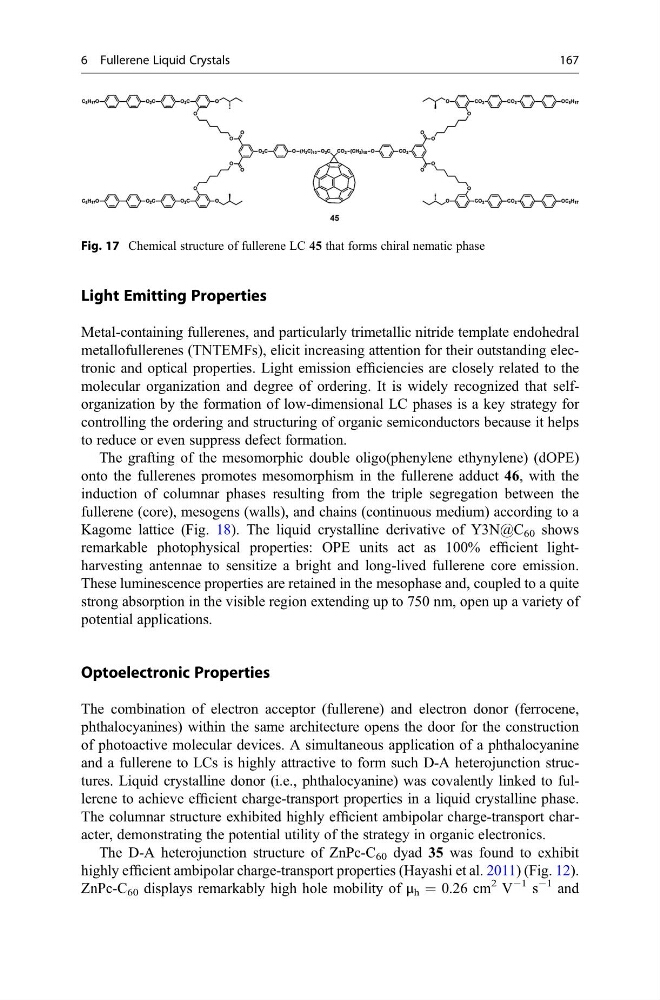
Fig. 17 Chemical structure of fullerene LC 45 that forms chiral nematic phase
6 Fullerene Liquid Crystals
167
Metal-containing fullerenes, and particularly trimetallic nitride template endohedral
metallofullerenes (TNTEMFs), elicit increasing attention for their outstanding electronic and optical properties. Light emission efficiencies are closely related to the
molecular organization and degree of ordering. It is widely recognized that selforganization by the formation of low-dimensional LC phases is a key strategy for
controlling the ordering and structuring of organic semiconductors because it helps
to reduce or even suppress defect formation.
The grafting of the mesomorphic double oligo(phenylene ethynylene) (dOPE)
onto the fullerenes promotes mesomorphism in the fullerene adduct 46, with the
induction of columnar phases resulting from the triple segregation between the
fullerene (core), mesogens (walls), and chains (continuous medium) according to a
Kagome lattice (Fig. 18). The liquid crystalline derivative of Y3N@C 60 shows
remarkable photophysical properties: OPE units act as 100% efficient lightharvesting antennae to sensitize a bright and long-lived fullerene core emission.
These luminescence properties are retained in the mesophase and, coupled to a quite
strong absorption in the visible region extending up to 750 nm, open up a variety of
potential applications.
Optoelectronic Properties
The combination of electron acceptor (fullerene) and electron donor (ferrocene,
phthalocyanines) within the same architecture opens the door for the construction
of photoactive molecular devices. A simultaneous application of a phthalocyanine
and a fullerene to LCs is highly attractive to form such D-A heterojunction structures. Liquid crystalline donor (i.e., phthalocyanine) was covalently linked to fullerene to achieve efficient charge-transport properties in a liquid crystalline phase.
The columnar structure exhibited highly efficient ambipolar charge-transport character, demonstrating the potential utility of the strategy in organic electronics.
The D-A heterojunction structure of ZnPc-C 60 dyad 35 was found to exhibit
highly efficient ambipolar charge-transport properties (Hayashi et al. 2011) (Fig. 12).
ZnPc-C 60 displays remarkably high hole mobility of μ h = 0.26 cm
2 V
À1 s
À1 and
Fig. 17 Chemical structure of fullerene LC 45 that forms chiral nematic phase
6 Fullerene Liquid Crystals
167