

point of view of electrochemical properties, since fullerene is acted as electron
acceptor subunits while ferrocene as an electron donor subunit (Fig. 2). The electrochemical behavior of the fullerene-ferrocene dyads has been investigated (Carano
et al. 2002). Both fullerene- and ferrocene-centered oxidation and reduction processes were observed in fullerene-ferrocene dyads: a total of seven reduction peaks
were detected in the negative potential region and two oxidation peaks in the positive
potential one.
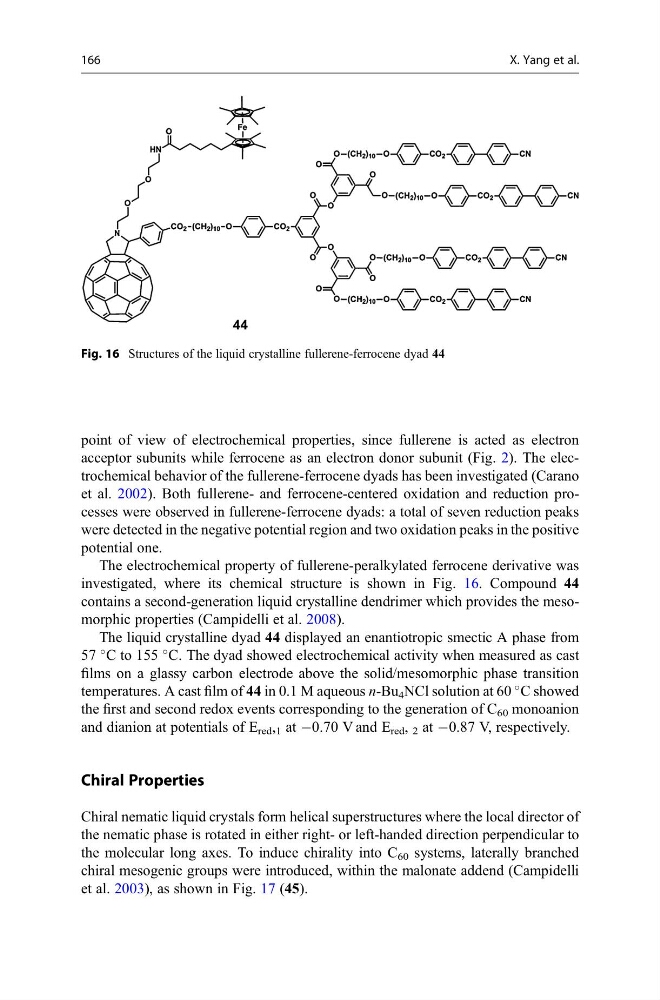
The electrochemical property of fullerene-peralkylated ferrocene derivative was
investigated, where its chemical structure is shown in Fig. 16. Compound 44
contains a second-generation liquid crystalline dendrimer which provides the mesomorphic properties (Campidelli et al. 2008).
The liquid crystalline dyad 44 displayed an enantiotropic smectic A phase from
57
C to 155
C. The dyad showed electrochemical activity when measured as cast
films on a glassy carbon electrode above the solid/mesomorphic phase transition
temperatures. A cast film of 44 in 0.1 M aqueous n-Bu 4 NCl solution at 60
C showed
the first and second redox events corresponding to the generation of C 60 monoanion
and dianion at potentials of E red , 1 at À0.70 V and E red , 2 at À0.87 V, respectively.
Chiral Properties
Chiral nematic liquid crystals form helical superstructures where the local director of
the nematic phase is rotated in either right- or left-handed direction perpendicular to
the molecular long axes. To induce chirality into C 60 systems, laterally branched
chiral mesogenic groups were introduced, within the malonate addend (Campidelli
et al. 2003), as shown in Fig. 17 (45).
Fig. 16 Structures of the liquid crystalline fullerene-ferrocene dyad 44
166
X. Yang et al.
acceptor subunits while ferrocene as an electron donor subunit (Fig. 2). The electrochemical behavior of the fullerene-ferrocene dyads has been investigated (Carano
et al. 2002). Both fullerene- and ferrocene-centered oxidation and reduction processes were observed in fullerene-ferrocene dyads: a total of seven reduction peaks
were detected in the negative potential region and two oxidation peaks in the positive
potential one.
The electrochemical property of fullerene-peralkylated ferrocene derivative was
investigated, where its chemical structure is shown in Fig. 16. Compound 44
contains a second-generation liquid crystalline dendrimer which provides the mesomorphic properties (Campidelli et al. 2008).
The liquid crystalline dyad 44 displayed an enantiotropic smectic A phase from
57
C to 155
C. The dyad showed electrochemical activity when measured as cast
films on a glassy carbon electrode above the solid/mesomorphic phase transition
temperatures. A cast film of 44 in 0.1 M aqueous n-Bu 4 NCl solution at 60
C showed
the first and second redox events corresponding to the generation of C 60 monoanion
and dianion at potentials of E red , 1 at À0.70 V and E red , 2 at À0.87 V, respectively.
Chiral Properties
Chiral nematic liquid crystals form helical superstructures where the local director of
the nematic phase is rotated in either right- or left-handed direction perpendicular to
the molecular long axes. To induce chirality into C 60 systems, laterally branched
chiral mesogenic groups were introduced, within the malonate addend (Campidelli
et al. 2003), as shown in Fig. 17 (45).
Fig. 16 Structures of the liquid crystalline fullerene-ferrocene dyad 44
166
X. Yang et al.