

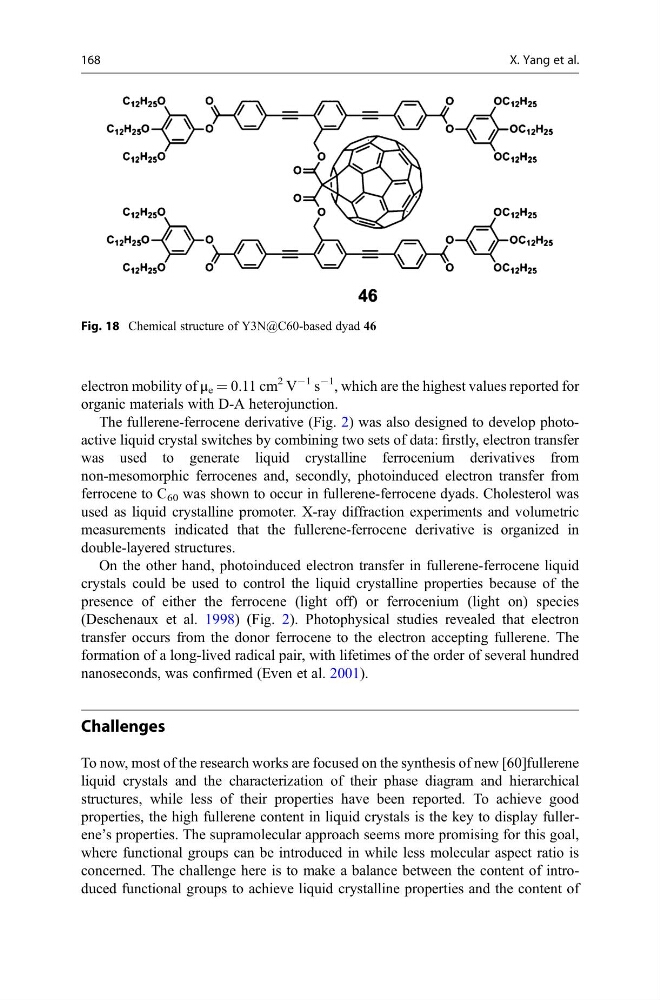
electron mobility of μ e = 0.11 cm
2 V
À1 s
À1 , which are the highest values reported for
organic materials with D-A heterojunction.
The fullerene-ferrocene derivative (Fig. 2) was also designed to develop photoactive liquid crystal switches by combining two sets of data: firstly, electron transfer
was used to generate liquid crystalline ferrocenium derivatives from
non-mesomorphic ferrocenes and, secondly, photoinduced electron transfer from
ferrocene to C 60 was shown to occur in fullerene-ferrocene dyads. Cholesterol was
used as liquid crystalline promoter. X-ray diffraction experiments and volumetric
measurements indicated that the fullerene-ferrocene derivative is organized in
double-layered structures.
On the other hand, photoinduced electron transfer in fullerene-ferrocene liquid
crystals could be used to control the liquid crystalline properties because of the
presence of either the ferrocene (light off) or ferrocenium (light on) species
(Deschenaux et al. 1998) (Fig. 2). Photophysical studies revealed that electron
transfer occurs from the donor ferrocene to the electron accepting fullerene. The
formation of a long-lived radical pair, with lifetimes of the order of several hundred
nanoseconds, was confirmed (Even et al. 2001).
Challenges
To now, most of the research works are focused on the synthesis of new [60]fullerene
liquid crystals and the characterization of their phase diagram and hierarchical
structures, while less of their properties have been reported. To achieve good
properties, the high fullerene content in liquid crystals is the key to display fullerene’s properties. The supramolecular approach seems more promising for this goal,
where functional groups can be introduced in while less molecular aspect ratio is
concerned. The challenge here is to make a balance between the content of introduced functional groups to achieve liquid crystalline properties and the content of
Fig. 18 Chemical structure of Y3N@C60-based dyad 46
168
X. Yang et al.
2 V
À1 s
À1 , which are the highest values reported for
organic materials with D-A heterojunction.
The fullerene-ferrocene derivative (Fig. 2) was also designed to develop photoactive liquid crystal switches by combining two sets of data: firstly, electron transfer
was used to generate liquid crystalline ferrocenium derivatives from
non-mesomorphic ferrocenes and, secondly, photoinduced electron transfer from
ferrocene to C 60 was shown to occur in fullerene-ferrocene dyads. Cholesterol was
used as liquid crystalline promoter. X-ray diffraction experiments and volumetric
measurements indicated that the fullerene-ferrocene derivative is organized in
double-layered structures.
On the other hand, photoinduced electron transfer in fullerene-ferrocene liquid
crystals could be used to control the liquid crystalline properties because of the
presence of either the ferrocene (light off) or ferrocenium (light on) species
(Deschenaux et al. 1998) (Fig. 2). Photophysical studies revealed that electron
transfer occurs from the donor ferrocene to the electron accepting fullerene. The
formation of a long-lived radical pair, with lifetimes of the order of several hundred
nanoseconds, was confirmed (Even et al. 2001).
Challenges
To now, most of the research works are focused on the synthesis of new [60]fullerene
liquid crystals and the characterization of their phase diagram and hierarchical
structures, while less of their properties have been reported. To achieve good
properties, the high fullerene content in liquid crystals is the key to display fullerene’s properties. The supramolecular approach seems more promising for this goal,
where functional groups can be introduced in while less molecular aspect ratio is
concerned. The challenge here is to make a balance between the content of introduced functional groups to achieve liquid crystalline properties and the content of
Fig. 18 Chemical structure of Y3N@C60-based dyad 46
168
X. Yang et al.