

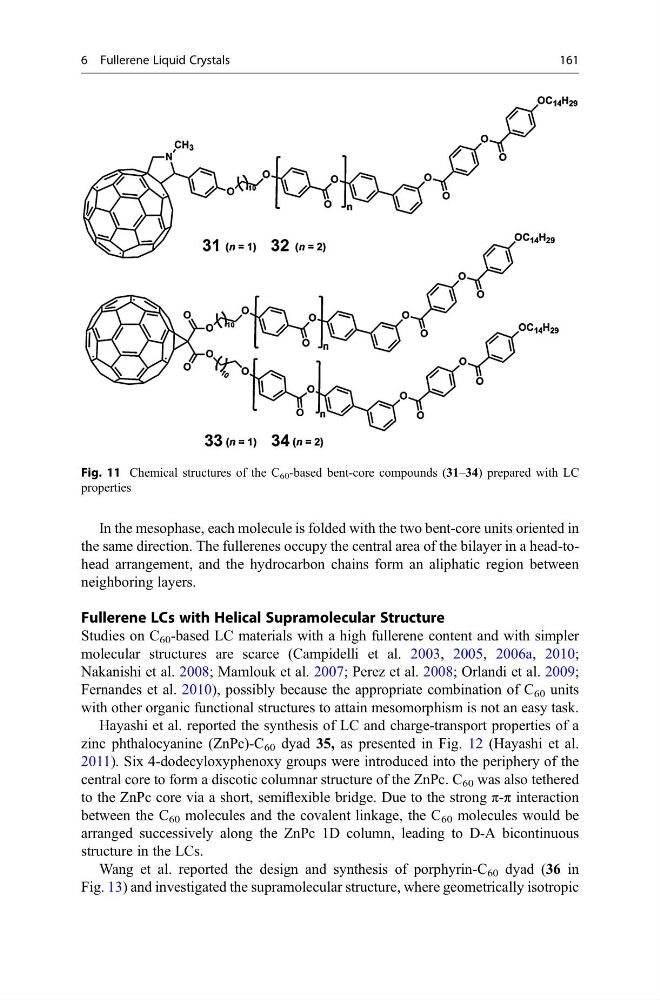
In the mesophase, each molecule is folded with the two bent-core units oriented in
the same direction. The fullerenes occupy the central area of the bilayer in a head-tohead arrangement, and the hydrocarbon chains form an aliphatic region between
neighboring layers.
Fullerene LCs with Helical Supramolecular Structure
Studies on C 60 -based LC materials with a high fullerene content and with simpler
molecular structures are scarce (Campidelli et al. 2003, 2005, 2006a, 2010;
Nakanishi et al. 2008; Mamlouk et al. 2007; Perez et al. 2008; Orlandi et al. 2009;
Fernandes et al. 2010), possibly because the appropriate combination of C 60 units
with other organic functional structures to attain mesomorphism is not an easy task.
Hayashi et al. reported the synthesis of LC and charge-transport properties of a
zinc phthalocyanine (ZnPc)-C 60 dyad 35, as presented in Fig. 12 (Hayashi et al.
2011). Six 4-dodecyloxyphenoxy groups were introduced into the periphery of the
central core to form a discotic columnar structure of the ZnPc. C 60 was also tethered
to the ZnPc core via a short, semiflexible bridge. Due to the strong π-π interaction
between the C 60 molecules and the covalent linkage, the C 60 molecules would be
arranged successively along the ZnPc 1D column, leading to D-A bicontinuous
structure in the LCs.
Wang et al. reported the design and synthesis of porphyrin-C 60 dyad (36 in
Fig. 13) and investigated the supramolecular structure, where geometrically isotropic
Fig. 11 Chemical structures of the C 60 -based bent-core compounds (31–34) prepared with LC
properties
6 Fullerene Liquid Crystals
161
the same direction. The fullerenes occupy the central area of the bilayer in a head-tohead arrangement, and the hydrocarbon chains form an aliphatic region between
neighboring layers.
Fullerene LCs with Helical Supramolecular Structure
Studies on C 60 -based LC materials with a high fullerene content and with simpler
molecular structures are scarce (Campidelli et al. 2003, 2005, 2006a, 2010;
Nakanishi et al. 2008; Mamlouk et al. 2007; Perez et al. 2008; Orlandi et al. 2009;
Fernandes et al. 2010), possibly because the appropriate combination of C 60 units
with other organic functional structures to attain mesomorphism is not an easy task.
Hayashi et al. reported the synthesis of LC and charge-transport properties of a
zinc phthalocyanine (ZnPc)-C 60 dyad 35, as presented in Fig. 12 (Hayashi et al.
2011). Six 4-dodecyloxyphenoxy groups were introduced into the periphery of the
central core to form a discotic columnar structure of the ZnPc. C 60 was also tethered
to the ZnPc core via a short, semiflexible bridge. Due to the strong π-π interaction
between the C 60 molecules and the covalent linkage, the C 60 molecules would be
arranged successively along the ZnPc 1D column, leading to D-A bicontinuous
structure in the LCs.
Wang et al. reported the design and synthesis of porphyrin-C 60 dyad (36 in
Fig. 13) and investigated the supramolecular structure, where geometrically isotropic
Fig. 11 Chemical structures of the C 60 -based bent-core compounds (31–34) prepared with LC
properties
6 Fullerene Liquid Crystals
161