

(C 60 ) and anisotropic (porphyrin) units coexist (Wang et al. 2012). Structural
analysis revealed that this stable phase possessed a supramolecular “double-cable”
structure with one p-type porphyrin core columnar channel and three helical n-type
C 60 peripheral channels. These “double-cable” columns further packed into a hexagonal lattice with a = b = 4.65 nm, c = 41.3 nm, α = β = 90
, and γ = 120
. The
column repeat unit was determined to possess a 129 44 helix. With both donor (D,
porphyrin) and acceptor (A, C 60 ) units having their own connecting channels as well
as the large D/A interface within the supramolecular “double-cable” structure, dyad
36 showed good photogenerated carriers with longer lifetimes compared to the
conventional electron acceptor [6,6]-phenyl-C 61 -butyric acid methyl ester (PCBM).
Star-shaped oligophenylenevinylene (OPV) mesogens are shape-persistent and
possess formally large void space. A mesogen with three phenylacetylene repeating
units packs densely in a columnar helical arrangement (Lehmann and Hugel 2015).
Attachment of one fullerene through a short spacer results in an exceptional increase
of the mesophase stability (38 and 39 in Fig. 14). The shape-persistent OPV stars
maintain their overall star morphology and exhibit large void space between their
arms. In the OPV-star 37 and star-OPV-fullerene hybrid 38, the void is perfectly
filled by non-mesomorphic fullerene guests. These guests facilitate the space filling
and stacking in columnar structures and consequently increase the mesophase
stability by more than 70
C compared to the parent mesogen 37. Fullerene is a
spherical building block and has, among others, been incorporated in LC phases by
coupling to mesogenic dendrons of various generations.
In the hybrid derivative 39 and the mixture between 39 and 37, fullerene fills a
great portion of the void space between the arms and facilitates the columnar
stacking. The systems optimize the packing of fullerenes by the arrangement in a
triple helix. Such highly ordered, columnar donor (stilbenoid scaffold)-acceptor
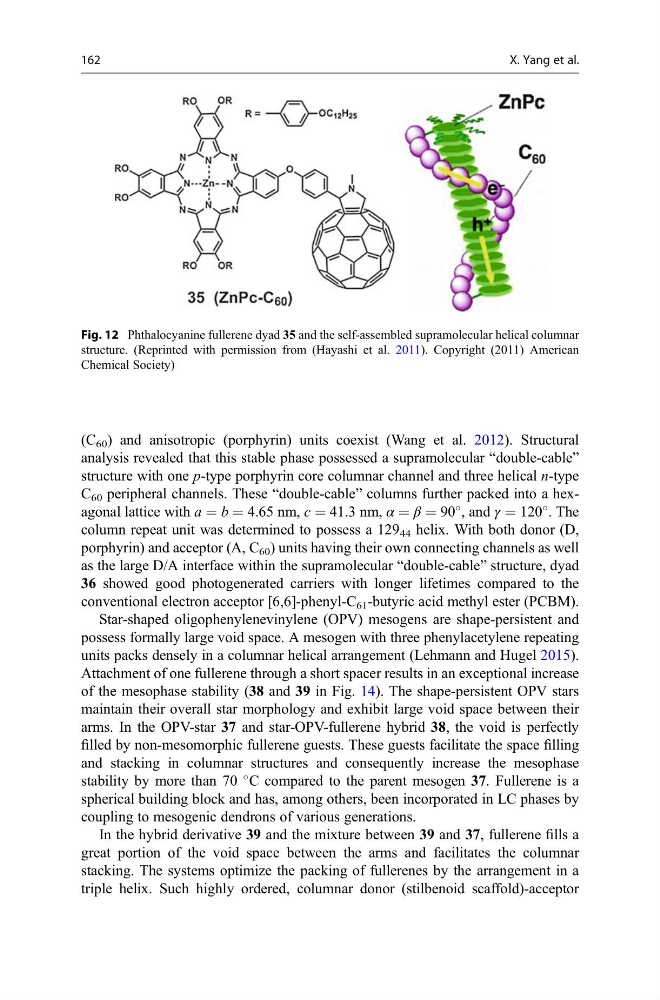
Fig. 12 Phthalocyanine fullerene dyad 35 and the self-assembled supramolecular helical columnar
structure. (Reprinted with permission from (Hayashi et al. 2011). Copyright (2011) American
Chemical Society)
162
X. Yang et al.
analysis revealed that this stable phase possessed a supramolecular “double-cable”
structure with one p-type porphyrin core columnar channel and three helical n-type
C 60 peripheral channels. These “double-cable” columns further packed into a hexagonal lattice with a = b = 4.65 nm, c = 41.3 nm, α = β = 90
, and γ = 120
. The
column repeat unit was determined to possess a 129 44 helix. With both donor (D,
porphyrin) and acceptor (A, C 60 ) units having their own connecting channels as well
as the large D/A interface within the supramolecular “double-cable” structure, dyad
36 showed good photogenerated carriers with longer lifetimes compared to the
conventional electron acceptor [6,6]-phenyl-C 61 -butyric acid methyl ester (PCBM).
Star-shaped oligophenylenevinylene (OPV) mesogens are shape-persistent and
possess formally large void space. A mesogen with three phenylacetylene repeating
units packs densely in a columnar helical arrangement (Lehmann and Hugel 2015).
Attachment of one fullerene through a short spacer results in an exceptional increase
of the mesophase stability (38 and 39 in Fig. 14). The shape-persistent OPV stars
maintain their overall star morphology and exhibit large void space between their
arms. In the OPV-star 37 and star-OPV-fullerene hybrid 38, the void is perfectly
filled by non-mesomorphic fullerene guests. These guests facilitate the space filling
and stacking in columnar structures and consequently increase the mesophase
stability by more than 70
C compared to the parent mesogen 37. Fullerene is a
spherical building block and has, among others, been incorporated in LC phases by
coupling to mesogenic dendrons of various generations.
In the hybrid derivative 39 and the mixture between 39 and 37, fullerene fills a
great portion of the void space between the arms and facilitates the columnar
stacking. The systems optimize the packing of fullerenes by the arrangement in a
triple helix. Such highly ordered, columnar donor (stilbenoid scaffold)-acceptor
Fig. 12 Phthalocyanine fullerene dyad 35 and the self-assembled supramolecular helical columnar
structure. (Reprinted with permission from (Hayashi et al. 2011). Copyright (2011) American
Chemical Society)
162
X. Yang et al.