

Similar to 23, nonamphiphilic 24 formed a smectic A LC mesophase in a
temperature range from 111.4
C to 12.5
C. SAXS pattern displayed intense and
weak diffractions with d-spacing of 5.7 and 2.9 nm, respectively, which were
indexed as (100) and (200) reflections of a lamellar structure with a layer width of
5.7 nm.
For the abovementioned C 60 -containing liquid crystals, the C 60 content (based on
molecular weight) in liquid crystals is usually ~20% because of their bulky appendage (Chuard and Deschenaux 1996, 2002; Sawamura et al. 2002; Bushby et al. 2005;
Felder et al. 2000; Zhong et al. 2007; Deschenaux et al. 2007). The low content of
fullerenes hinders their excellent optoelectronic properties. How to increase the
content of C 60 while maintaining the LC properties is a main challenge for the
C 60 -containing LCs, since the low content of C 60 will hinder their application.
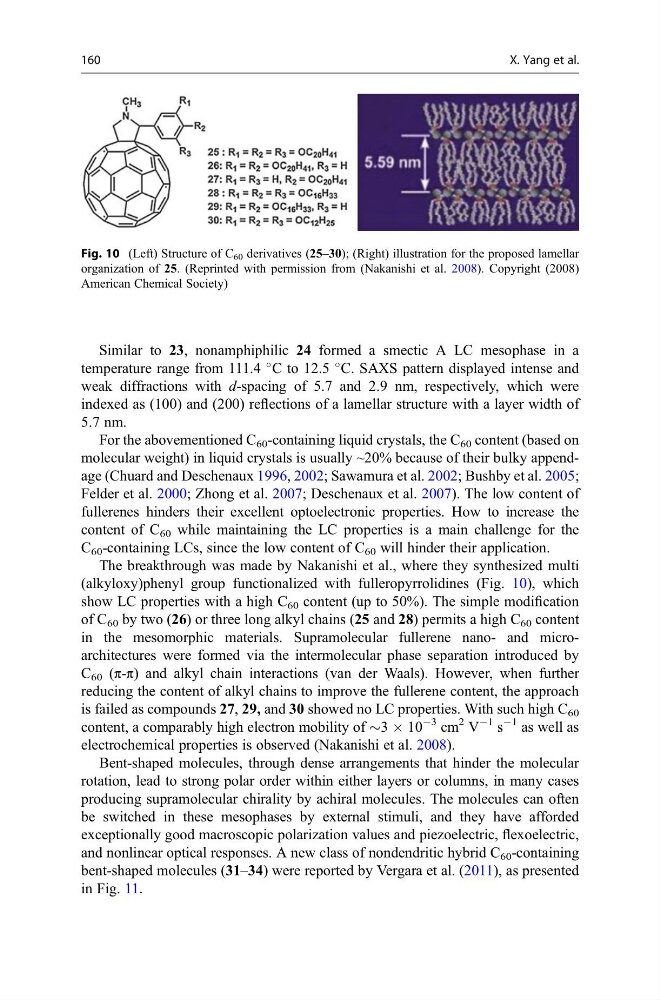
The breakthrough was made by Nakanishi et al., where they synthesized multi
(alkyloxy)phenyl group functionalized with fulleropyrrolidines (Fig. 10), which
show LC properties with a high C 60 content (up to 50%). The simple modification
of C 60 by two (26) or three long alkyl chains (25 and 28) permits a high C 60 content
in the mesomorphic materials. Supramolecular fullerene nano- and microarchitectures were formed via the intermolecular phase separation introduced by
C 60 (π-π) and alkyl chain interactions (van der Waals). However, when further
reducing the content of alkyl chains to improve the fullerene content, the approach
is failed as compounds 27, 29, and 30 showed no LC properties. With such high C 60
content, a comparably high electron mobility of $3 Â 10
À3 cm
2 V
À1 s
À1 as well as
electrochemical properties is observed (Nakanishi et al. 2008).
Bent-shaped molecules, through dense arrangements that hinder the molecular
rotation, lead to strong polar order within either layers or columns, in many cases
producing supramolecular chirality by achiral molecules. The molecules can often
be switched in these mesophases by external stimuli, and they have afforded
exceptionally good macroscopic polarization values and piezoelectric, flexoelectric,
and nonlinear optical responses. A new class of nondendritic hybrid C 60 -containing
bent-shaped molecules (31–34) were reported by Vergara et al. (2011), as presented
in Fig. 11.
Fig. 10 (Left) Structure of C 60 derivatives (25–30); (Right) illustration for the proposed lamellar
organization of 25. (Reprinted with permission from (Nakanishi et al. 2008). Copyright (2008)
American Chemical Society)
160
X. Yang et al.
temperature range from 111.4
C to 12.5
C. SAXS pattern displayed intense and
weak diffractions with d-spacing of 5.7 and 2.9 nm, respectively, which were
indexed as (100) and (200) reflections of a lamellar structure with a layer width of
5.7 nm.
For the abovementioned C 60 -containing liquid crystals, the C 60 content (based on
molecular weight) in liquid crystals is usually ~20% because of their bulky appendage (Chuard and Deschenaux 1996, 2002; Sawamura et al. 2002; Bushby et al. 2005;
Felder et al. 2000; Zhong et al. 2007; Deschenaux et al. 2007). The low content of
fullerenes hinders their excellent optoelectronic properties. How to increase the
content of C 60 while maintaining the LC properties is a main challenge for the
C 60 -containing LCs, since the low content of C 60 will hinder their application.
The breakthrough was made by Nakanishi et al., where they synthesized multi
(alkyloxy)phenyl group functionalized with fulleropyrrolidines (Fig. 10), which
show LC properties with a high C 60 content (up to 50%). The simple modification
of C 60 by two (26) or three long alkyl chains (25 and 28) permits a high C 60 content
in the mesomorphic materials. Supramolecular fullerene nano- and microarchitectures were formed via the intermolecular phase separation introduced by
C 60 (π-π) and alkyl chain interactions (van der Waals). However, when further
reducing the content of alkyl chains to improve the fullerene content, the approach
is failed as compounds 27, 29, and 30 showed no LC properties. With such high C 60
content, a comparably high electron mobility of $3 Â 10
À3 cm
2 V
À1 s
À1 as well as
electrochemical properties is observed (Nakanishi et al. 2008).
Bent-shaped molecules, through dense arrangements that hinder the molecular
rotation, lead to strong polar order within either layers or columns, in many cases
producing supramolecular chirality by achiral molecules. The molecules can often
be switched in these mesophases by external stimuli, and they have afforded
exceptionally good macroscopic polarization values and piezoelectric, flexoelectric,
and nonlinear optical responses. A new class of nondendritic hybrid C 60 -containing
bent-shaped molecules (31–34) were reported by Vergara et al. (2011), as presented
in Fig. 11.
Fig. 10 (Left) Structure of C 60 derivatives (25–30); (Right) illustration for the proposed lamellar
organization of 25. (Reprinted with permission from (Nakanishi et al. 2008). Copyright (2008)
American Chemical Society)
160
X. Yang et al.