

should be applicable to a range of other molecules and materials and opens a facile way to
build a variety of fullerene LCs since the molecular aspect ratio is not needed by this
strategy.
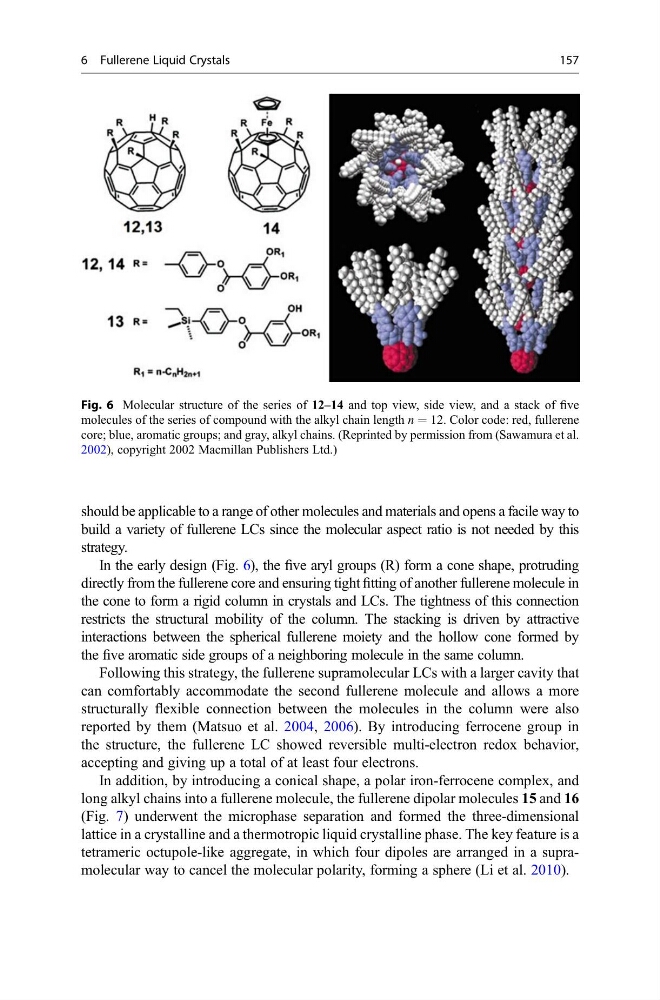
In the early design (Fig. 6), the five aryl groups (R) form a cone shape, protruding
directly from the fullerene core and ensuring tight fitting of another fullerene molecule in
the cone to form a rigid column in crystals and LCs. The tightness of this connection
restricts the structural mobility of the column. The stacking is driven by attractive
interactions between the spherical fullerene moiety and the hollow cone formed by
the five aromatic side groups of a neighboring molecule in the same column.
Following this strategy, the fullerene supramolecular LCs with a larger cavity that
can comfortably accommodate the second fullerene molecule and allows a more
structurally flexible connection between the molecules in the column were also
reported by them (Matsuo et al. 2004, 2006). By introducing ferrocene group in
the structure, the fullerene LC showed reversible multi-electron redox behavior,
accepting and giving up a total of at least four electrons.
In addition, by introducing a conical shape, a polar iron-ferrocene complex, and
long alkyl chains into a fullerene molecule, the fullerene dipolar molecules 15 and 16
(Fig. 7) underwent the microphase separation and formed the three-dimensional
lattice in a crystalline and a thermotropic liquid crystalline phase. The key feature is a
tetrameric octupole-like aggregate, in which four dipoles are arranged in a supramolecular way to cancel the molecular polarity, forming a sphere (Li et al. 2010).
Fig. 6 Molecular structure of the series of 12–14 and top view, side view, and a stack of five
molecules of the series of compound with the alkyl chain length n = 12. Color code: red, fullerene
core; blue, aromatic groups; and gray, alkyl chains. (Reprinted by permission from (Sawamura et al.
2002), copyright 2002 Macmillan Publishers Ltd.)
6 Fullerene Liquid Crystals
157
build a variety of fullerene LCs since the molecular aspect ratio is not needed by this
strategy.
In the early design (Fig. 6), the five aryl groups (R) form a cone shape, protruding
directly from the fullerene core and ensuring tight fitting of another fullerene molecule in
the cone to form a rigid column in crystals and LCs. The tightness of this connection
restricts the structural mobility of the column. The stacking is driven by attractive
interactions between the spherical fullerene moiety and the hollow cone formed by
the five aromatic side groups of a neighboring molecule in the same column.
Following this strategy, the fullerene supramolecular LCs with a larger cavity that
can comfortably accommodate the second fullerene molecule and allows a more
structurally flexible connection between the molecules in the column were also
reported by them (Matsuo et al. 2004, 2006). By introducing ferrocene group in
the structure, the fullerene LC showed reversible multi-electron redox behavior,
accepting and giving up a total of at least four electrons.
In addition, by introducing a conical shape, a polar iron-ferrocene complex, and
long alkyl chains into a fullerene molecule, the fullerene dipolar molecules 15 and 16
(Fig. 7) underwent the microphase separation and formed the three-dimensional
lattice in a crystalline and a thermotropic liquid crystalline phase. The key feature is a
tetrameric octupole-like aggregate, in which four dipoles are arranged in a supramolecular way to cancel the molecular polarity, forming a sphere (Li et al. 2010).
Fig. 6 Molecular structure of the series of 12–14 and top view, side view, and a stack of five
molecules of the series of compound with the alkyl chain length n = 12. Color code: red, fullerene
core; blue, aromatic groups; and gray, alkyl chains. (Reprinted by permission from (Sawamura et al.
2002), copyright 2002 Macmillan Publishers Ltd.)
6 Fullerene Liquid Crystals
157