

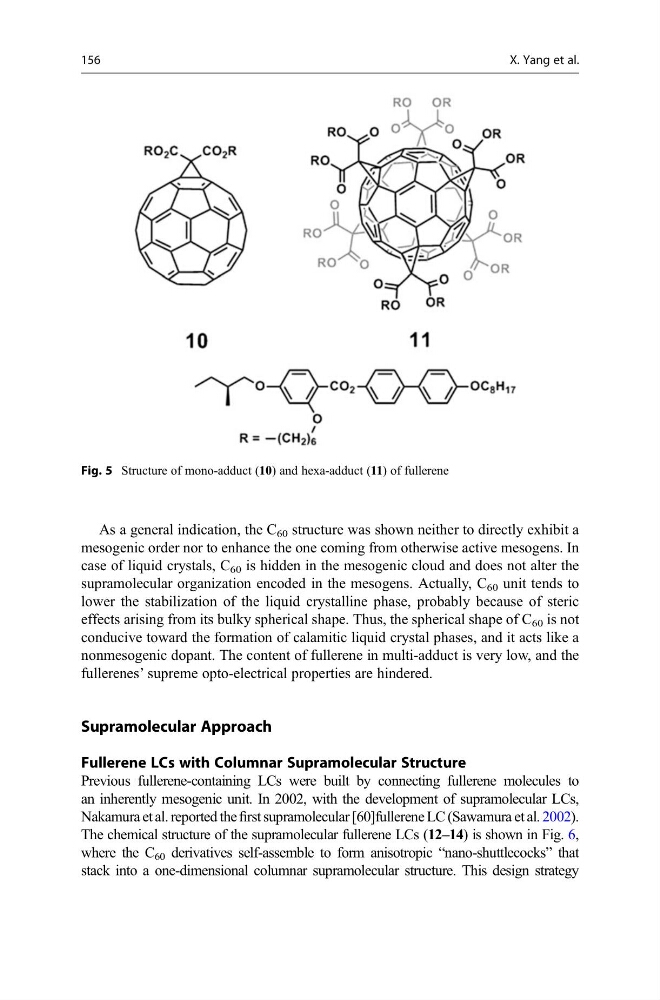
As a general indication, the C 60 structure was shown neither to directly exhibit a
mesogenic order nor to enhance the one coming from otherwise active mesogens. In
case of liquid crystals, C 60 is hidden in the mesogenic cloud and does not alter the
supramolecular organization encoded in the mesogens. Actually, C 60 unit tends to
lower the stabilization of the liquid crystalline phase, probably because of steric
effects arising from its bulky spherical shape. Thus, the spherical shape of C 60 is not
conducive toward the formation of calamitic liquid crystal phases, and it acts like a
nonmesogenic dopant. The content of fullerene in multi-adduct is very low, and the
fullerenes’ supreme opto-electrical properties are hindered.
Supramolecular Approach
Fullerene LCs with Columnar Supramolecular Structure
Previous fullerene-containing LCs were built by connecting fullerene molecules to
an inherently mesogenic unit. In 2002, with the development of supramolecular LCs,
Nakamura et al. reported the first supramolecular [60]fullerene LC (Sawamura et al. 2002).
The chemical structure of the supramolecular fullerene LCs (12–14) is shown in Fig. 6,
where the C 60 derivatives self-assemble to form anisotropic “nano-shuttlecocks” that
stack into a one-dimensional columnar supramolecular structure. This design strategy
Fig. 5 Structure of mono-adduct (10) and hexa-adduct (11) of fullerene
156
X. Yang et al.
mesogenic order nor to enhance the one coming from otherwise active mesogens. In
case of liquid crystals, C 60 is hidden in the mesogenic cloud and does not alter the
supramolecular organization encoded in the mesogens. Actually, C 60 unit tends to
lower the stabilization of the liquid crystalline phase, probably because of steric
effects arising from its bulky spherical shape. Thus, the spherical shape of C 60 is not
conducive toward the formation of calamitic liquid crystal phases, and it acts like a
nonmesogenic dopant. The content of fullerene in multi-adduct is very low, and the
fullerenes’ supreme opto-electrical properties are hindered.
Supramolecular Approach
Fullerene LCs with Columnar Supramolecular Structure
Previous fullerene-containing LCs were built by connecting fullerene molecules to
an inherently mesogenic unit. In 2002, with the development of supramolecular LCs,
Nakamura et al. reported the first supramolecular [60]fullerene LC (Sawamura et al. 2002).
The chemical structure of the supramolecular fullerene LCs (12–14) is shown in Fig. 6,
where the C 60 derivatives self-assemble to form anisotropic “nano-shuttlecocks” that
stack into a one-dimensional columnar supramolecular structure. This design strategy
Fig. 5 Structure of mono-adduct (10) and hexa-adduct (11) of fullerene
156
X. Yang et al.