

extended conformation than in the crystalline phase, due to the rigidifying effect
imposed by n-alkyl groups.
A mesophase has been observed for every PDmSi with m = 3–12 and 14 (Weber
et al. 1990; Karikari et al. 1993), while no concrete experimental data support a
mesophase in PD1Si and PD2Si. This again contrasts with poly(di-n-alkylsiloxane)s
and poly(di-n-alkoxyphosphazene)s, where a mesophase only can be observed in
polymers with very limited alkyl chain length. All PDmSis show a wide mesophase
temperature range (Ganicz and Stanczyk 2002), with 154
C (56–210
C) as
the narrowest one, reported for PD14Si (Varma-Nair et al. 1991). In many cases,
the isotropization transition does not have a prominent endotherm, and the temperature is higher or near the thermal degradation temperature. It has been reported that
PD3Si shows a nematic phase above its melting point (~222
C). The assignment
was made based on the spectroscopic evidences (UV and Raman) showing the
polysilane main-chain in the disordered conformation and the X-ray pattern featuring only one sharp diffraction at small angle (Menescal et al. 1994). However, with
the small-angle diffraction as sharp as that in the crystalline phase, the mesophase is
much more likely a columnar phase, probably a Col h phase with higher-order
diffractions too weak to be detected. For all other PDmSis, a Col h phase above the
melting point was identified, mainly by X-ray diffraction. In Fig. 5 the d-spacing of
the main sharp diffraction of the mesophase were plotted against the side-chain
length, in their all-anti conformation (Karikari et al. 1993). The good linear
relationship confirms that all the polymers exhibit the same type of mesophase, the
Col h phase. Moreover, the slope of the linear least-square fit is 0.67 nm/nm,
suggesting n-alkyl chains in a fairly disordered conformation in the mesophase.
Poly(n-alkyloxycarbonylmethylene)s
Syndiotactic poly(n-alkyloxycarbonylmethylene)s (Cm in Chart 4) are structurally
related to poly(di-n-alkylsilane)s. As shown in the figure, there is an alkyloxycarbonyl substituent on every backbone atom. Although the substitution density of
Cms is lower than that of poly(di-n-alkylsilane)s, it is noticeably higher than that of
poly(di-n-alkylsiloxane)s and poly(di-n-alkoxyphosphoazne)s. A Col h phase has
been observed in C6, C12, and C18, with the clearing point above thermal degradation temperature (~ 250
C) (Tokita et al. 2013). The d-spacing of the strongest
20
40
60
80
100
TEMPERATURE (°C)
1.08
1.10
1.12
INTERPLANAR SPACING
(nm)
120
140
(CH 2 ) m H
(CH 2 ) m H
n
Si
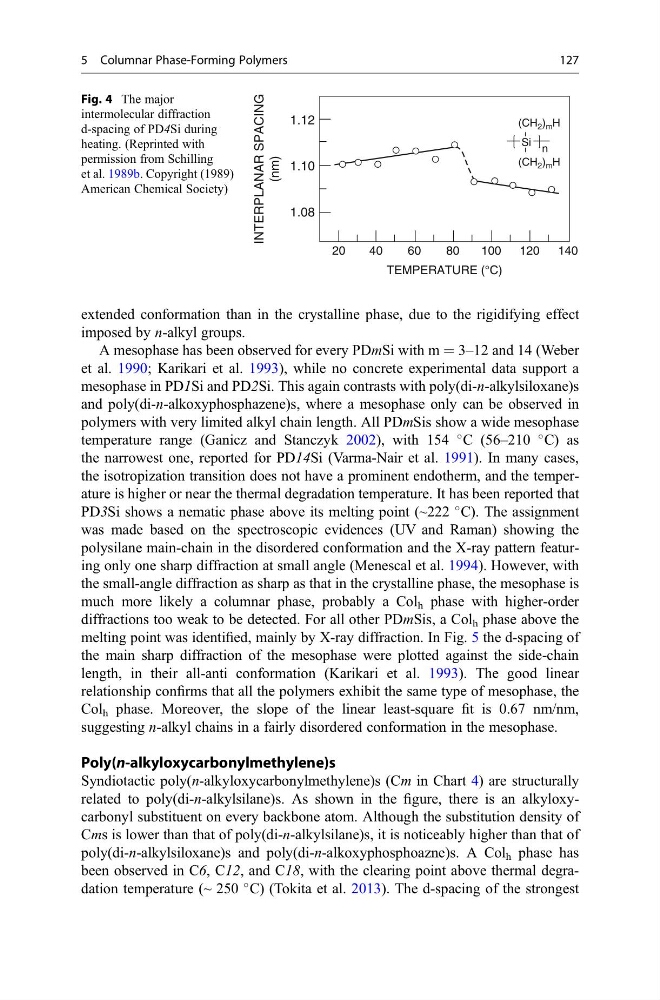
Fig. 4 The major
intermolecular diffraction
d-spacing of PD4Si during
heating. (Reprinted with
permission from Schilling
et al. 1989b. Copyright (1989)
American Chemical Society)
5 Columnar Phase-Forming Polymers
127
imposed by n-alkyl groups.
A mesophase has been observed for every PDmSi with m = 3–12 and 14 (Weber
et al. 1990; Karikari et al. 1993), while no concrete experimental data support a
mesophase in PD1Si and PD2Si. This again contrasts with poly(di-n-alkylsiloxane)s
and poly(di-n-alkoxyphosphazene)s, where a mesophase only can be observed in
polymers with very limited alkyl chain length. All PDmSis show a wide mesophase
temperature range (Ganicz and Stanczyk 2002), with 154
C (56–210
C) as
the narrowest one, reported for PD14Si (Varma-Nair et al. 1991). In many cases,
the isotropization transition does not have a prominent endotherm, and the temperature is higher or near the thermal degradation temperature. It has been reported that
PD3Si shows a nematic phase above its melting point (~222
C). The assignment
was made based on the spectroscopic evidences (UV and Raman) showing the
polysilane main-chain in the disordered conformation and the X-ray pattern featuring only one sharp diffraction at small angle (Menescal et al. 1994). However, with
the small-angle diffraction as sharp as that in the crystalline phase, the mesophase is
much more likely a columnar phase, probably a Col h phase with higher-order
diffractions too weak to be detected. For all other PDmSis, a Col h phase above the
melting point was identified, mainly by X-ray diffraction. In Fig. 5 the d-spacing of
the main sharp diffraction of the mesophase were plotted against the side-chain
length, in their all-anti conformation (Karikari et al. 1993). The good linear
relationship confirms that all the polymers exhibit the same type of mesophase, the
Col h phase. Moreover, the slope of the linear least-square fit is 0.67 nm/nm,
suggesting n-alkyl chains in a fairly disordered conformation in the mesophase.
Poly(n-alkyloxycarbonylmethylene)s
Syndiotactic poly(n-alkyloxycarbonylmethylene)s (Cm in Chart 4) are structurally
related to poly(di-n-alkylsilane)s. As shown in the figure, there is an alkyloxycarbonyl substituent on every backbone atom. Although the substitution density of
Cms is lower than that of poly(di-n-alkylsilane)s, it is noticeably higher than that of
poly(di-n-alkylsiloxane)s and poly(di-n-alkoxyphosphoazne)s. A Col h phase has
been observed in C6, C12, and C18, with the clearing point above thermal degradation temperature (~ 250
C) (Tokita et al. 2013). The d-spacing of the strongest
20
40
60
80
100
TEMPERATURE (°C)
1.08
1.10
1.12
INTERPLANAR SPACING
(nm)
120
140
(CH 2 ) m H
(CH 2 ) m H
n
Si
Fig. 4 The major
intermolecular diffraction
d-spacing of PD4Si during
heating. (Reprinted with
permission from Schilling
et al. 1989b. Copyright (1989)
American Chemical Society)
5 Columnar Phase-Forming Polymers
127