

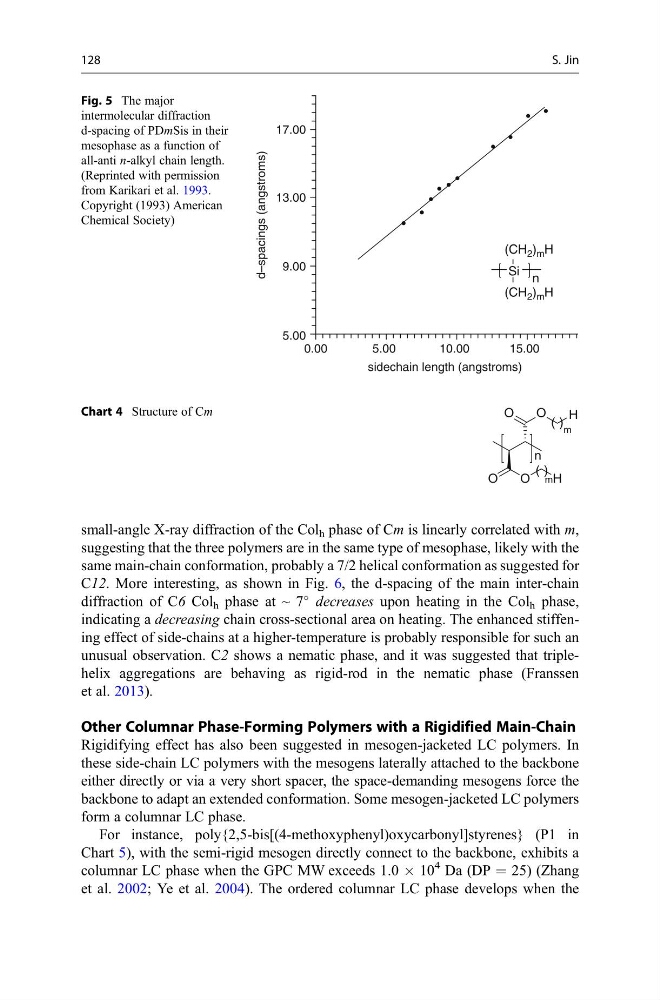
small-angle X-ray diffraction of the Col h phase of Cm is linearly correlated with m,
suggesting that the three polymers are in the same type of mesophase, likely with the
same main-chain conformation, probably a 7/2 helical conformation as suggested for
C12. More interesting, as shown in Fig. 6, the d-spacing of the main inter-chain
diffraction of C6 Col h phase at ~ 7
decreases upon heating in the Col h phase,
indicating a decreasing chain cross-sectional area on heating. The enhanced stiffening effect of side-chains at a higher-temperature is probably responsible for such an
unusual observation. C2 shows a nematic phase, and it was suggested that triplehelix aggregations are behaving as rigid-rod in the nematic phase (Franssen
et al. 2013).
Other Columnar Phase-Forming Polymers with a Rigidified Main-Chain
Rigidifying effect has also been suggested in mesogen-jacketed LC polymers. In
these side-chain LC polymers with the mesogens laterally attached to the backbone
either directly or via a very short spacer, the space-demanding mesogens force the
backbone to adapt an extended conformation. Some mesogen-jacketed LC polymers
form a columnar LC phase.
For instance, poly{2,5-bis[(4-methoxyphenyl)oxycarbonyl]styrenes} (P1 in
Chart 5), with the semi-rigid mesogen directly connect to the backbone, exhibits a
columnar LC phase when the GPC MW exceeds 1.0 Â 10
4 Da (DP = 25) (Zhang
et al. 2002; Ye et al. 2004). The ordered columnar LC phase develops when the
0.00
5.00
9.00
13.00
17.00
5.00
10.00
15.00
sidechain length (angstroms)
d–spacings (angstroms)
(CH 2 ) m H
(CH 2 ) m H
n
Si
Fig. 5 The major
intermolecular diffraction
d-spacing of PDmSis in their
mesophase as a function of
all-anti n-alkyl chain length.
(Reprinted with permission
from Karikari et al. 1993.
Copyright (1993) American
Chemical Society)
O
O
H
O
O
H
( )
( )
m
m
n
Chart 4 Structure of Cm
128
S. Jin
suggesting that the three polymers are in the same type of mesophase, likely with the
same main-chain conformation, probably a 7/2 helical conformation as suggested for
C12. More interesting, as shown in Fig. 6, the d-spacing of the main inter-chain
diffraction of C6 Col h phase at ~ 7
decreases upon heating in the Col h phase,
indicating a decreasing chain cross-sectional area on heating. The enhanced stiffening effect of side-chains at a higher-temperature is probably responsible for such an
unusual observation. C2 shows a nematic phase, and it was suggested that triplehelix aggregations are behaving as rigid-rod in the nematic phase (Franssen
et al. 2013).
Other Columnar Phase-Forming Polymers with a Rigidified Main-Chain
Rigidifying effect has also been suggested in mesogen-jacketed LC polymers. In
these side-chain LC polymers with the mesogens laterally attached to the backbone
either directly or via a very short spacer, the space-demanding mesogens force the
backbone to adapt an extended conformation. Some mesogen-jacketed LC polymers
form a columnar LC phase.
For instance, poly{2,5-bis[(4-methoxyphenyl)oxycarbonyl]styrenes} (P1 in
Chart 5), with the semi-rigid mesogen directly connect to the backbone, exhibits a
columnar LC phase when the GPC MW exceeds 1.0 Â 10
4 Da (DP = 25) (Zhang
et al. 2002; Ye et al. 2004). The ordered columnar LC phase develops when the
0.00
5.00
9.00
13.00
17.00
5.00
10.00
15.00
sidechain length (angstroms)
d–spacings (angstroms)
(CH 2 ) m H
(CH 2 ) m H
n
Si
Fig. 5 The major
intermolecular diffraction
d-spacing of PDmSis in their
mesophase as a function of
all-anti n-alkyl chain length.
(Reprinted with permission
from Karikari et al. 1993.
Copyright (1993) American
Chemical Society)
O
O
H
O
O
H
( )
( )
m
m
n
Chart 4 Structure of Cm
128
S. Jin