

temperature crystalline phase to the mesophase (Varma-Nair et al. 1991). On the
other hand,
29 Si,
13 C, and
2 H NMR results indicated that the silicon atoms and all
carbon atoms in the side-chains are highly mobile in the mesophase. Note that with
backbone silicon atoms in a mobile state, all carbon atoms will be mobile as they are
attached to backbone. However, there are few local disordering motions around the
C-C bond of the two innermost carbons atoms in each alkyl chain, as they are
experiencing the most severe crowding effect. As the result, they don’t contribute to
the entropy gain in the mesophase with respect to the crystalline phase. This
speculation was supported by the differential rates of n-alkyl carbons that were
estimated on the basis of
13 C relaxation time results, showing much slower local
motion of two innermost C-C bonds (Varma-Nair et al. 1991).
The high rigidity of PDmSis is also supported by the ability of oligo
(dimethylsilane) (CH 3 (Si(CH 3 ) 2 ) n CH 3 with n = 9–12), the oligomers of the least
rigid PDmSis, to form a smectic B phase (Yatabe et al. 1997; Okumoto et al. 1999), a
feature typically reserved for rigid-rod molecules. Another important piece of
experimental evidence suggesting that PDmSis feature rigidified chains instead of
“self-compacting” chains comes from X-ray diffraction and
29 Si NMR study on
crystalline-mesophase transition of PD4Si. As shown in Fig. 4 (Schilling et al.
1989b), the d-spacing of the main inter-chain diffraction decreases abruptly at the
crystal-mesophase transition, indicating a smaller chain cross-section area in the
mesophase than the crystalline phase. This is in sharp contrast with lateral chain
expansion observed for “self-compacting” chains. In agreement with the X-ray
diffraction result,
29 Si NMR also indicated that there are more anti Si-Si bonds in
the mesophase than that in the 7/3 helical conformation found in the crystalline phase
(Schilling et al. 1989b). In other words, the polysilane backbones are in a more
P
1
2
3
# OF C ATOMS
(CH 2 ) m H
(CH 2 ) m H
n
Si
4
5
6
0.38
0.39
0.40
0.41
Si - BACKBONE REPEAT (nm)
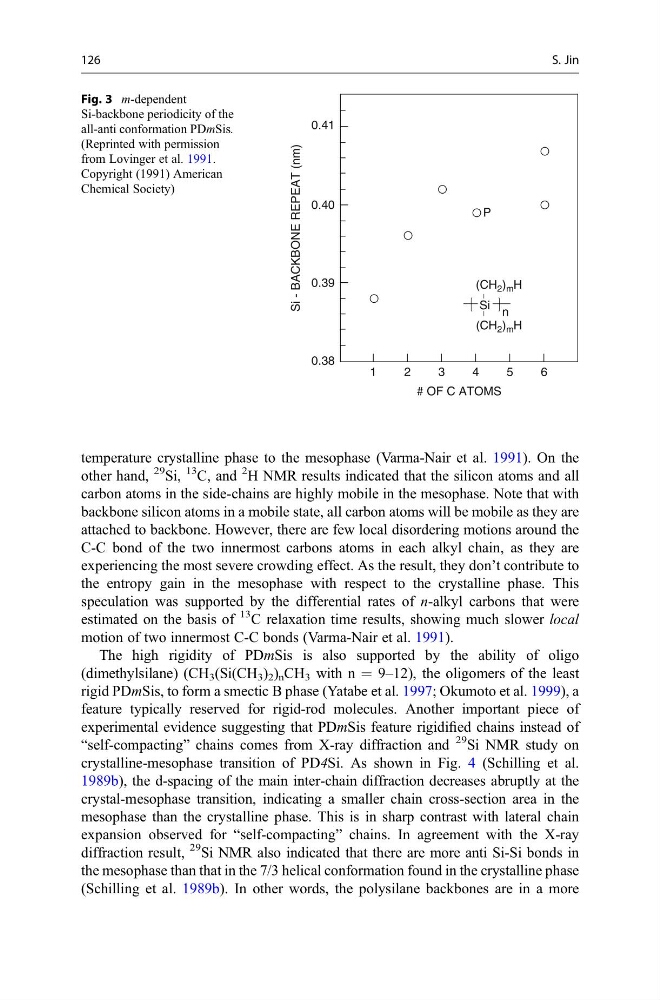
Fig. 3 m-dependent
Si-backbone periodicity of the
all-anti conformation PDmSis.
(Reprinted with permission
from Lovinger et al. 1991.
Copyright (1991) American
Chemical Society)
126
S. Jin
other hand,
29 Si,
13 C, and
2 H NMR results indicated that the silicon atoms and all
carbon atoms in the side-chains are highly mobile in the mesophase. Note that with
backbone silicon atoms in a mobile state, all carbon atoms will be mobile as they are
attached to backbone. However, there are few local disordering motions around the
C-C bond of the two innermost carbons atoms in each alkyl chain, as they are
experiencing the most severe crowding effect. As the result, they don’t contribute to
the entropy gain in the mesophase with respect to the crystalline phase. This
speculation was supported by the differential rates of n-alkyl carbons that were
estimated on the basis of
13 C relaxation time results, showing much slower local
motion of two innermost C-C bonds (Varma-Nair et al. 1991).
The high rigidity of PDmSis is also supported by the ability of oligo
(dimethylsilane) (CH 3 (Si(CH 3 ) 2 ) n CH 3 with n = 9–12), the oligomers of the least
rigid PDmSis, to form a smectic B phase (Yatabe et al. 1997; Okumoto et al. 1999), a
feature typically reserved for rigid-rod molecules. Another important piece of
experimental evidence suggesting that PDmSis feature rigidified chains instead of
“self-compacting” chains comes from X-ray diffraction and
29 Si NMR study on
crystalline-mesophase transition of PD4Si. As shown in Fig. 4 (Schilling et al.
1989b), the d-spacing of the main inter-chain diffraction decreases abruptly at the
crystal-mesophase transition, indicating a smaller chain cross-section area in the
mesophase than the crystalline phase. This is in sharp contrast with lateral chain
expansion observed for “self-compacting” chains. In agreement with the X-ray
diffraction result,
29 Si NMR also indicated that there are more anti Si-Si bonds in
the mesophase than that in the 7/3 helical conformation found in the crystalline phase
(Schilling et al. 1989b). In other words, the polysilane backbones are in a more
P
1
2
3
# OF C ATOMS
(CH 2 ) m H
(CH 2 ) m H
n
Si
4
5
6
0.38
0.39
0.40
0.41
Si - BACKBONE REPEAT (nm)
Fig. 3 m-dependent
Si-backbone periodicity of the
all-anti conformation PDmSis.
(Reprinted with permission
from Lovinger et al. 1991.
Copyright (1991) American
Chemical Society)
126
S. Jin