

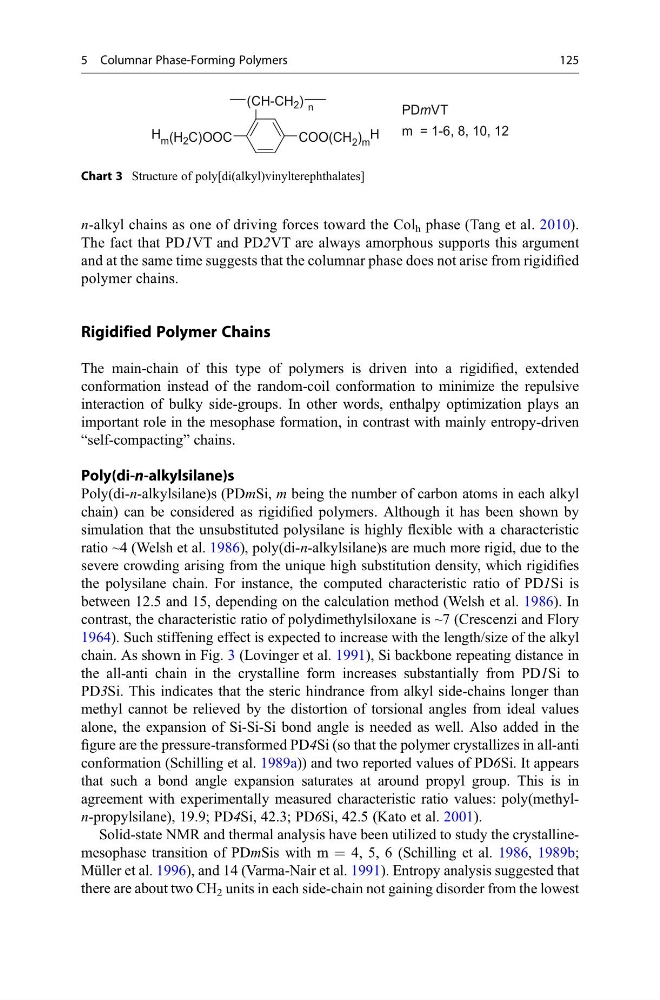
n-alkyl chains as one of driving forces toward the Col h phase (Tang et al. 2010).
The fact that PD1VT and PD2VT are always amorphous supports this argument
and at the same time suggests that the columnar phase does not arise from rigidified
polymer chains.
Rigidified Polymer Chains
The main-chain of this type of polymers is driven into a rigidified, extended
conformation instead of the random-coil conformation to minimize the repulsive
interaction of bulky side-groups. In other words, enthalpy optimization plays an
important role in the mesophase formation, in contrast with mainly entropy-driven
“self-compacting” chains.
Poly(di-n-alkylsilane)s
Poly(di-n-alkylsilane)s (PDmSi, m being the number of carbon atoms in each alkyl
chain) can be considered as rigidified polymers. Although it has been shown by
simulation that the unsubstituted polysilane is highly flexible with a characteristic
ratio ~4 (Welsh et al. 1986), poly(di-n-alkylsilane)s are much more rigid, due to the
severe crowding arising from the unique high substitution density, which rigidifies
the polysilane chain. For instance, the computed characteristic ratio of PD1Si is
between 12.5 and 15, depending on the calculation method (Welsh et al. 1986). In
contrast, the characteristic ratio of polydimethylsiloxane is ~7 (Crescenzi and Flory
1964). Such stiffening effect is expected to increase with the length/size of the alkyl
chain. As shown in Fig. 3 (Lovinger et al. 1991), Si backbone repeating distance in
the all-anti chain in the crystalline form increases substantially from PD1Si to
PD3Si. This indicates that the steric hindrance from alkyl side-chains longer than
methyl cannot be relieved by the distortion of torsional angles from ideal values
alone, the expansion of Si-Si-Si bond angle is needed as well. Also added in the
figure are the pressure-transformed PD4Si (so that the polymer crystallizes in all-anti
conformation (Schilling et al. 1989a)) and two reported values of PD6Si. It appears
that such a bond angle expansion saturates at around propyl group. This is in
agreement with experimentally measured characteristic ratio values: poly(methyln-propylsilane), 19.9; PD4Si, 42.3; PD6Si, 42.5 (Kato et al. 2001).
Solid-state NMR and thermal analysis have been utilized to study the crystallinemesophase transition of PDmSis with m = 4, 5, 6 (Schilling et al. 1986, 1989b;
Müller et al. 1996), and 14 (Varma-Nair et al. 1991). Entropy analysis suggested that
there are about two CH 2 units in each side-chain not gaining disorder from the lowest
(CH-CH 2 )
COO(CH 2 ) m
H
H m (H 2 C)OOC
n
PDmVT
m = 1-6, 8, 10, 12
Chart 3 Structure of poly[di(alkyl)vinylterephthalates]
5 Columnar Phase-Forming Polymers
125
The fact that PD1VT and PD2VT are always amorphous supports this argument
and at the same time suggests that the columnar phase does not arise from rigidified
polymer chains.
Rigidified Polymer Chains
The main-chain of this type of polymers is driven into a rigidified, extended
conformation instead of the random-coil conformation to minimize the repulsive
interaction of bulky side-groups. In other words, enthalpy optimization plays an
important role in the mesophase formation, in contrast with mainly entropy-driven
“self-compacting” chains.
Poly(di-n-alkylsilane)s
Poly(di-n-alkylsilane)s (PDmSi, m being the number of carbon atoms in each alkyl
chain) can be considered as rigidified polymers. Although it has been shown by
simulation that the unsubstituted polysilane is highly flexible with a characteristic
ratio ~4 (Welsh et al. 1986), poly(di-n-alkylsilane)s are much more rigid, due to the
severe crowding arising from the unique high substitution density, which rigidifies
the polysilane chain. For instance, the computed characteristic ratio of PD1Si is
between 12.5 and 15, depending on the calculation method (Welsh et al. 1986). In
contrast, the characteristic ratio of polydimethylsiloxane is ~7 (Crescenzi and Flory
1964). Such stiffening effect is expected to increase with the length/size of the alkyl
chain. As shown in Fig. 3 (Lovinger et al. 1991), Si backbone repeating distance in
the all-anti chain in the crystalline form increases substantially from PD1Si to
PD3Si. This indicates that the steric hindrance from alkyl side-chains longer than
methyl cannot be relieved by the distortion of torsional angles from ideal values
alone, the expansion of Si-Si-Si bond angle is needed as well. Also added in the
figure are the pressure-transformed PD4Si (so that the polymer crystallizes in all-anti
conformation (Schilling et al. 1989a)) and two reported values of PD6Si. It appears
that such a bond angle expansion saturates at around propyl group. This is in
agreement with experimentally measured characteristic ratio values: poly(methyln-propylsilane), 19.9; PD4Si, 42.3; PD6Si, 42.5 (Kato et al. 2001).
Solid-state NMR and thermal analysis have been utilized to study the crystallinemesophase transition of PDmSis with m = 4, 5, 6 (Schilling et al. 1986, 1989b;
Müller et al. 1996), and 14 (Varma-Nair et al. 1991). Entropy analysis suggested that
there are about two CH 2 units in each side-chain not gaining disorder from the lowest
(CH-CH 2 )
COO(CH 2 ) m
H
H m (H 2 C)OOC
n
PDmVT
m = 1-6, 8, 10, 12
Chart 3 Structure of poly[di(alkyl)vinylterephthalates]
5 Columnar Phase-Forming Polymers
125