

41
2
and property control, and this often leads to possibilities for
reduction in subassemblies and simple manufacturing. For
example, a multistep process of manufacturing a metallic
high-pressure vessel may be overcome by a single process of
filament winding. A thermoplastic, filament wound composite
compressed natural gas (CNG) tank (type IV pressure vessel)
has been made using tape winding over a thermoplastic (nylon
6) liner. The liner is blow moulded and 2 m in length, as
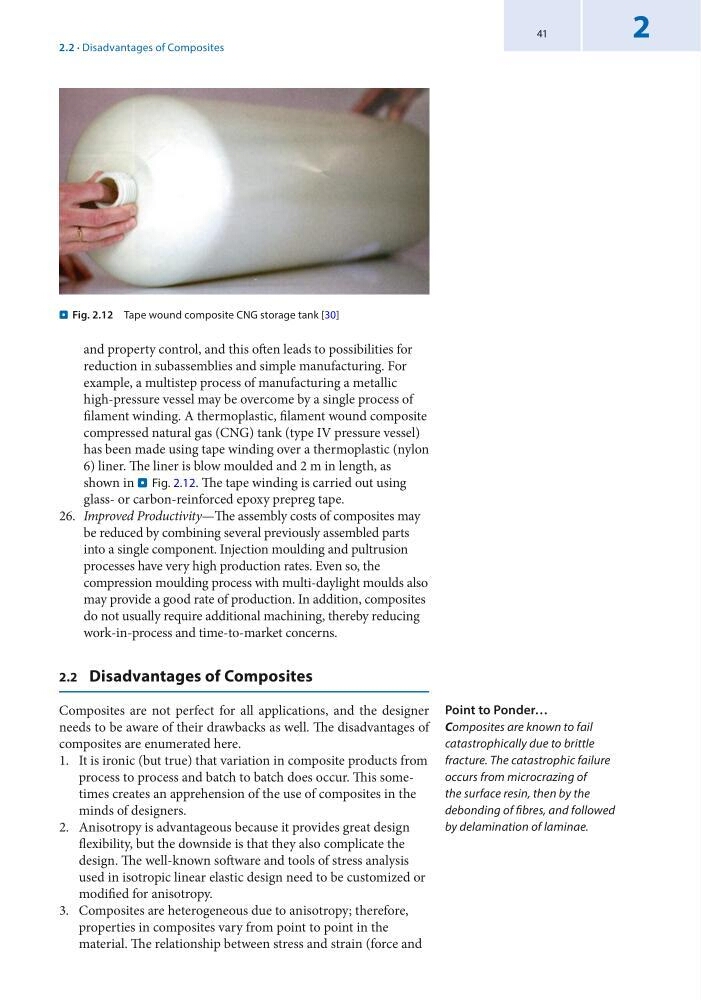
shown in . Fig. 2.12. The tape winding is carried out using
glass- or carbon-reinforced epoxy prepreg tape.
26. Improved Productivity—The assembly costs of composites may
be reduced by combining several previously assembled parts
into a single component. Injection moulding and pultrusion
processes have very high production rates. Even so, the
compression moulding process with multi-daylight moulds also
may provide a good rate of production. In addition, composites
do not usually require additional machining, thereby reducing
work- in- process and time-to-market concerns.
2.2 Disadvantages of Composites
Composites are not perfect for all applications, and the designer
needs to be aware of their drawbacks as well. The disadvantages of
composites are enumerated here.
1. It is ironic (but true) that variation in composite products from
process to process and batch to batch does occur. This sometimes creates an apprehension of the use of composites in the
minds of designers.
2. Anisotropy is advantageous because it provides great design
flexibility, but the downside is that they also complicate the
design. The well-known software and tools of stress analysis
used in isotropic linear elastic design need to be customized or
modified for anisotropy.
3. Composites are heterogeneous due to anisotropy; therefore,
properties in composites vary from point to point in the
material. The relationship between stress and strain (force and
Point to Ponder…
Composites are known to fail
catastrophically due to brittle
fracture. The catastrophic failure
occurs from microcrazing of
the surface resin, then by the
debonding of fibres, and followed
by delamination of laminae.
. Fig. 2.12 Tape wound composite CNG storage tank [30]
2.2 · Disadvantages of Composites
2
and property control, and this often leads to possibilities for
reduction in subassemblies and simple manufacturing. For
example, a multistep process of manufacturing a metallic
high-pressure vessel may be overcome by a single process of
filament winding. A thermoplastic, filament wound composite
compressed natural gas (CNG) tank (type IV pressure vessel)
has been made using tape winding over a thermoplastic (nylon
6) liner. The liner is blow moulded and 2 m in length, as
shown in . Fig. 2.12. The tape winding is carried out using
glass- or carbon-reinforced epoxy prepreg tape.
26. Improved Productivity—The assembly costs of composites may
be reduced by combining several previously assembled parts
into a single component. Injection moulding and pultrusion
processes have very high production rates. Even so, the
compression moulding process with multi-daylight moulds also
may provide a good rate of production. In addition, composites
do not usually require additional machining, thereby reducing
work- in- process and time-to-market concerns.
2.2 Disadvantages of Composites
Composites are not perfect for all applications, and the designer
needs to be aware of their drawbacks as well. The disadvantages of
composites are enumerated here.
1. It is ironic (but true) that variation in composite products from
process to process and batch to batch does occur. This sometimes creates an apprehension of the use of composites in the
minds of designers.
2. Anisotropy is advantageous because it provides great design
flexibility, but the downside is that they also complicate the
design. The well-known software and tools of stress analysis
used in isotropic linear elastic design need to be customized or
modified for anisotropy.
3. Composites are heterogeneous due to anisotropy; therefore,
properties in composites vary from point to point in the
material. The relationship between stress and strain (force and
Point to Ponder…
Composites are known to fail
catastrophically due to brittle
fracture. The catastrophic failure
occurs from microcrazing of
the surface resin, then by the
debonding of fibres, and followed
by delamination of laminae.
. Fig. 2.12 Tape wound composite CNG storage tank [30]
2.2 · Disadvantages of Composites