

42
2
deformation) is much more complicated in anisotropic
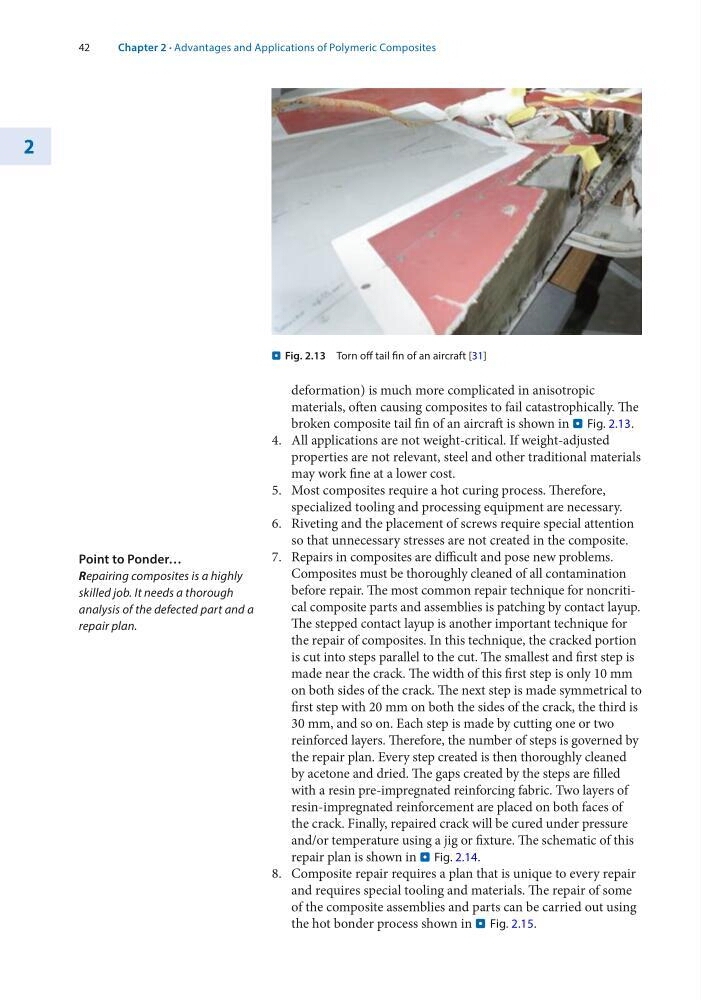
materials, often causing composites to fail catastrophically. The
broken composite tail fin of an aircraft is shown in . Fig. 2.13.
4. All applications are not weight-critical. If weight- adjusted
properties are not relevant, steel and other traditional materials
may work fine at a lower cost.
5. Most composites require a hot curing process. Therefore,
specialized tooling and processing equipment are necessary.
6. Riveting and the placement of screws require special attention
so that unnecessary stresses are not created in the composite.
7. Repairs in composites are difficult and pose new problems.
Composites must be thoroughly cleaned of all contamination
before repair. The most common repair technique for noncritical composite parts and assemblies is patching by contact layup.
The stepped contact layup is another important technique for
the repair of composites. In this technique, the cracked portion
is cut into steps parallel to the cut. The smallest and first step is
made near the crack. The width of this first step is only 10 mm
on both sides of the crack. The next step is made symmetrical to
first step with 20 mm on both the sides of the crack, the third is
30 mm, and so on. Each step is made by cutting one or two
reinforced layers. Therefore, the number of steps is governed by
the repair plan. Every step created is then thoroughly cleaned
by acetone and dried. The gaps created by the steps are filled
with a resin pre-impregnated reinforcing fabric. Two layers of
resin-impregnated reinforcement are placed on both faces of
the crack. Finally, repaired crack will be cured under pressure
and/or temperature using a jig or fixture. The schematic of this
repair plan is shown in . Fig. 2.14.
8. Composite repair requires a plan that is unique to every repair
and requires special tooling and materials. The repair of some
of the composite assemblies and parts can be carried out using
the hot bonder process shown in . Fig. 2.15.
Point to Ponder…
Repairing composites is a highly
skilled job. It needs a thorough
analysis of the defected part and a
repair plan.
. Fig. 2.13 Torn off tail fin of an aircraft [31]
Chapter 2 · Advantages and Applications of Polymeric Composites
2
deformation) is much more complicated in anisotropic
materials, often causing composites to fail catastrophically. The
broken composite tail fin of an aircraft is shown in . Fig. 2.13.
4. All applications are not weight-critical. If weight- adjusted
properties are not relevant, steel and other traditional materials
may work fine at a lower cost.
5. Most composites require a hot curing process. Therefore,
specialized tooling and processing equipment are necessary.
6. Riveting and the placement of screws require special attention
so that unnecessary stresses are not created in the composite.
7. Repairs in composites are difficult and pose new problems.
Composites must be thoroughly cleaned of all contamination
before repair. The most common repair technique for noncritical composite parts and assemblies is patching by contact layup.
The stepped contact layup is another important technique for
the repair of composites. In this technique, the cracked portion
is cut into steps parallel to the cut. The smallest and first step is
made near the crack. The width of this first step is only 10 mm
on both sides of the crack. The next step is made symmetrical to
first step with 20 mm on both the sides of the crack, the third is
30 mm, and so on. Each step is made by cutting one or two
reinforced layers. Therefore, the number of steps is governed by
the repair plan. Every step created is then thoroughly cleaned
by acetone and dried. The gaps created by the steps are filled
with a resin pre-impregnated reinforcing fabric. Two layers of
resin-impregnated reinforcement are placed on both faces of
the crack. Finally, repaired crack will be cured under pressure
and/or temperature using a jig or fixture. The schematic of this
repair plan is shown in . Fig. 2.14.
8. Composite repair requires a plan that is unique to every repair
and requires special tooling and materials. The repair of some
of the composite assemblies and parts can be carried out using
the hot bonder process shown in . Fig. 2.15.
Point to Ponder…
Repairing composites is a highly
skilled job. It needs a thorough
analysis of the defected part and a
repair plan.
. Fig. 2.13 Torn off tail fin of an aircraft [31]
Chapter 2 · Advantages and Applications of Polymeric Composites