

40
2
provide service temperatures in excess of 300 °C. It is used in
supersonic aerospace vehicles.
22. Cost-Effectiveness for Small Quantities—Fabrication of
high-quality products in small quantities or of one odd item is
more cost-effective in composites rather than making the
same product out of conventional materials. This is due to the
low cost of tooling and processing involved in the fabrication
of composites. Toolings made out of composites, plaster of
Paris, wood, etc. are cost-effective for limited production of
composite products.
23. Low Processing Cost—Composites have lower processing costs
and lower wastage compared to conventional materials. The
infrastructure required to process composites is also minimal
due to fewer numbers of processing steps. The durability of
the tooling for high production volumes of composites is quite
good, and the cost of tooling is amortized in a few initial
production lots.
24. Low Material Cost—The consumption of composite materials
is low due to their high specific strength and modulus. This
makes overall costs of composites quite low. Also, composites
can be precisely moulded; therefore, there is no or little
wastage. Composites do not rust as do many ferrous alloys,
and resistance to this common form of environmental
degradation may offer a better life cycle cost—even if the
original structure is initially more costly.
25. Reduction in Inventory—A single piece made of composite
materials can replace an entire assembly of metal parts.
Reducing the number of parts in a product or a structure saves
time and cuts down on the maintenance and cost needed over
the lifetime of the composite product. Assembly from a
number of subassemblies adds to the process and complexity
of the design. Composites offer a lot of flexibility in processing
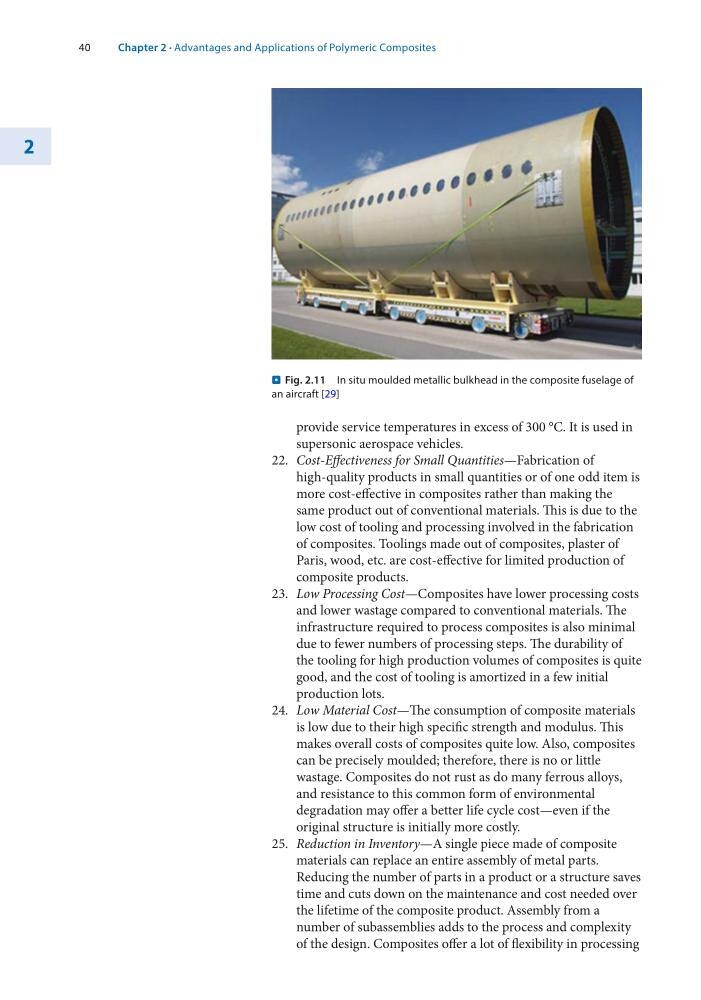
. Fig. 2.11 In situ moulded metallic bulkhead in the composite fuselage of
an aircraft [29]
Chapter 2 · Advantages and Applications of Polymeric Composites
2
provide service temperatures in excess of 300 °C. It is used in
supersonic aerospace vehicles.
22. Cost-Effectiveness for Small Quantities—Fabrication of
high-quality products in small quantities or of one odd item is
more cost-effective in composites rather than making the
same product out of conventional materials. This is due to the
low cost of tooling and processing involved in the fabrication
of composites. Toolings made out of composites, plaster of
Paris, wood, etc. are cost-effective for limited production of
composite products.
23. Low Processing Cost—Composites have lower processing costs
and lower wastage compared to conventional materials. The
infrastructure required to process composites is also minimal
due to fewer numbers of processing steps. The durability of
the tooling for high production volumes of composites is quite
good, and the cost of tooling is amortized in a few initial
production lots.
24. Low Material Cost—The consumption of composite materials
is low due to their high specific strength and modulus. This
makes overall costs of composites quite low. Also, composites
can be precisely moulded; therefore, there is no or little
wastage. Composites do not rust as do many ferrous alloys,
and resistance to this common form of environmental
degradation may offer a better life cycle cost—even if the
original structure is initially more costly.
25. Reduction in Inventory—A single piece made of composite
materials can replace an entire assembly of metal parts.
Reducing the number of parts in a product or a structure saves
time and cuts down on the maintenance and cost needed over
the lifetime of the composite product. Assembly from a
number of subassemblies adds to the process and complexity
of the design. Composites offer a lot of flexibility in processing
. Fig. 2.11 In situ moulded metallic bulkhead in the composite fuselage of
an aircraft [29]
Chapter 2 · Advantages and Applications of Polymeric Composites